Dressing up the past as the present







Chinese designers are setting themselves apart from the global competition today by turning to China's rich history for inspiration to create their contemporary apparel
Long before the invention of the qipao, or the cheongsam, there was a similar type of clothing that most Chinese wore, starting from as early as the 26th century BC.
Known as hanfu, or Han clothing, this traditional robelike attire featured loose lapels and long, flowing sleeves and was often adorned with vibrant colors. While the details found on the clothing changed through the centuries, the style of the hanfu has endured until today, with a growing number of Chinese designers turning to it for inspiration and infusing elements of it into their contemporary clothing.
| An undergraduate student at Parsons School of Art and Design. |
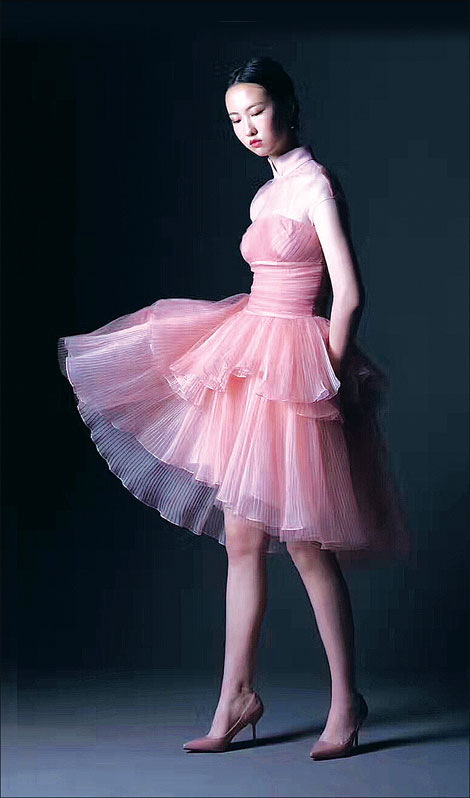
"The old style is monotonous and makes people think of elaborate embroidery patterns featuring dragons and phoenixes. To make it appealing to today's crowd, we need to get rid of the original frame and be innovative," says Cai Wenqiao, an integrated design undergraduate student at Parsons School of Art and Design in New York.
For her final-year project, Cai designed eight pieces of clothing inspired by the Chinese prose called Peach Blossom Spring by Tao Yuanming, a famous writer of the Eastern Jin Dynasty (317-420). Four of the designs are meant for everyday wear, while the rest are suitable for formal events.
Cai used pink as the main color for all the pieces, since it represents the peach blossom. She has also included classic hanfu elements such as embroidery featuring flowers and butterflies. Silk, a common material used to make Han clothing, was also the fabric chosen for the project.
"Eight years of studying abroad have taught me the differences between Eastern and Western cultures. For this project, I wanted to find a balance between them," says Cai.
Apart from the hanfu, the cheongsam is another piece of traditional wear that is frequently used as the basis of modern Chinese clothing. One of the brands that is well-known for its contemporary renditions of the cheongsam is Danmang.
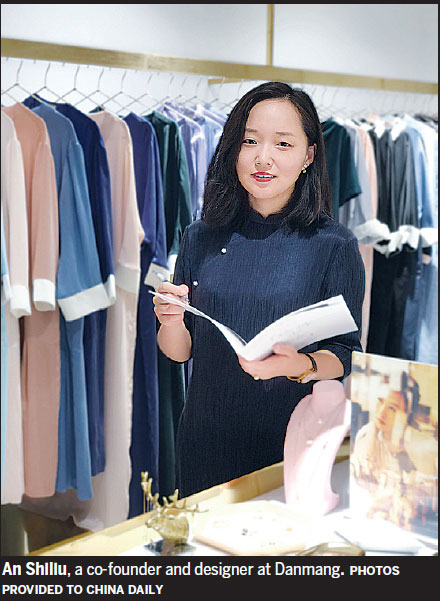
Established in March 2015, the Chinese company creates a variety of cheongsam-esque clothes that can be worn for daily life, work and even sport. It also has several creations that feature hanfu elements. Danmang currently sells from 350 to 450 items of clothing each month.
"Customers choose our products because they want to wear clothes that combine urban style with Chinese elements, such as a small collar or embroidery on the cuffs or shoulders," says An Shiliu, a co-founder and designer at Danmang.
Apart from aesthetics, another reason Danmang's clothes are popular is because they are practical and comfortable. Traditional Han Chinese clothing and cheongsams are usually long and fall below the knee, which could make movement cumbersome, and come with tight-fitting collars that could be uncomfortable.
To address these issues, designers at Danmang have eliminated the shoulder pads, loosened the collar areas, shortened the skirts and even added pockets. Embroidery is also kept to a minimum.
The founders of Danmang initially thought their target audience would be women between ages 25 and 40. To their surprise, Danmang's designs have been well received by a much wider spectrum of consumers, from ages 18 to 60.
Another Chinese designer who specializes in gentrifying traditional Chinese apparel is Uma Wang. After completing her studies at China Textile University in Shanghai, Wang pursued a fashion degree at the prestigious Central Saint Martins college of art and design in London.
She registered her eponymous label in London in 2005 and has showcased her creations at fashion shows in Milan, London and Paris.
Wang's creations have often been described as experimental. During the 2014 Milan Fashion Week, she unveiled a collection of ultra-lightweight clothes made using Chinese paper that was processed in Italy.
"Mine is a continuous journey from East to West. It is a free movement on a long road that leads to Italy," Wang was quoted as saying after the show.
Bao Mingxin, a fashion culture research professor at Donghua University's fashion and design school in Shanghai, says there are several factors behind the growing trend of wearing Chinese-style clothing today, and among them is a sense of national pride that stems from the rapid development of China's economy and its growing stature on the international scene.
Mike Bastin, a visiting professor at the University of International Business and Economics in Beijing and a senior lecturer at Southampton University, wrote in a commentary earlier this year that this trend of combining the old and the new will not be going away anytime soon.
"Nostalgia provides an unfathomable depth of heritage for Chinese designers and should continue to feature prominently in their work, now on display across the international fashion landscape," he wrote.
"A fusion of nostalgia and modern influences should combine to set fashion trends for some time to come, with Chinese designers - often foreign-educated and Europe-based - well placed to contribute richly. ...Fashion's future is far from clear, but what is clear is that Chinese designer influence and Chinese heritage infusion are here to stay."
He Qi contributed to this story.
Contact the writer at heqi@chinadaily.com.cn
(China Daily European Weekly 08/18/2017 page22)