The faces of Rugao







I spent a week in Rugao, Jiangsu, a third- or four-tier city about 200 km northwest of Shanghai, participating in the 20th Asian Masters Athletics Championship. I went there with a simple expectation, other than trying to get into the finals of the 100m event for the 65-69 age group, to take some good photos of historical architecture, of a China before development wipes away its past. I lugged along my SLR, which I normally don’t carry especially when I was there to run and not sightseeing. It was a piece of baggage that I would have to bear with me for the whole trip.
I did not get to see what I wanted to see in Rugao, a city famous for having the most centenarians alive in China. We arrived at Rugao at nearly midnight and the first sight of Rugao was in the morning, from the window of Wenfeng City Hotel. There, right in front of me, were rows and rows of neatly built and good quality low-rise homes of pretty recent origin. And there were many high-rise condominiums rising in the distance. The streets were landscaped and manicured and not much different from Singapore.
The infrastructure of Rugao was everything a modern city would have, not a third-tier city away from the futuristic coastal cities. I managed to sneak away into the villages and along the way the sight was of newly built farmers' homes, built just behind the small living quarters of the past. The few remnants of the past that were still standing have been rebuilt and served the owners in their bigger homes as storerooms or garages.
The only pieces of the past left in Rugao were the mansion of Mo Biqiang and Dong Xiaowan and a well preserved patch of low ancient houses right in the heart of the city. These houses still serve as living quarters to some residents and small commercial enterprises. The mansion and the houses were some 400 years old and stood there to remind the people of the way of life of their ancestors.
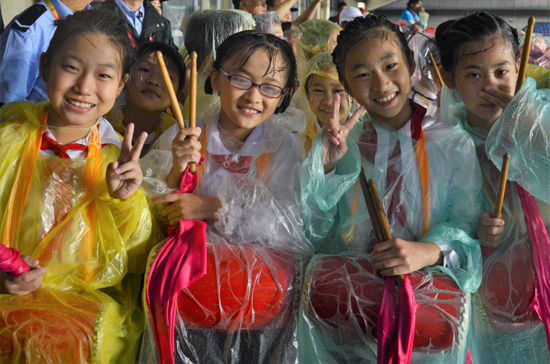
What really impressed me was the sight of the people of Rugao. The people were pretty well off, well heeled, living in good quality homes and looking very contented with their lives. The children, the youth and the young were a pleasant surprise. They were all at the stadium during the Opening Ceremony for the Asian Masters. Some were there to perform, some were there as spectators to this international events. And the unpredictable happened, the sky opened up, and everyone was wet. But the youth and children came well prepared, with a thin transparent raincoat over their costumes and their latest trendy wear.
The rain did not dampen their free spirit. They ran, but to the stadium, not away. They were there to celebrate a big international event, to welcome the visitors to their home town. What was written all over their faces was a future of hope, confidence and well being. Their innocence, their free spirit, their laughter, there was not a hint of fear or uncertainties in them, as they celebrated life. The faces of the Rugao children today are the faces of joy, of a happy young people living for now and for a better tomorrow as young people should.
China today has reached a point where the people could live life, enjoy peace and be themselves without a worry. Such a privilege only comes about when the country is strong and prosperous and well managed. The children and youth of Rugao are a manifestation of the children and youth of China today, living in a time when security and prosperity are a new normal. To live a happy and cheerful life of plenty, being young and enjoying growing up as children and young adults shielded from the vagaries of life, with a bright and secure future that a strong and prosperous China has bestowed upon them. The children and youth of Rugao and all over China are the new China, a people blessed to live a life never the same as the parents and grandparents of old China. This is the new China and the China Dream.
The author is a political observer from Singapore.
The opinions expressed here are those of the writer and don't represent views of China Daily and China Daily website.