Washington plays security game of hegemony







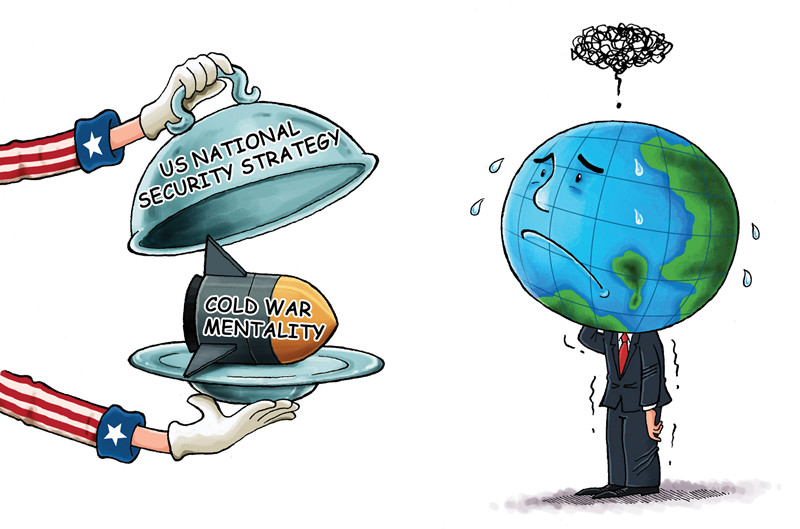
Donald Trump is the first US president to unveil a National Security Strategy in his first year in office. And the release of the document on Monday, widely seen as an important move that broadly reflects the US' foreign policy, highlights the Trump administration's result-dominated approach to global issues and desperation to achieve big results.
The document, in general, is a continuation of former US president Barack Obama's policy to use the National Security Strategy as a tool to maintain the US' hegemony and status. But there are evident differences between the two documents in terms of strategic ideology on which they are based and their paths of implementation.
First, Trump's strategy is based on "principled realism". The document admits the Trump administration will "inherit" the realistic inclination of the US' traditional diplomacy and stresses the importance of national interests and military strength. It also emphasizes the importance of "principles" such as "America First", that is, to maintain global peace in a way that maximizes US interests with the help of its superior military power.
"America is in the game and America is going to win," Trump said on Monday, making clear that the US will protect its interests even if it means acting unilaterally or alienating other countries on issues such as trade, climate change and immigration.
In other words, the "principled realism" of Trump is more of a compromise between his "America First" policy and the Republicans' traditional diplomatic concept. It is also likely to become the basic logic on which Trump's foreign policy will be based.
Second, at the core of the document is "economic security". In the national security strategies mapped out by US presidents over the past three decades, "economic interests" didn't occupy so prominent a position. The high importance given to "economic security" conforms to Trump's policy agenda aimed at "making America great" again, and highlights the inward-looking approach of the world's sole superpower. That Trump seeks to ensure the US' economic security by raising it to the strategic security level shows he is hell-bent on maximizing US interests at any cost.
Third, the new document reflects the Trump administration's obsession with the Cold War mindset and zero-sum game. For example, the report overstates the external threats to the US, especially the challenges it faces from other powers.
"China and Russia challenge American power, influence, and interests, attempting to erode American security and prosperity," the document says. "They are determined to make economies less free and less fair, to grow their militaries, and to control information and data to repress their societies and expand their influence."
Such language betrays the sense of unease and anxiety among US elites toward the ongoing change in global governance and the world political order. But by exaggerating the imagined external threats, especially threats from other powers, the US will only make it more difficult to further develop cooperative and mutually beneficial relations with other countries.
According to the White House, the new National Security Strategy is based on the measures Trump has taken over the past 11 months to boost the US' confidence to deal with problems at home and abroad. But, in essence, it is the work of a US president in political and diplomatic "apprenticeship", which is rife with hawkish military and protectionist trade measures.
It remains to be seen whether it is only a move to add color to Trump's first year's "list of merits", or a real strategic roadmap that will be implemented to the letter.
The author is a researcher at the Institute of American Studies, Chinese Academy of Social Sciences. The article was first published in Beijing News.