China, EU lead fight against emissions







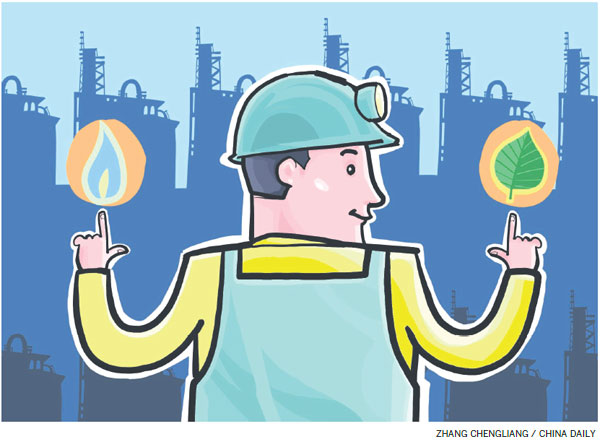
Countries around the world are applauding China's emissions trading system (ETS) development plan, which demonstrates the country's resolve to put its commitments under the 2015 Paris climate agreement into practice, through policies and measures that will reduce emissions.
China's decision announced on Dec 19 is a careful, considered plan, drawing on several years of piloting in diverse cities and provinces and building on years of experience elsewhere. The ETS will start with the power sector, covering other major emitting sectors by 2020.
In October 2003, European Union decision-makers agreed to a law on ETS. The three-year pilot phase started in January 2005, covering power generators and energy-intensive industries, and allowed government bodies and companies to "learn by doing". Today, the EU-operated ETS covers 31 countries: 28 EU member states, and Norway, Iceland and Liechtenstein. And in 2020 it will be linked with Switzerland's ETS. It manages to deal with a per capita income disparity between the EU's poorest and richest member states of more than 1:10, and sets a declining cap on emissions of around 11,000 energy-intensive installations as well as aircraft operators. In practice, it means there is a carbon price covering 45 percent of the EU's greenhouse gas emissions.
As in China, the power sector in the EU has played an important role, both as a major source of carbon dioxide emissions and a sector with great potential to reduce emissions. EU companies have supported the shift from "command and control" measures to a more flexible, market-based approach through the ETS. The power sector was one of the first to embrace the logic of pricing carbon and recognized the benefits of emissions trading, running trading simulations before the launch of the ETS and emphasizing the need for a price signal to guide investment decisions, attract finance for low carbon solutions, and ensure flexibility in the shorter term to drive down the cost of compliance with emissions reduction commitments.
The EU-operated ETS is a central element of the mix of policies and measures that allow Europe to meet its climate commitments. Between 2005 and 2016, the ETS facilitated a 26 percent reduction in emissions, and the reduction target for 2030 has been set for 43 percent below 2005 levels. The EU has developed a liquid carbon market with an annual turnover of about 50 billion ($60.06 billion), governed by financial market regulations. Trading emission allowances enable price discovery through the interactions between buyers and sellers, and the resulting price signals guide companies to seek the most efficient emissions reductions, benefiting the economy and the climate.
It takes time to develop a new, fully functioning carbon market. The EU's ETS took the management of CO2 emissions out of the hands of environmental and technical managers and put it into the boardroom, making it a matter for finance and company leaders.
Putting a price on carbon is an important signal for the economy. It should be clear to all, emitting sectors in particular, that carbon emissions must continue to reduce significantly over time. And by setting a carbon price signal now, governments are helping companies prepare for the future.
China has taken the initial steps to build a nationwide carbon market. Similarly, the EU has built and progressively improved its ETS over time. Well into its third phase, the EU-operated ETS now covers more sectors and gases, and its rules have been increasingly harmonized. Also, governments now auction a major part of the emissions allowances, creating important revenue for climate action or other benefits to society.
The redistribution of revenues under the ETS helps address some of the disparities between richer and poorer countries of the EU, and a proportion of the allowances is set aside to create funds that provide important financial support for innovation in and modernization of the energy sector.
A few weeks ago, EU lawmakers approved revised legislation, setting the rules for the European carbon market's operation in the next decade. This will allow the EU to meet a significant proportion of its 2030 commitment under the Paris climate agreement.
Like China, the EU, too, is committed to the Paris accord and is putting commitments into action, including supporting climate action by others and keeping an open dialogue on common implementation challenges.
The EU and its member states have supported the training of thousands of people from government and industry across China, in order to help develop a pool of Chinese experts who can train others and thus ensure local authorities, companies and all those indispensable to make the emissions trade work at central, provincial and local levels are prepared to play their respective roles.
With the announcement of the ETS, China has become, along with the EU, a source of inspiration for other economies as they develop the best ways of moving from commitments to emission reductions. The EU, China and other economies are now working on strategies for long-term low-carbon development, and devising ways to develop successful, stable low-carbon economies for the benefit of all. It is clear therefore that emissions trading and carbon markets have a key role to play.
The author is director-general, Climate Action, European Commission.