Initiative not a threat to the West







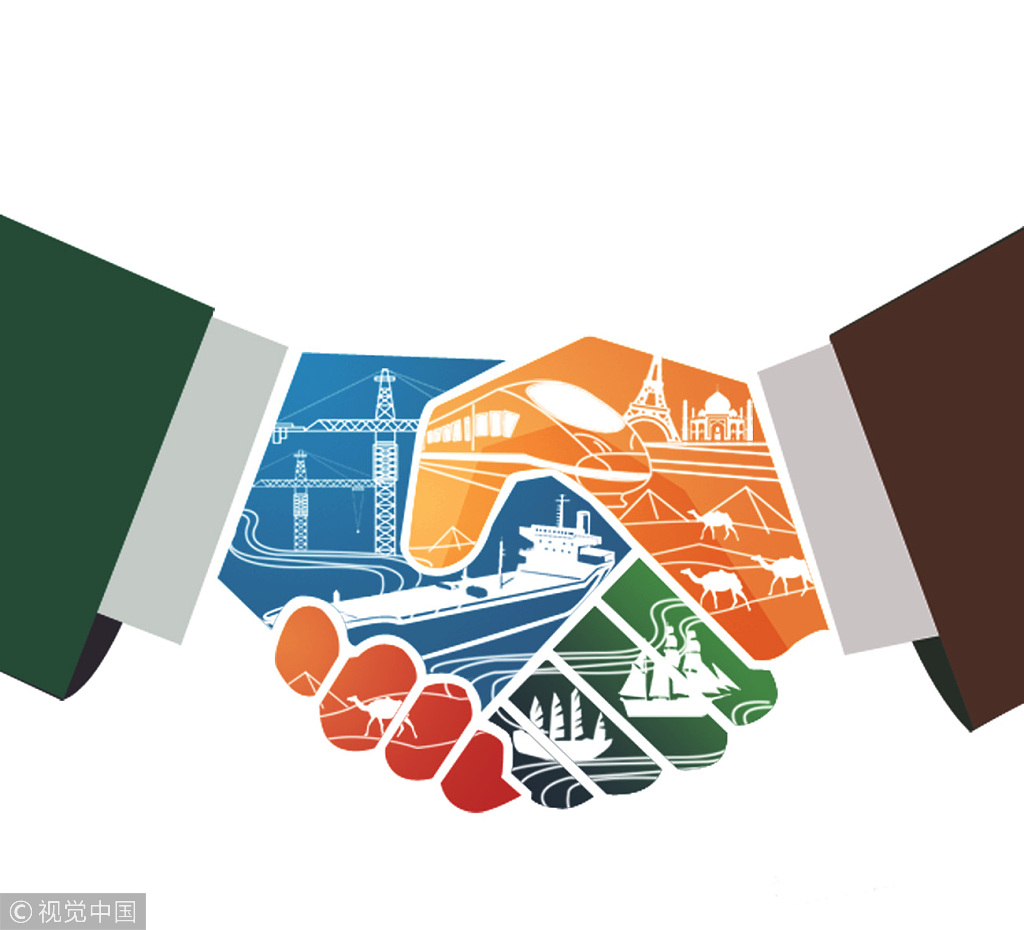
Out of ulterior motives, some Western countries seem to be joining hands to counter the Belt and Road Initiative.
At the 54th Munich Security Conference, German Foreign Minister Sigmar Gabriel rejected the China-proposed initiative, saying that it is not in the interests of democracy or freedom, and that the West needs to offer an alternative. Gabriel said China was using the initiative's infrastructure fund to promote a value system different from the West, and the European Union should launch its own initiative to promote the development of infrastructure from Eastern Europe to Central Asia and also in Africa, with European money, and with European standards. Gabriel's sentiments were backed by European Commission President Jean-Claude Juncker and French Prime Minister édouard Philippe, who both spoke of growing challenges to Western liberalism at the conference.
Yet in an earlier visit to China, French President Emmanuel Macron promised to work with China on the Belt and Road Initiative, although he recalled the French colonial experience in Africa and urged China not to turn the initiative into a new form of hegemony that could make host countries China's vassals.
It is not European countries alone that have voiced concerns about China's Belt and Road Initiative, the United States, Australia, Japan and India have also said recently they will join hands to create an alternative regardless of China reiterating on numerous occasions that the initiative aims to realize strategic synergy with other countries, not to overthrow the established order.
No need for West to cast doubt on initiative
In its advancement of the Belt and Road Initiative, China, through policy coordination with other countries, strives to achieve the effect of "one plus one being greater than two" and promote lasting peace, common security, common prosperity, openness and inclusiveness, and shared and sustainable development. China is willing to share with other countries its development experience, but it will not interfere in the internal affairs of other countries.
China will neither introduce foreign models nor export its own model and never demand other countries copy its practices. By advancing the Belt and Road Initiative, China is not repeating the old geopolitical games, but instead offering a new win-win cooperation model. The initiative will not destabilize world peace and stability but contribute to the building of a big world family of harmonious coexistence.
Behind Western unease about the Belt and Road Initiative is their misunderstanding and disapproval of the China's model and their all-out attempt not to abandon their self-righteous universal values. Problems-and goals-guided, China's model aims to promote a perfect combination between a functioning government and an efficient market, in which the visible and invisible hands both play their roles, but the market plays the decisive role. Such a model will offer countries whose market economy has not been fully developed an all-new option in the pursuit of industrialization and will help them resolve the problems which the West's free market formula cannot resolve.
Due to the lack of self-confidence in their own development model, Western countries have showed great anxiety over the competition from China's development model in recent years and this has been extended to the Belt and Road Initiative, as partially reflected by the different approaches between Europe and China toward globalization.
Disapproving of the Chinese development model and its popularization, the West views the Belt and Road Initiative as China's strategy to rewrite international rules and change the existing regional and international order, and acquire regional and global dominance.
West will lose chance because of fear of China
In stark contrast with Western countries, the massive developing and non-core Western countries extensively welcome the Chinese initiative and hope to benefit from China's fast economic development. Since the Belt and Road Initiative was first raised, China, through consultation on an equal basis, has signed 101 cooperative agreements with 86 countries and international organizations, carried out regular capacity cooperation with more than 30 countries, built 75 economic and trade zones with 24 countries along the routes, and made a cumulative investment of $50 billion in involved countries, creating nearly 200,000 jobs. All this, a full demonstration of the initiative's mutual beneficial and win-win essence, can explain why the initiative has received warm support and welcome among the involved countries and wider international community. The Belt and Road initiative will bring some changes, it will push globalization to evolve in a more open, inclusive, balanced, mutually-reciprocal and sustainable direction. Given that China enjoys huge advantages in infrastructure construction, the advancement of the Belt and Road Initiative will surely boost connectivity between China and the rest of the world. China is not opposed to but welcomes the US working with allies to launch their own infrastructure construction programs in other countries.
The largest risk to the Belt and Road Initiative comes from Western countries, with their groundless doubts over funds, standards, geopolitics, transparency, procurements and other issues. But only when Western misgivings over China's development model disappear, will their doubts over the Belt and Road Initiative disappear as well.
As the Belt and Road Initiative irreversibly advances, the West risks losing not only China but the world if it misses the opportunities being created by the initiative.
The author is Jean Monnet chair professor at and director of the Institute of International Affairs, Renmin University of China.