HK must further integrate with mainland







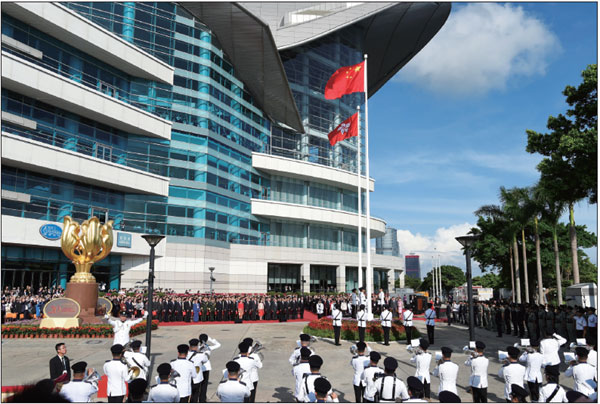
As Premier Li Keqiang said in the Government Work Report this year, the "one country, two systems" principle, implemented in the Hong Kong Special Administrative Region for more than two decades, has been consistently enriched and developed, and the authority of China's Constitution and the basic laws of the Hong Kong and Macao SARs have been further enhanced in the two regions.
The central authorities have affirmed the achievements of the "one country, two systems" principle and re-emphasized its original intention, while reiterating for the past five years the comprehensive meaning of the principle to make sure it is not changed.
But some people have intentionally or unintentionally "misunderstood" the principle, and made a series of moves that go against the "one country, two systems" principle. The call for "Hong Kong independence" is one of them.
The mainstream society in Hong Kong has stayed away from this call, saying the "one country, two systems" principle is the best choice for Hong Kong. Legislation of Article 23 of the Basic Law of the Hong Kong SAR, which states the "Hong Kong SAR shall enact laws on its own to prohibit any act of treason, secession, sedition, subversion against the Central People's Government…", is yet to be completed, and the anti-national education campaign has seriously weakened some youths' sense of national identity. Hong Kong's political reform has also been undermined by the illegal "Occupy Central" campaign in 2014, when some youths even called for "Hong Kong independence". The need therefore is to make people better understand the "one country, two systems" principle.
Hong Kong is a special administrative region with a high degree of autonomy, but it is still under the jurisdiction of the central government. China's Constitution and the Basic Law determine the SAR's political and legal status. The Basic Law is an enabling statute, which shows the political relationship between the central government and the SAR administration is that of a central government and a local government.
The principle of "one country, two systems" enriches China's political structure based on the strategy of national unity. As a historical innovation, it is quite normal for the practice of "one country, two systems" to encounter some problems. But it should be made clear that such problems are China's internal governance issue.
The call of "Hong Kong independence" is seditious and secessionist, as it goes against not only the "one country, two systems" principle but also the will of the Chinese people, including Hong Kong residents. And as the ruling party, the Communist Party of China is committed to taking all measures possible to safeguard national unity and territorial integrity.
Hong Kong is a plural and free society where the rule of law prevails, and it has been the central authorities' consistent policy to deal with issues relating to Hong Kong strictly in accordance with the Constitution and the Basic Law. Although freedom of expression is fully guaranteed, any words and deeds advocating "Hong Kong independence" are strictly prohibited in the SAR.
In this context, the interpretation of Article 104 of the Basic Law by the Standing Committee of the National People's Congress, China's top legislature, is an effective legal safeguard for the "one country, two systems" principle by requiring the administrative, the legislative and judicial members to swear to uphold the Basic Law.
The spirit of "one country, two systems" and the Basic Law should be spread in Hong Kong society, in order to fight the voices of "Hong Kong independence" and clear Hong Kong residents' misunderstanding of the principle.
Those advocating Hong Kong "independence or separatism" should be stopped from polluting the Hong Kong governance system, and influential public figures should be prohibited from making remarks that instigate "Hong Kong independence".
By recognizing that the "two systems" are an undeniable part of "one country", Hong Kong will be able to better integrate into the country's overall development.
The author is a professor at Shenzhen University and a member of the Chinese Association of Hong Kong and Macao Studies.