Why the world is fixated on modern China







Global media coverage of the ongoing two sessions in Beijing has taken my mind back to the pre-internet era of the early 1980s.
Back then, studious high school students in India, where I come from, used to glean "general knowledge" from the mass media, trivia books and almanacs. The goal was to become well-informed as well as win prizes in interschool quiz and debate competitions.
We enjoyed memorizing trivia. From a "Third World" perspective, the West seemed fascinating-and learning more about it was considered natural, even expected. So: What's the capital of the United States? Washington. What's the currency of the United Kingdom? Pound sterling. What's the lower house of the British parliament called? The House of Commons. Where's it located? Westminster.
Only Japan was a bit of an exception. It wasn't the West, but we knew Tokyo was its capital and the yen its currency. There were a couple of other exceptions: Who's Malaysia's prime minister? Mahathir Mohamad. Who's the president of Cuba? Fidel Castro.
Learning "who's who" meant we knew "big" names such as Ronald Reagan, Mikhail Gorbachev, Helmut Kohl and Francois Mitterrand.
Back then, we knew very little about China, except that it was a large, populous, agricultural, somewhat similar "Third World" country that boasted the Great Wall (which, it was believed, was the only man-made structure visible from space). Except for the bit about Beijing being its capital, and Deng Xiaoping being its leader, China was by and large a known unknown. Ignorance was bliss.
Not anymore.
Who could have imagined that in a little over three decades, the "knowledge" of the West accumulated over the years would become relatively unimportant? I certainly never imagined I'd one day live and work in China.
The advent of the internet and the simultaneous politico-economic rise of China have ensured that not just my generation (those born in the late '60s and early '70s), but the one that preceded us as well as the one that followed us, are all now forced to sit up, take notice, and-shall we say-cram as many details about China as quickly as possible into our individual and collective consciousness.
This became obvious to me the other day when a childhood friend in India told me his college-going teenage son, like his peers, shows a deep interest in China, reads about it online and even has a question related to the two sessions: "Why are the members of the National People's Congress referred to as 'deputies' and not 'members of parliament', or 'MPs', as they are called in India, or 'lawmakers', like in the US?"
It may seem like a trivial question. But given my familiarity with trivia, it also represented the level of interest the world now has in China. It indicated why everyone wants to know more, not less, about China.
It also underlined the need for the country's leading institutions, such as the Communist Party of China, the top legislature and the central and local governments, to better engage with the rest of the world in order to quench the seemingly unquenchable thirst for information, news and views on China.
In October, the Party held its 19th National Congress. And now the world is riveted by the ongoing two sessions. It would be folly to attribute this curiosity to what appears to be the inevitable rise of the Chinese economy to global prominence. There's more going on here, I'd argue.
Ordinary people across the world, empowered by technology that enables access to real-time information are looking for alternatives to failed or dubious systems of governance. You could say it's part of the process of the evolution of public consciousness itself.
For a long time, developing nations were enamored with the West and bought into its media outlets' spin. Now, it seems, consumers of content are no longer sure if they should accept such messages and value systems at face value.
The reality is, while the world is overwhelmed by the exhumed incidents of gender inequality and sexual discrimination, and convulses through"#MeToo" hashtags, China's legislature reveals its liberal, modern fabric: 742 of the total 2,980 deputies, or 25 percent, are women.
The reality is, the so-called democracies have seen their parliaments, allegedly their supreme institutions, failing to shake themselves free from the vice-like grip of lobbyists of planet-pillaging, tax-evading corporations. They have seen outright criminals becoming lawmakers. They have seen lawmakers failing to enact laws to rein in the gun culture that enables shootings of innocents ad nauseam. They have also seen their august legislatures become venues for violence, stalling or rollback of reforms, and attempts to reverse, circumvent or disregard the will of the people expressed via referendums.
Around the same time, the world is also seeing in China a national legislature that actually performs-it communicates its intent, and ensures the government delivers on its promises.
When the world wonders if China could be trusted on a plethora of issues, the Government Work Report shows that every year there is a lot going on-opening-up, supply-side reforms, innovation initiatives, robust protection for intellectual property rights-to warrant a rethink.
An open-minded world is looking for answers to vexing problems. People everywhere are questioning received wisdom-is it really wise to replace a wise president with someone arguably less so because the law forbids the former from continuing in office as he has already served the maximum two terms? Should we change the law? Or, should we uphold the law (and elect a joker next because that's the choice a democracy inflicts on us)?
Such profound conundrums are boggling the world. China appears to have ignited the world's imagination with its distinct, flexible and arguably practical approach to such dilemmas.
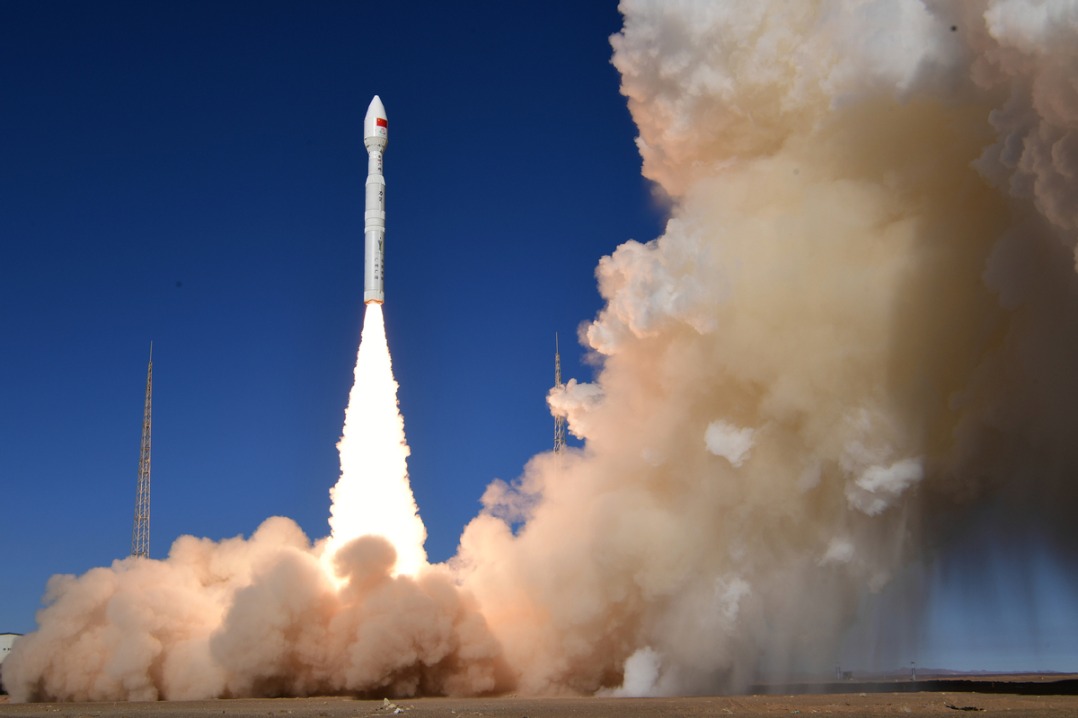

- China's commercial rocket maker puts two satellites into orbit
- People in Taiwan commemorate victims of White Terror period
- China successfully launches new test satellites
- China launches Lijian 1 Y9 carrier rocket
- First cross-border event debuts at the National Games
- China Focus: National Games enhances coordination under 'one country, two systems'