Patriotism basis of 'one country, two systems'







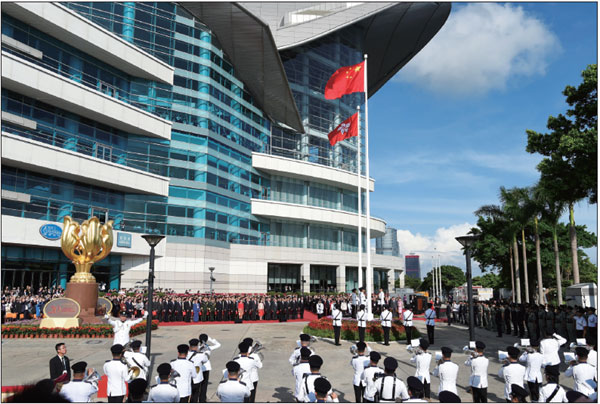
Speaking at the closing of the first session of the 13th National People's Congress last month, President Xi Jinping said the Hong Kong and Macao special administrative regions should integrate their own development into the country's development, and take measures to enhance the sense of national consciousness and patriotism among their residents.
And the report of the 19th National Congress of the Communist Party of China in October last year and the Government Work Report last month emphasized that for the long-term prosperity and stability of Hong Kong and Macao, it is necessary to fully and faithfully implement the policies of "one country, two systems", the "Hong Kong people governing Hong Kong", the "people of Macao governing Macao", and a high degree of autonomy for both regions.
Advocating patriotism, however, is crucial for implementing the "one country, two systems" principle. To begin with, patriotism reflects the original intention of the "one country, two systems" principle, which aims to peacefully resolve the national unity issue. Although Hong Kong and Macao have reunified with the motherland, patriotism still needs to be promoted in the two regions, especially among youngsters and students, because some people, by advocating "Hong Kong independence" in the recent past, have violated the country's Constitution and the Hong Kong Basic Law, and undermined national sovereignty, security and interests.
Second, advocating patriotism is conducive to promoting the "one country, two systems" principle. The Standing Committee of the National People's Congress, China's top legislature, has made some decisions on and interpreted the Basic Law. But some Hong Kong residents wrongly presume Hong Kong alone should decide its political system, which reflects their lack of national consciousness and betrays their misunderstanding of the plenary jurisdiction of the central government on Hong Kong based on China's Constitution and the Hong Kong Basic Law.
Hong Kong's power is granted by the central government, and its political system is determined by the Basic Law approved by the NPC. It means the central government, rather than Hong Kong, will decide the SAR's political system after soliciting HK residents' opinion on the issue.
The NPC Standing Committee has interpreted Article 104 of the Hong Kong Basic Law, stating that all civil servants are obligated to "uphold the Basic Law of the Hong Kong SAR of the People's Republic of China" and bear "allegiance to the Hong Kong SAR of the PRC". These are not only the legal content which must be included in the oath prescribed by Article 104 but also the legal requirements and preconditions for standing for election in respect of or taking up a public office in Hong Kong. This means any person advocating "Hong Kong independence" violates the Constitution and the Hong Kong Basic Law, and thus should be barred from holding a public office.
The National Anthem Law, too, has been extended to Hong Kong as part of Annex III of the Basic Law, and the Hong Kong Legislative Council has started local legislation for the National Anthem Law, whose implementation in the SAR will promote national consciousness and enhance the sense of patriotism among Hong Kong residents.
Third, advocating patriotism is conducive to the principle of Hong Kong people governing Hong Kong, and Macao people governing Macao. It will also help better safeguard national sovereignty, security and interests, as well as guarantee the long-term prosperity and stability of the SARs. Hong Kong should be governed by patriotic Hong Kong residents who can better understand the relationship between the central government's plenary jurisdiction and the high degree of autonomy enjoyed by Hong Kong and Macao.
In fact, Hong Kong people have a long history of patriotism, which goes back to the Chinese People's War of Resistance Against Japanese Aggression (1931-45). And after the reform and opening-up were introduced in 1978, Hong Kong and Macao residents were the first to support the Chinese mainland's economic construction, with the two regions serving as the initial channels for the funds and technologies that facilitated the mainland's economic development.
Now that the mainland has achieved unprecedented economic development and relative prosperity, Hong Kong and Macao should integrate their own development into the country's development, as President Xi has advocated, and seize the opportunities offered by the Belt and Road Initiative, by taking advantage of the principle of "one country, two systems", to create a beautiful future for the motherland.
Moreover, advocating patriotism in Hong Kong and Macao is also conducive to spreading knowledge about the Constitution, which is essential for understanding the Hong Kong Basic Law.
The author is a professor of law at Peking University.