Only reciprocal moves can boost trade ties







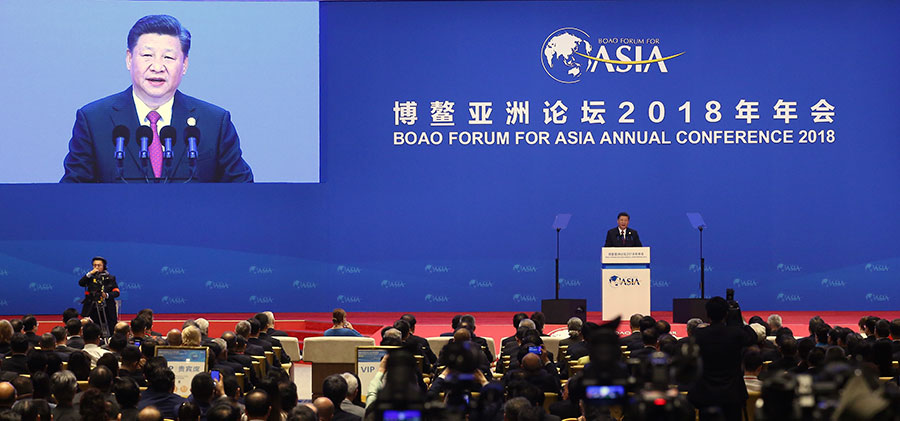
In his keynote speech at the Boao Forum for Asia on April 10, President Xi Jinping elaborated on China's new vision, policies, responsibilities and initiatives to advance opening-up, demonstrating China's commitment to further opening up its economy in the new era.
Xi's remarks also show further opening-up is the only way for China to pursue higher-quality economic development, build a modern economic system, and shoulder its responsibilities as a big power while promoting globalization for the well-being of people across the world. Further opening up its economy to the outside world, attracting high-quality foreign capital, increasing imports, and promoting the free flow of capital, goods and technologies will help China better respond to international concerns, intensify self-development and reduce frictions with other countries to realize win-win cooperation and help build a community of shared future for humankind.
Foreign-funded enterprises have played a vital role in China's economic development and helped it to expand its capital and foreign exchange reserves, introduce talents, and implement market-oriented reforms. China wants them to continue playing that role in the new era.
China's economy is shifting from high-speed growth to higher-quality development, but many of its industries still lag behind those in developed economies in terms of technology, expertise and efficiency.
So, to attract top-notch multinational enterprises and improve the quality of foreign capital, China should deepen supply-side structural reform by, for instance, making better use of global resources, keeping pace with global technological development, establishing modern corporate and market economic systems, and promoting higher-quality economic development. This will also help developed economies' enterprises to better use their technological advantages and make higher profits.
One of China's key goals is to lower the entry threshold to its service market to attract more foreign capital. China eased the restrictions on the share of foreign capital in domestic banking, securities and insurance sectors at the end of last year, and it is expected to further relax or suspend such restrictions in the fund management, futures, and financial asset management sectors. It will also further open up its telecommunications, healthcare, education and pension services sectors.
Besides, China is expected to ease or cancel the limits on foreign shareholding in its automobile, shipbuilding, and aircraft manufacturing industries to push forward domestic reform, accelerate innovation, optimize resource distribution and promote middle- and high-end development in manufacturing.
Expressing concern over China's intellectual property rights protection laws, some developed economies are reluctant to invest capital or technologies in China. But the fact is that China has always tried to strengthen IPR protection and meet the World Trade Organization's requirements to improve its socialist market economy.
Believing IPR protection is necessary to attract foreign capital, technologies and talents, China will deepen cooperation between domestic enterprises and foreign companies. As a significant step toward reinforcing IPR protection, China has re-organized its intellectual property office, which may impose higher penalty for IPR infringements.
Moreover, China will also increase imports so that the rest of world can better share the fruits of its development. As President Xi has said, China is a beneficiary of and also a contributor to economic globalization, and its development is an opportunity for the world.
With the increase of Chinese people's incomes, the demand for high-quality goods and services, such as foods, healthcare, and cultural activities in China will keep growing. Which means China will have to import more and more of such goods and services to meet its citizens' upgraded consumption demand.
But only through the joint efforts of other countries can China effectively increase its imports. If, based on WTO rules, China lowers import tariffs on such consumer goods as cars, medicines, healthcare products, cosmetics, instruments and apparatuses, and simplifies the customs clearance procedures for them to facilitate their import, other countries, especially developed ones, will have to forego their prejudices and effectively relax their restrictions on the export of high-tech products to China to better share the huge Chinese market.
The authors are researchers at the Institute of International Economic Research, Chinese Academy of Macroeconomic Research.