Shenzhen's 'can-do' drive forges new ground







Education reform
Talent has been key to Shenzhen's development, but the prosperous city lacked indigenous high-level research and education institutions, which limited its ability to produce quality talent and original work.
To remedy the situation, the Shenzhen government established the Southern University of Science and Technology, known as SUSTech, in 2011 to cultivate innovative minds in the fields of science and technology and serve as a testing ground for China's most radical educational reforms.
SUSTech now ranks as the third-best university in Guangdong and 43rd in the nation in terms of overall rating, but it tops the nation in terms of the quality and influence of the scientific papers it produces, according to the Academic Ranking of World Universities.
"Thanks to reforms, SUSTech has completed 50 years' worth of development in just seven short years," said Li Fengliang, the university's deputy Party chief.
Li said the university's reforms are in line with fulfilling the "three No 1" principles coined by President Xi in March. They are that development is the No 1 priority, talent is the No 1 resource, and innovation is the No 1 driving force.
The reforms at SUSTech range from student admission to school administration, Li said, and the "experience learned here will be invaluable in improving China's overall higher education system".
There were around 26 million college students in China last year, with the ratio of professors to students at a university is typically one to several hundred. Yet, at SUSTech, the ratio is around 1 to 10, Li said.
SUSTech has around 4,300 students and 500 faculty. The students are accepted based on a unique "631" criteria, which means 60 percent of the decision is based on grades from the college entrance exam, 30 percent on SUSTech's own entrance exam, and 10 percent on the student's high school grade.
Teachers are also hired differently compared with other schools. Not only do they need excellent academic and research abilities, it is also key for them to have teaching experience in top foreign universities, Li said.
SUSTech is one of the few universities in China with a contract and tenured faculty system, and it can provide housing, funding, laboratory space and staff, legal services for intellectual property and patents, and various perks to researchers.
"Research, innovation and entrepreneurship are our three tenants," Li said. "These services ensure researchers have all the necessary tools to innovate and foster an open and collaborative environment to conduct interdisciplinary work."
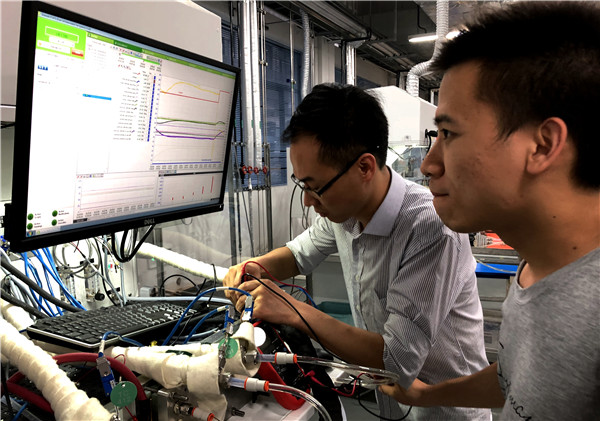
SUSTech also encourages researchers to turn their research into real products. In 2012, He Jiankui, an associate professor, founded Direct Genomics with resources and experts from the university to produce a new gene sequencer for medical use.
In 2015, the company created Asia's first third-generation gene sequencer - GenoCare. The new machine can greatly reduce the cost of analyzing genes, allowing more accurate and affordable early diagnoses for cancer and other genetic diseases.
"Start up companies are risky," He said. "But I really appreciate the school giving me the green light and resources to pursue my dream."
AI advances
On the afternoon of Jan 26, 2017, the police bureau in Shenzhen's Longgang district received a call from a worried father who said his 3-year-old son had been kidnapped.
The police reviewed security footage of the area where the child was last seen and found that a middle-aged woman had taken him. Through facial recognition software, they were able to identify the woman and track her to the railway station, where she boarded a train to Wuhan, Hubei province, about 1,000 kilometers away.
The Shenzhen police contacted security staff at the railway station in Wuhan. At 6 am the next day, the woman was caught on the train and the child was flown back home. The entire rescue, from the father's call to returning home, took just 15 hours.
It is just one of thousands of cases where artificial intelligence from IntelliFusion, a tech company in Shenzhen, has helped solve a crime. Since the start of 2017, the company's facial recognition and security cameras have helped solve more than 4,000 cases throughout Shenzhen, 500 of them criminal ones.
"Reviewing security footage with human eyes is very time-consuming, and lighting, shadows, and other factors can greatly effect accuracy and efficiency," said Chen Ning, the company's founder. "But AI is tireless and adaptive, it can find the right suspect from billions of photos in seconds, and cross-check thousands of photos to piece together a suspect's obscured features."
AI will dramatically improve the efficiency of police work and urban management, especially in crowded area such as airports, train stations and shopping malls, Chen said. The system has now been implemented in 20 major cities and provinces throughout China.
However, AI development requires collecting and analyzing a large amount of data, which raises fears of data breaches and invasion of privacy, he added.
"Our company cannot succeed without the necessary policies, regulations and infrastructure to support integrating AI into government work and our daily lives," he said.
"Thankfully, Shenzhen's government officials appreciate new science and technologies, and they are willing to work with companies and experts to make them as safe and beneficial to society as possible," Chen said. This included building new security measures, authorization protocols, and secure terminals to access image data, he added.
"I think what makes Shenzhen so attractive to talent is that there is generally an inclusive, 'can-do' attitude in the city's DNA," Chen said.
In the Futian Bonded Zone, four self-driving buses are being tested in a trial operation. By the end of the year, four more will be added, said Hu Jianping, the president of Haylion Technology, the bus' developer.
Launched in December, the 1.2 km bus route was the first in the world to run autonomous buses. The smart buses, about half the size of a regular bus, are designed to run at speeds of up to 30 kilometers per hour.
Equipped with sensors, cameras, and GPS antennas, the buses can avoid hitting pedestrians, vehicles and barriers, safely change lanes and stop at designated locations, though a driver still needs to be at the wheel in case of emergency.
"The main purpose of public transport is to reduce the number of cars on the road, as well as save space for parking, therefore making traffic flow more smoothly," Hu said.
The recent fatal crash of an Uber autonomous car in Arizona, in the United States, raised concerns over the technology's safety and led the state to ban autonomous vehicles from its roads indefinitely. Shenzhen is supporting work to make them safer.
"The safety of autonomous vehicles has always been the company and the government's top concern," Hu said. "But instead of banning new technology in the face of controversy, the Shenzhen government has been supportive in making it safer through more trials and regulations."



- Eight missing after cargo ship collides with fishing vessel near Shandong
- Investing in people: a worthwhile investment
- Exhibition commemorating the epic relocation of universities opens in Fujian
- Twelve punished for scaffold collapse that killed 7 in Shandong
- Slovenian official visits whole-process people's democracy practice site of CPPCC committees
- China's commercial rocket maker puts two satellites into orbit