Rural students ride to 'new beginning'







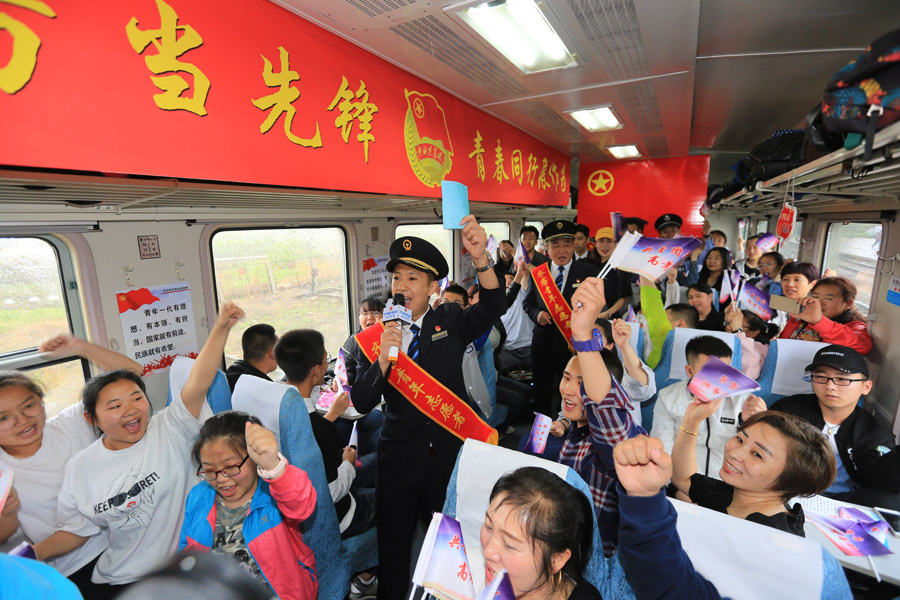
The small platform at the Dayangshu town railway station was packed with excited teenagers at lunchtime on Tuesday. Some chatted with friends, others played on smartphones, while a few simply waited quietly for the train that would start the next chapter of their lives.
The 12:58 service to Alihe, a town 135 kilometers away on the border between the Inner Mongolia autonomous region and Heilongjiang province, has been used each year since 2003 to transport students to the nearest test center for the national college entrance examination, known as the gaokao.
Red banners had been hung on the classic green-colored train, with slogans urging the students to "fight for their dreams", while the walls on the inside were decorated with pictures from previous years.
"For me, this train symbolizes the end of high school and a new beginning," said Meng Xin, 18, a senior at Dayangshu's No 2 High School. "It will not only take us to the test center, but also toward realizing our hopes and dreams."
Dayangshu lies in the southern part of Inner Mongolia's Greater Hinggan Mountains. It is inhabited largely by people from the Oroqen, Daur and Ewenki ethnic groups. The town is too small to have its own test center, so students travel to Alihe for the gaokao, which this year starts on Thursday.
The route has carried about 15,000 students over 15 years, according to China Railway Harbin Group, which operates the service.
Before the special train was used, the journey involved a combination of buses and trains and took more than six hours. The direct train takes just 90 minutes.
The completion of a national highway in 2010 connected the two towns, with a one-way road trip now taking about 2 1/2 hours. However, many students still choose to take the train, seeing it as a rite of passage.
"I'd often heard about the train from teachers and older students, some of whom went on to famous universities like Tsinghua," Meng said shortly before boarding. "Plus it'll be the last time I can be together with all my classmates and teachers. This journey will be one of the most unforgettable memories of my life."
To mark the occasion, train attendants turned the train carriages' narrow aisles into stages and put on performances that included songs, dancing and a short magic show.
"It's my fourth time accompanying the students to the gaokao," Ren Dazhang, 37, apolitics teacher from No 3 Middle School, said during a break in the singing mid-journey. "The activities make the trip feel much shorter and greatly help ease the students' anxiety about the looming exam."
For conductor Sun Jing, 27, the ride brought back happy memories of when she took the train as a high school student.
"I still remember that day. A rail worker guided us onto the train. He wore a neat uniform and white gloves. It left a deep impression on me," she said, adding that the experience inspired her to study at Batou Railway Vocational and Technical College, where in 2014 she graduated with a degree in railway transportation operation and management.
"I'm involved in the special train service every year," she said. "When I look at the young faces, it always reminds me of my own beautiful memories."
Although the train still attracts many students, the numbers are dropping. According to Cheng Xianmin, head of passenger transport at Dayangshu railway station, the service carried 1,071 students in its first year, reaching a peak of 1,407 in 2006. This year, only about 540 made the trip.
"Even with the numbers decreasing due to the improved traffic conditions, we'll continue to operate the special train for those who choose it," he said.
The return service will depart Alihe on Friday night, just a few hours after the end of the students' entrance exam.


- National Games vibe is everywhere in Guangzhou
- Forum unites global experts to enhance city image communication
- Miao New Year celebrations get underway in Guizhou's Leishan county
- Mainland spokesman reiterates stand on Taiwan
- Fujian county's rural development becomes a big draw for Taiwan investors
- Nobel laureate in chemistry: Give young scientists more independence