Technology company tests robots for home deliveries







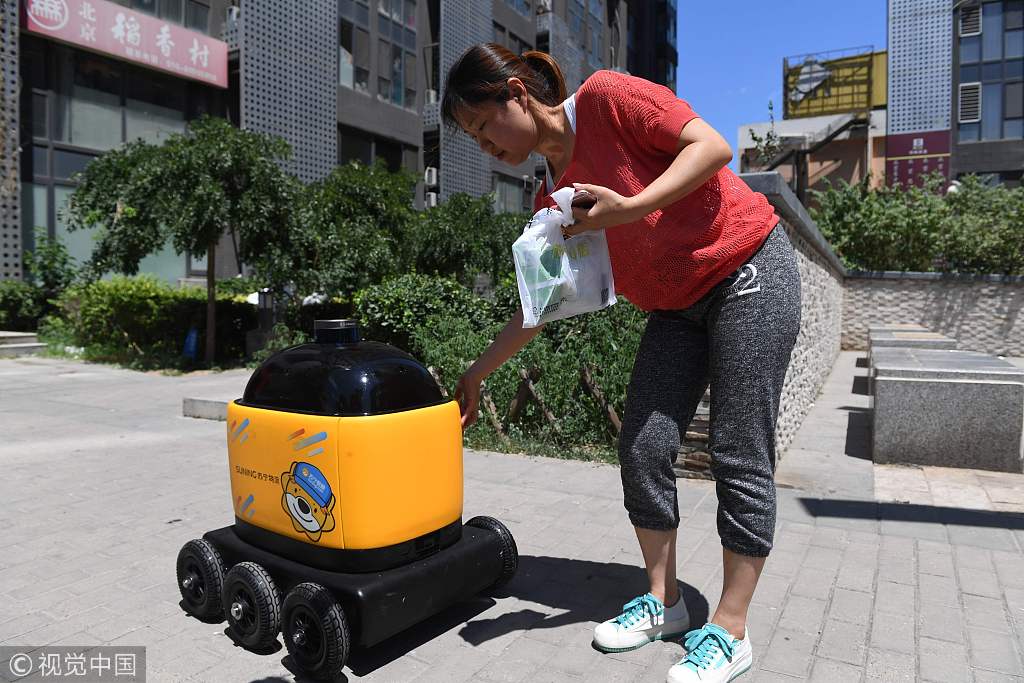
BEIJING - Along a quiet residential street on the outer edges of Beijing, a yellow and black cube about the size of a small washing machine trundles to its destination.
This "little yellow horse" is an autonomous delivery robot, ferrying daily essentials such as drinks, fruit and snacks from the local store to the residents of a nearby compound in the capital city.
Equipped with a GPS system, cameras and radar, the robots are seen by their creator as the future of logistics in China, where he says one billion packages will eventually be delivered every day.
Traveling at a less than overwhelming three kilometers per hour - a slow walking speed - the robot has room for improvement, said one customer as she removed a packet of nuts from its bowels.
"The weak point is that it cannot deliver directly to the door like a person," said the customer, who does not live on the ground floor.
"But it's still quite practical. The robot delivers relatively quickly," she said.
The robot takes advantage of Chinese consumers' love of cashless payments and smartphone shopping.
China is the world's biggest online shopping market with more than half of its population making at least one smartphone purchase per month, according to professional services firm PwC. This compares to 14 percent in the rest of the world.
Whether buying electronics or toilet paper, avocados or clothes, people in China are used to simply tapping a button on their smartphone and getting a home delivery - sometimes several per day.
To get a delivery via the little yellow horse, the customer selects the desired products, taps in the address and pays via their phone.
The supermarket staff place the items in the robot, and the robot bustles off.
Liu Zhiyong, founder and CEO of Zhen Robotics, which manufactures the robot, sees a bright future for his yellow creation.
"At the moment, there are 100 million packages delivered every day in China. It will be one billion in the future," Liu told media.
"There will not be enough people to make the deliveries. We need more and more robots to fill this gap in manpower and to reduce costs," Liu added.
These costs are especially high in the last kilometer of a delivery, where precision is key and a customized service is required to get the product to the front door.
At the moment, the yellow robots in the compound have little to trouble them, moving along a wide pavement with no obstacles - and no cars.
Weighing 30 kilograms and with a theoretical top speed of 12 km/h on their six wheels, the robots have four cameras constantly scanning the world around them and a laser tele-detection system allowing them to avoid obstacles.
Liu's firm has already signed up Suning, a large electronics firm that also runs a network of small supermarkets.
But not everyone is convinced the robots are a longterm logistics solution.
Shao Zhonglin, former deputy secretary-general of the China Express Association, said they were useful "over a short range".
"It's not certain however that they can be a broad solution for the final kilometer of delivery. Because the client still has to come down to get their package," Shao added.
"Plus the costs remain quite high: buying and maintaining the robots, operating costs, etc."
But Zhen Robotics is convinced the costs will come down over time.
CEO Liu also says the robot will soon be equipped with the necessary technology to operate a lift, meaning it will no longer be confined to ground-floor deliveries.
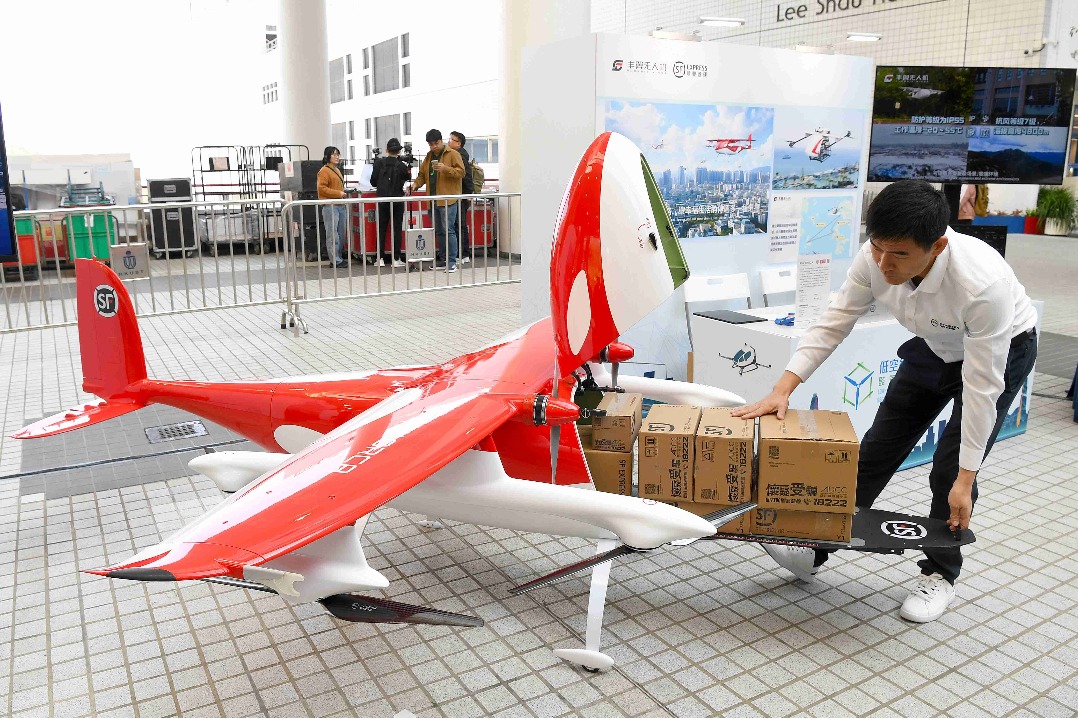
In the meantime, deliveries in China are increasingly being made by autonomous means. In recent months, several firms have received the green light to operate drones, either to deliver directly to customers or to ferry goods between hubs.
Online food delivery giant Ele.me, for instance, was granted permission in May to use unmanned drones, which can cut food delivery time to an average of 20 minutes. Regular delivery times range from 30 minutes to more than an hour.
In all, 17 air routes, all of which are in an industrial park in Shanghai's suburban Jinshan district, have been approved, covering about 58 square kilometers and serving more than 100 merchants, Ele.me added.
AFP - China Daily