BRICS a powerful force against US protectionism







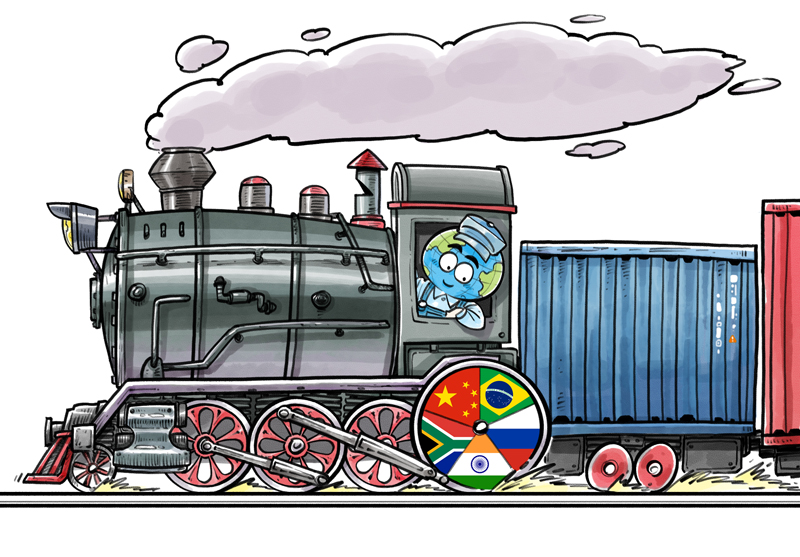
The invitation to the leaders of 22 emerging and developing countries, including 19 from Africa, made the just concluded BRICS summit in Johannesburg an even more important platform to demonstrate that the developing world and emerging economies as a whole, along with many developed economies, are strongly opposed to the Donald Trump administration's trade protectionist policies and punitive tariffs on imports.
The US administration has imposed high tariffs on imports from many economies, especially China, to push forward Trump's "America first" strategy. Some economies, China, India, and Russia in particular, have been forced to impose additional tariffs on US imports in response. And Brazil is worried about the US tariffs, on its steel products, even though its farmers may benefit from increased export of agricultural products to China.
A number of South African companies producing steel for the US market, including ArcelorMittal South Africa, the world's leading integrated steel and mining company, and Hulamin, an enterprise that supplies aluminum products for Elon Musk's Tesla vehicles, are also deeply worried about the US tariffs.
Also, the International Monetary Fund recently warned that the high US tariffs and tit-for-tat response from its trade partners could knock 0.5 percentage points off global growth by 2020. But the Trump administration has all but ignored that warning.
However, the US' trade policies have brought BRICS member states closer, and prompted them to try and unite the developing and emerging economies to oppose US policies, as evident from the statement issued at the BRICS summit.
Trump's trade policies have also prompted BRICS (Brazil, Russia, India, China and South Africa) to expedite the building of a platform for new instrumental dynamism and deep integration with other emerging and developing economies. The five member states of the group, for instance, have decided to increase intra-BRICS trade and lower tariffs against each other, because they have a collective interest in promoting free trade.
The BRICS group has made some remarkable achievements in fields such as finance, trade, agriculture, science, security and academic dialogue. The establishment of the BRICS New Development Bank and a business forum are two of its most important achievements. The BRICS members have already discussed greater financial integration and investment facilitation, including transaction settlement and direct investment in local currencies, consistent with their respective central bank's mandates.
The BRICS summit also took forward discussions on a "BRICS investment facilitation" mechanism to facilitate investments among the member states. South Africa, more broadly Africa, can benefit from increased trade and investment with fast growing BRICS countries such as China and India, as BRICS accounts for more than 40 percent of the global population, represents some of the biggest emerging economies and has the potential to reshape world trade.
The theme of the Johannesburg summit, "BRICS in Africa: Collaboration for Inclusive Growth and Shared Prosperity in the 4th Industrial Revolution" indicates BRICS is committed to leading the next generation's development. India has pledged that it would like to work with BRICS on the issue of the Fourth Industrial Revolution to together prepare best practices and policies in this connection.
Besides, the Johannesburg summit provided a platform for BRICS members to hold important discussion on the sidelines. Russian President Vladimir Putin met with his Turkish counterpart Recep Tayyip Erdogan in Johannesburg on July 26 to discuss trade and other issues. And China and India held discussions on trade matters, not least because both have been at the receiving end of the US' punitive tariffs and trade restrictions. In fact, the two sides vowed to defend the World Trade Organization framework and rules.
With Trump pursuing protectionism and unilateralism against the global trend of multilateralism and economic globalization, the fate of international agreements appears under siege. In such circumstance, BRICS is perhaps one of the most important blocs that is openly opposing protectionism and promoting globalization and free trade, both in principle and action, and has thus emerged as the most potent force against US unilateralism.
The author is a research fellow at and director of the Division of American Economic Studies at the Institute of American Studies, China Institutes of Contemporary International Relations.