On World Animal Day, end the suffering in Chinese circuses







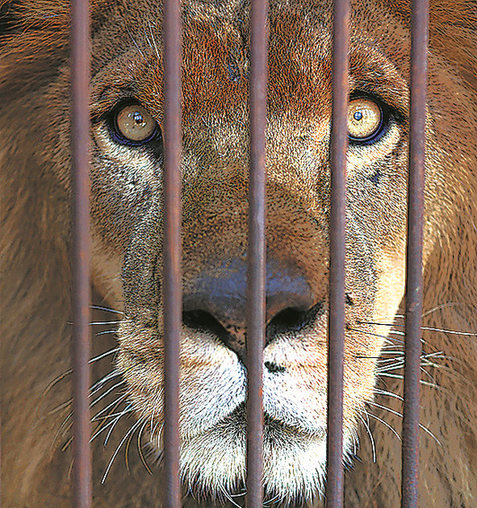
Throughout China, circuses, traveling shows, and roadside displays force animals to perform for the public. The town of Suzhou, located in East China's Anhui province, alone is home to more than 300 circuses. PETA investigators visited the area in 2015 and toured 10 circuses and training facilities, documenting horrendous conditions and entrenched animal suffering.
All the animals were living in squalid conditions. Most lacked food and water. They were routinely restrained with chains or ropes and crammed into cages so small that they could barely move. They appeared to be sickly, lethargic, frightened, and depressed. Trainers used force and fear to make them perform confusing, dangerous, and even painful tricks. They were dragged by chains around their necks, hit with sticks, taunted, and kicked. On World Animal Day, Oct 4, these are just a few of the reasons to remember the plight of animals used in circuses.
Bears are among the most abused animals in the industry. In their natural habitat, these highly intelligent animals — who have the capacity for empathy and are capable of experiencing a wide range of emotions — are active for up to 18 hours a day and spend their time exploring diverse terrain. In the wild, they forage for a variety of foods, digging through the soft earth, brush, and leaves. They have an acute sense of smell and are curious and playful.
Those used in circuses and roadside shows are taken away from their mothers when they're still babies—as young as 6 months old. The frightened and traumatized cubs are forced to stand on their hind legs as part of their training—they're hooked by the neck to a short chain hanging from a wall. If they can't hold themselves up, they risk choking or hanging themselves.
PETA's investigation also prompted China's State Forestry Administration to raid a circus and confiscate more than 20 bears when trainers failed to display a license for them. In addition to walking upright, the animals are also forced to "box," jump rope, "play" a trumpet, and lift furniture. Engaging in such unnatural behavior causes many to cry, scream, grunt, groan, flinch, cringe and struggle, as well as to develop painful arthritis and other joint problems.
When they're not performing or being subjected to cruel training practices, bears are confined to cramped, barren, concrete-and-iron cages. Terrified, lonely, and confused, most develop abnormal behavior, including rocking, walking in endless circles, and gnawing on the bars of the cages.
Monkeys in these traveling shows spend most of their lives housed alone in transport trailers and filthy, rusty old cages that have no solid flooring (they have to balance on iron bars) and barely enough space to move around in. A collar around their neck is attached to a chain that's securely fixed to the iron bars. Their water bowls seen were empty.
In their natural habitat, monkeys are extremely social animals who need the company and companionship of other primates. In circuses, they're often dragged out of their cages by the chains attached to their collars. PETA's investigators saw monkeys grimacing, struggling, defecating in fear, and attempting to escape. Most develop abnormal behavior, such as rocking and pacing. Some may even chew on their own fingers and limbs as a result of loneliness and stress.
Tigers used in performances are forced to balance on balls, roll around on the ground, and stand on their hind legs. Trainers hit, poke, and threaten them with long, heavy metal poles. When they're not being "trained," many spend their days confined to cages so small that they can't take more than two or three steps in any direction. Only one of the 10 facilities that the investigators toured had an indoor area in which tigers could escape from the sweltering heat.
Many other animals, including dogs, llamas, pigs, goats and peacocks, also are used in the circus industry. All the dogs seen were dirty, many had matted fur, and all appeared to be depressed and uncomfortable. And according to one circus owner, the use of seals — aquatic animals who need to live in vast expanses of water — in traveling acts is increasing.
Public sentiment toward using animals in entertainment has shifted in the past few years. Thanks to the spotlight that many in prominent positions are shining on animal abuse in circuses, more people are becoming aware of the issue. For example, Professor Xie Yan of the Chinese Academy of Sciences Institute of Zoology agrees that animal abuse in circus training programs is a problem and points out that some of the animals are captured in the wild or imported through smuggling. Several celebrities are also speaking out against animal circuses, including Han Geng, Jolin Tsai, and Jane Zhang.
Of course, the abuse is not unique to China. Circuses around the world subject animals to terrifying and cruel training methods, as well as to barren, cramped living conditions. People who care about animals will continue to stay away from any business that exploits them for profit.
Keith Guo is PETA Asia's media officer for China. For more information on the organization's work there, please visit PETAAsia.cn.
The opinions expressed here are those of the writer and do not represent the views of China Daily and China Daily website.