China, Japan can seize bright future together







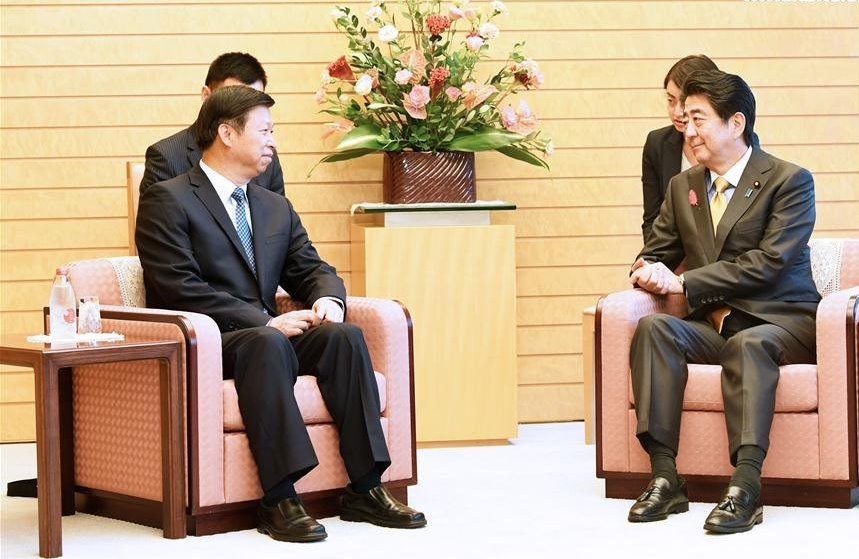
Japanese Prime Minister Shinzo Abe made a long-awaited visit to China this Thursday, sending a strong signal toward warming ties between the two nations. Abe is also the first Japanese Prime Minister to visit China since Yoshihiko Noda back in 2011, a sore fact difficult to reconcile considering China and Japan are two major regional and global economic players.
The timing speaks for itself. This October marks the 40th anniversary of the China-Japan Treaty of Peace and Friendship, and thus presents an opportunity for both countries to launch a new phase for cooperation despite past historical and territorial disputes.
This opportunity comes with mutual willingness and effort for a change in the bilateral relationship from both sides. Chinese Premier Li Keqiang paid a historical official visit to Tokyo last May, which was warmly welcomed by his counterpart in Japan. Li’s visit has successfully set an inspiring tone for a closer relationship.
The past few years have witnessed turbulent political exchanges between the two countries, especially after the illegal purchase of the Diaoyu Islands by the Japanese government in 2012. The chilly atmosphere cast negative effects on economic cooperation between China and Japan. Over the past six years, a notable drop in foreign direct investment from Japan to China has been blamed on worsening bilateral relations.
However, China and Japan are the second- and third-largest economies in the world respectively, and still share strong economic connections and mutual interests in various areas. China has been Japan's largest trading partner since 2007, while Japan was the largest trading partner of China for many years and was second–largest until recently.
The coming years provide a very important window for development of bilateral relations. China currently is on a track of economic structural change, adapting to a "new normal" that features a relatively slower growth rate with higher efficiency and better quality. The Japanese economy is also facing challenges while seeking stable growth. The complementary nature of the two economies is high during this period. There are many areas where China and Japan can expand and deepen cooperation, especially in industries like technology, high-end manufacturing, medical care, energy saving and environmental protection industries.
As income levels keep rising, the purchasing power of Chinese consumers has grown accordingly. In 2017, Chinese tourists spent about $39.6 billion dollars in Japan, accounting for 38.4 percent of the amount spent by all tourists visiting Japan. The fast-growing Chinese market has adapted to new technologies and business models, such as mobile payments and bike-sharing. It has become a potential testing ground for new technology companies from all over the world. China is a market Japanese companies cannot afford to lose.
Cooperation in third-country markets also attracts the attention of enterprises from both sides. Chinese and Japanese companies have had success in setting up joint enterprises to build hydroelectric infrastructure in Nepal as early as in 1985. The Belt and Road Initiative, proposed by President Xi Jinping in 2015, provides a whole new platform for enterprises from China and Japan to make the best of their own advantages in third-country markets, which can lead to broader and deeper cooperation based on well-framed rules. This will bring benefits to all participating partners.
Furthermore, several high-profile events are due to be held in both countries in the coming years. The next G20 summit is due to be held in Osaka in 2019, the Summer Olympic Games in Tokyo in 2020 and Asian Games in Hangzhou in 2022. All these highlight the importance of China and Japan moving forward in a cooperative manner and sharing more stable and beneficial connections, instead of making noise at one another now and then.
There are, of course, still some obstacles and uncertainties that should be taken into account by both sides. It is important for the people and politicians of Japan to accept China's rise is inevitable, and brings a chance for win-win situations in East Asia and the global community rather than a threat. In order to grasp the coming opportunity and make it into a reality, the two countries should enhance mutual political trust and lead relations into a prolonged, stable future.
Lin Jiang is a researcher at the China Center for International Economic Exchanges.
The opinions expressed here are those of the writer and do not represent the views of China Daily and China Daily website.