Earliest cannabis smoking evidence found in China







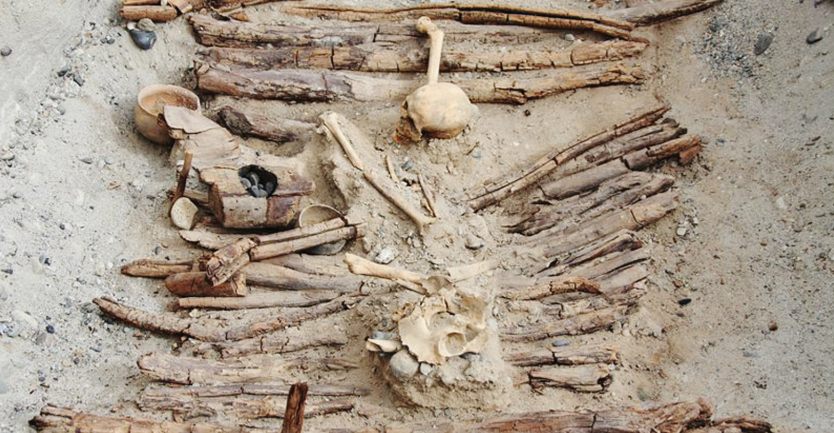
Chinese and German researchers have discovered residue from a potent strain of marijuana at a 2,500-year-old tomb in China, providing the earliest record of the use of cannabis for its psychoactive effects.
Researchers from the Chinese Academy of Sciences and the Max Planck Institute in Germany found the residue on incense burners at a high-altitude burial site known as the Jirzankal Cemetery in western China's Xinjiang Uygur autonomous region.
Testing at the site revealed a high concentration of the psychoactive compound THC, which is indicative of a cannabis variety used for its mind-altering qualities.
Some strains of cannabis were cultivated to make textiles from as early as 4,000 BC, though such varieties had low levels of THC.
"To our excitement, we identified the biomarkers of cannabis and local chemicals related to the psychoactive properties of a plant," said Yang Yimin, an archaeologist from the Chinese Academy of Sciences. "This is among the earliest chemical evidence of cannabis smoking."
Archaeological clues into the origin of cannabis smoking have remained surprisingly elusive despite the widespread use of the plant around the world today.
The earliest written reference is in a Chinese text dated to 2,727 BC, while Greek historian Herodotus wrote about cannabis smoking among Central Eurasian communities in the 5th century BC.
This recent discovery provides the clearest archaeological evidence that people have smoked marijuana for well more than 4,000 years.
"The findings support the idea that cannabis plants were first used for their psychoactive compounds in the mountainous regions of eastern Central Asia, thereafter spreading to other regions of the world," said Nicole Boivin, a director at the Max Planck Institute for the Science of Human History.
The researchers used a method called gas chromatography-mass spectrometry to isolate and identify compounds preserved in the incense burners, which were operated by transferring hot stones from a fire into a wooden container.
"Biomarker analyses open a unique window onto details of ancient plant exploitation and cultural communication that other archaeological methods cannot of er," said Yang.
Robert Spengler, an archaeobotanist at the Max Planck Institute, said the findings indicate that communities in Central Asia either sought out or cultivated cannabis strains with a high yield of THC.
Cannabis smoking most likely spread via the Silk Road trading network, according to Spengler.
"The exchange routes of the early Silk Road functioned more like the spokes of a wagon wheel than a long-distance road, placing Central Asia at the heart of the ancient world," he said. "Our study implies that knowledge of cannabis smoking and specific high-chemical-producing varieties of the cannabis plant were among the cultural traditions that spread along these exchange routes."
While, today, cannabis is used primarily as a recreational or medicinal drug, the evidence from the Jirzankal Cemetery suggests people burned cannabis during ritual ceremonies.
"This study of ancient cannabis use helps us understand early human cultural practices, and speaks to the intuitive human awareness of natural phytochemicals in plants," said Yang.