Experts: China's GDP not a factor in trade deal







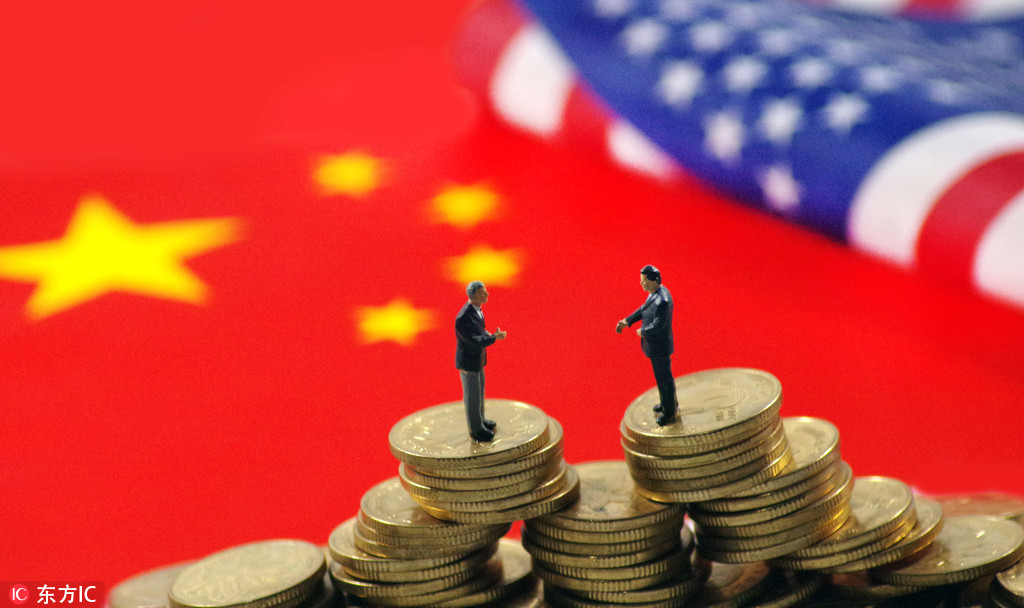
US President Donald Trump's premise that Beijing needs a trade agreement with Washington because China's economy is slowing is mistaken, and China is not in a hurry to cut a deal out of fear, several US experts have said.
Trump, commenting on China's latest growth figures, tweeted on Monday: "The United States tariffs are having a major effect on companies wanting to leave China for non-tariffed countries. Thousands of companies are leaving. This is why China wants to make a deal with the US, and wishes it had not broken the original deal in the first place."
"This is political gloss, not a rational narrative," Gary Hufbauer, a senior fellow and trade expert at the Peterson Institute for International Economics in Washington, said on Tuesday.
He said China's economy is slowing more because of domestic factors than the trade dispute.
Data released by China's National Bureau of Statistics on Monday showed that China's GDP growth slowed to 6.2 percent year-on-year in the second quarter, its slowest pace in the 27 years since quarterly record-keeping began.
The bureau said the economic performance was "stable", and the rate is in line with the government's annual target of 6 to 6.5 percent.
Beijing could have resorted to massive stimulus policies for higher economic growth, but instead, it has been committed to high-quality growth based on economic restructuring and industrial transformation and upgrading, according to reports in Chinese media.
Asked if he had found signs that China's loss is America's gain, Hufbauer said: "Not at all. Both countries are losing from the trade war. Trump talks a lot about the tariff revenue collected on imports from China. He doesn't mention the broader and far larger losses to the US economy-consumers, farmers, manufacturers."
Hufbauer also said that "there is a trickle, not a flood, of departures" of foreign companies to other countries, adding that reworking their supply chains in China or exiting is costly.
Foreign Ministry spokesman Geng Shuang said on Tuesday that the US allegation that China wants to make a deal because of an economic slowdown is "entirely misleading".
"China is not the only one that wants to conclude a trade deal. The US wants it, too," Geng said at a regular news conference. "American people, especially consumers, strongly oppose the trade war and the additional tariffs on Chinese goods. Their voice speaks volumes."
Stephen Roach, one of Wall Street's leading authorities on Asia, suggested in an interview that China is in no rush to cut a trade deal with the US.
"I think they're going to stay cautious on moving aggressively to cut a deal out of the fear of a weak economy, as President Trump would like us to believe," he said Monday on CNBC's Trading Nation.
The senior fellow at Yale University said he was in China last week, and the general sense was that the economy was slowing in the manufacturing sector.
"The larger, more rapidly growing services sector was likely to provide a source of resilience," he said.
China's services sector, which contributed 54.9 percent to the country's total GDP, rose 7 percent in the first half, surpassing a 3 percent increase in primary industry and a 5.8 percent rise in secondary industry, officials said on Monday. Primary industries extract raw materials, while secondary industries make products from those materials.
Simon Lester, associate director of the Herbert A. Stiefel Center for Trade Policy Studies at the Cato Institute in Washington, said, "I don't think the latest China GDP numbers have changed the calculation for either side in how to approach the current trade war."
Craig Allen, president of the US-China Business Council, said that in a global economy where nations are interconnected, any slowdown in China's economy will have global implications, including for US exporters and investors in China.
Allen, whose organization represents about 200 US companies that do business with China, has called for an expedited resolution of the trade dispute.
"Trade is a positive-sum game, not a zero-sum or negative-sum game. There will be bad consequences for virtually everyone if the tariffs remain in place for the longer term and the uncertainty continues," he said.