Leaders' friendship helps boost relations worldwide







Editor's note: Xi Jinping Thought on Diplomacy is the fundamental guideline for China's diplomatic work in the new era. China Daily is publishing a series of stories to examine how Xi's proposals have become internationally accepted and made great contributions to world peace and human progress.
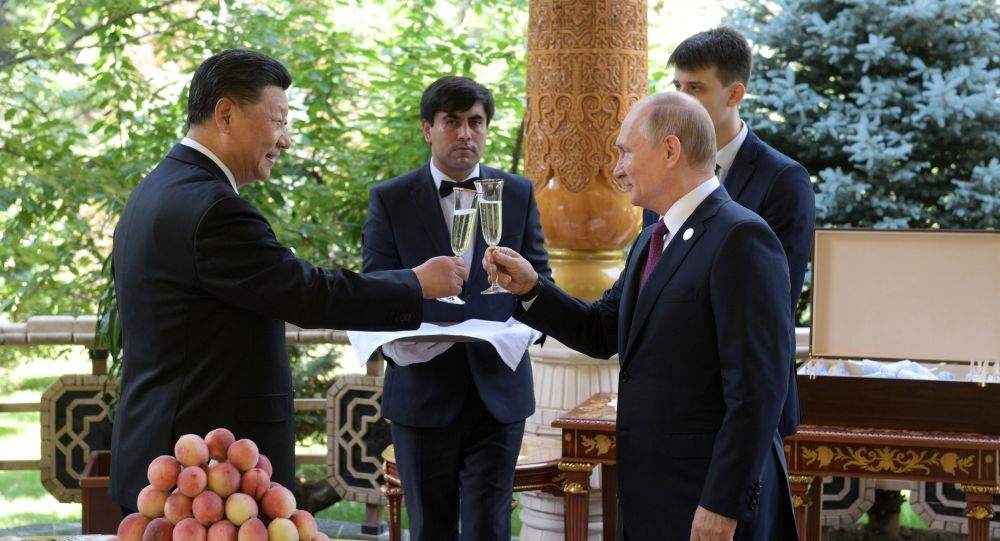
On June 15, the 66th birthday of President Xi Jinping, he received surprising gifts — a big cake and some ice cream — from his Russian counterpart, Vladimir Putin.
The celebration took place in Dushanbe, capital of Tajikistan, where the two leaders were attending the Conference on Interaction and Confidence-Building Measures in Asia. It was their second meeting in just a week, following one at the Shanghai Cooperation Organization summit in Bishkek, capital of Kyrgyzstan.
The birthday celebration showed the close personal friendship between Xi and Putin. The leaders' countries celebrated the 70th anniversary this year of their establishment of diplomatic ties. Xi and Putin exchanged congratulatory messages last week.
In the past six years, Xi has made eight visits to Russia while Putin has visited China nine times. They also had over 30 meetings.
While Xi visited Vladivostok to attend the Eastern Economic Forum in September last year, Putin, dressed in an apron, showed him how to make a local type of crepes. He later invited Xi to taste the crepes with Russian caviar.
During his visit to Tianjin in June last year, Putin also learned from Xi how to make two kinds of Tianjin snacks — goubuli baozi (stuffed buns) and jianbingguozi (a large crepe with an egg, spices and fried dough sticks).
Developing personal friendships with other leaders is a prominent characteristic of Xi's diplomacy, and his friendship with Putin has greatly advanced China-Russia relations, according to Jin Yong, a professor of international relations studies at the Communication University of China.
China and Russia, both permanent members of the United Nations Security Council, also have enhanced coordination in regional and international affairs, which is of great significance to global peace and stability, he said.
According to State Councilor and Foreign Minister Wang Yi, head-of-state diplomacy is the highest level of international communication and has irreplaceable effects and strategic value.
Since the 18th National Congress of the Communist Party of China in 2012, Xi has been the chief architect of China's distinctive major-country diplomacy. He has been personally involved in the planning and conduct of head-of-state diplomacy.
Xi's leadership style and his personal charm have attracted lots of leaders from countries of different social systems and cultural backgrounds, and many of them have become Xi's good friends, Wang said at a news conference at the annual session of the National People's Congress, the top legislature, in March last year.
B.R. Deepak, a professor at the Center for Chinese and Southeast Asian Studies at Jawaharlal Nehru University in India, said Indian Prime Minister Narendra Modi and Xi have established a friendly rapport during their formal and informal meetings.
In April last year, Xi and Modi had a highly unusual two-day, informal summit in Wuhan, Hubei province. The two leaders took a walk, tried two types of local tea, had talks on a boat and visited a museum.
Informal summits are helpful in establishing strategic communication between leaders, building consensus on certain issues and providing overall direction to bilateral relations, Deepak said.
He said that during the Wuhan summit, the two leaders agreed to issue strategic guidance to their militaries to bolster trust and mutual understanding. "They reached a consensus that differences between the two should not become disputes," he added.
Xi's diplomatic style has won respect from global leaders, and he has been feted many times with high-level receptions while visiting other countries.
When Xi visited Germany in March 2014 and July 2017, he and his wife, Peng Liyuan, received warm greetings from German Chancellor Angela Merkel and her husband, Joachim Sauer.
Qin Gang, vice-foreign minister and then assistant foreign minister, told China Central Television in a program broadcast in 2017 that Sauer seldom attends public events, but he accompanied Xi during the two visits to show respect for the Chinese leader.
Juan Carlos Capunay, former Peruvian ambassador to China, said that Xi, through diplomacy at the presidential level, has consolidated the bonds that China has developed with other nations, especially in cooperation with reciprocal benefits.
"The foreign policy of President Xi has, as one of its core elements, the highest level of contact with leaders of countries beyond Asia," he said.
In September 2016, Pedro Pablo Kuczynski, then president of Peru, visited China. It was his first visit to a foreign country after assuming presidential office. Just three months later, Xi made a state visit to Peru, right after participating in the Asia-Pacific Economic Cooperation meeting in Lima.
Xi's "sincere and friendly endorsement" made it possible for China to become the main market for Peruvian exports and the top investor in mining and other economic sectors, Capunay said. China is also one of the main contributors to the economic and social development of Peru, he added.
"The presidential diplomacy implemented by President Xi has helped different countries in the developing world integrate their economies into the global market and reap the benefits of international connectivity and integration," he said, adding that Xi's personal touch has been "well accepted by other leaders and governments".
- Beijing community leads the way in grassroots governance
- HKSAR govt extends thanks to various units for supporting people affected by residential complex fire
- Influencers barred from vulgar, false, or harmful content
- Hangzhou–Quzhou High-Speed Railway begins operations
- China records rise in survival prospects for child and adolescent cancer patients
- Ministry unveils draft revision of the national air quality standards