West's hypocrisy over Hong Kong exposed







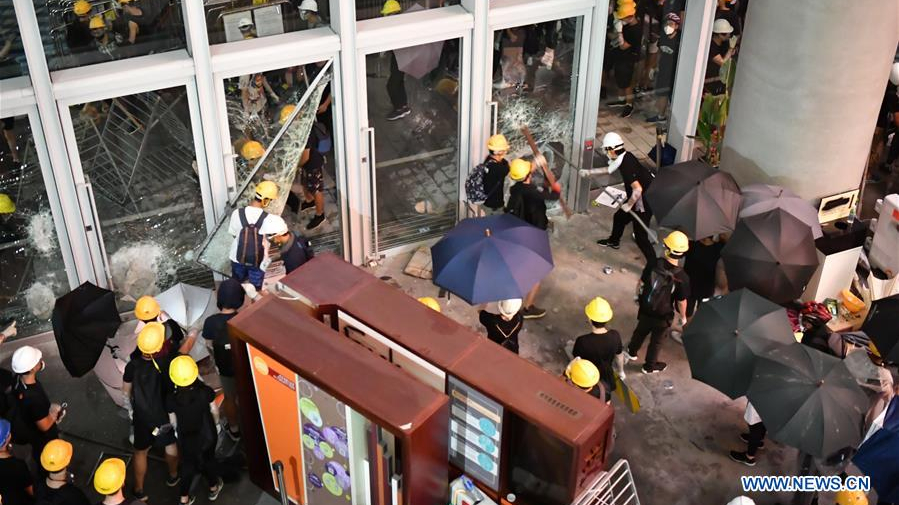
As the protests in Hong Kong enter their sixth month, one thing that stands out is the one-sided reporting by the Western media. News outlets such as CNN, BBC, Al Jazeera, The New York Times, The Washington Post and The Guardian have been openly partisan, singing praises of the protesters. They have been selective in their reporting and used language in a way that favors one side over the other.
The mayhem in the Hong Kong Special Administrative Region would definitely not be allowed in any other place; note the way the state acted against the Occupy Wall Street Movement protesters in the United States, and the yellow vests (gilets jaunes) in France.
Contrary to popular belief, the Western media is not free but beholden to and influenced by corporate advertising clients and interest groups, including the political and financial elite.
Western media use distorting filters
In their seminal 1988 work Manufacturing Consent: The Political Economy of the Mass Media, Noam Chomsky and Edward S. Herman have analyzed the role of the media as a propaganda tool for manufacturing public consent, and identified five editorially distorting filters applied to news reporting, one of which is "anti-communism".
Clinging to na?ve black-and-white notions of "democracy" versus "communism", some Hong Kong residents evince a shallow understanding of what they entail, even though many of those who left Hong Kong in the wake of its return to China in 1997 have since returned, sobered by unemployment, racial discrimination, rising crime and declining morals in the West.
Opinion polls conducted by Western organizations have consistently shown Chinese citizens have a high level of satisfaction with their government. Available since 2002, Pew surveys show Chinese citizens are much more satisfied with their government than American nationals are with the US administration.
Highly satisfied with country's direction
In a 2013 survey of 39 countries, 85 percent of the Chinese respondents said they were highly satisfied with the direction their country has taken, compared with 57 percent in Germany, 33 percent in Japan, 31 percent in the US, and 24 percent in the Republic of Korea. And in a 2017 poll of 28 countries and regions by Edelman Global Public Relations, Chinese people expressed the highest level of trust (76 percent) in their government whereas in several recent Gallup polls, Americans gave their president, Congress and executive branch a very low, "F" rating.
Still, the US and the United Kingdom continue to support the protesters, hailing them as "pro-democracy" activists. How can the protesters be democratic when they attack, even set on fire, those who do not share their views? Such behavior used to be called fascist.
The term "democratic" has become synonymous with freedom and justice, and any group that wears that label is assumed to be good and deserves support. But one only has to consider the atrocities committed by Western powers to realize that name and substance can be two very different things.
Any serious study of colonial history will disabuse readers of the notion of benevolent Western democracy. White colonizers acted with impunity against the native people in all the colonies, and had scant regard for human rights in the Americas, Indochina, Indonesia, Malacca, Africa and India. Consider the decimation of Native Americans by the British settlers or the brutal enslavement of the Arawak Indians by the Spaniards (documented by Dominican friar Bartolomé de las Casas).
Colonial powers' use of naked force
Using naked force, Western powers reduced China to a semi-colony in the mid-19th and early 20th centuries. According to a recent study published in the journal Geophysical Research Letters, the Bengal famine in India in 1943, which killed up to 3 million people, was not the result of drought but the consequence of Winston Churchill, then British prime minister, diverting food stocks from starving Indian civilians to well-supplied British soldiers and to build up European stockpiles.
Moreover, the CIA's role in fomenting unrest and toppling democratically elected governments around the world is not a well kept secret, and the list of injustices gets longer as fresh evidence emerges.
In the light of modern history, the Hong Kong Human Rights and Democracy Act passed by the US Congress recently calling for sanctions against Chinese mainland residents and Hong Kong officials whom Washington deems to have violated human rights in Hong Kong is the height of hypocrisy. Harvard historian Arthur Schlesinger affirms that for much of its history, the US has been a racist nation. Historically, whites have discriminated against Native Indians, blacks, Asians and Hispanics, and excluded them from mainstream US society.
US has a sense of cultural supremacy
In his 1944 study, Gunnar Myrdal, winner of the Nobel Prize for economics, said: "There is no doubt that the overwhelming majority of white Americans desire that there be as few" blacks as possible in America. If the blacks "could be eliminated from America or greatly decreased in numbers, this would meet the whites' approval."
Racism continues today and has found its way into US foreign policy. Former Singapore prime minister Lee Kuan Yew has said: "For America to be displaced, not in the world, but only in the western Pacific, by an Asian people long despised and dismissed with contempt as decadent, feeble, corrupt, and inept is emotionally very difficult to accept. The sense of cultural supremacy of the Americans will make this adjustment most difficult."
White supremacist sentiments fuel US angst about a rising China, and Hong Kong protesters serve as ready pawns in Washington's bid to contain China.
The writer is the author of US-China Relations in the 21st Century: A Question of Trust and China and Her Neighbors: Asian Politics and Diplomacy from Ancient History to the Present Day.
The views don't necessarily represent those of China Daily.