China can raise image with green investment







The 2015 Paris Agreement on climate change sets the target of limiting global temperature rise to less than 2 C above preindustrial levels, and strives to limit the temperature increase to 1.5 C.
To achieve the goal, global carbon dioxide emissions should be reduced by not less than 50 percent by 2050. Net zero emissions should be realized by then.
In November 2018, the European Union pledged to achieve net zero greenhouse gas emissions by 2050. Many developed countries also have set the target of reducing carbon emissions by at least 80 percent by 2050, in order to cap global warming below 2 C.
Given the sustainable development plan adopted by China, and the pressure from technological competition under the zero emission development model, the country will further slash carbon emissions.
It is against this background that we turn to study the reduction pathways for developing countries, particularly those in Asia, and proposed the"2 C Asia" initiative.
We have simulated the scenarios of energy use in some major Asian countries under the 2 C and 1.5 C targets-including their energy supply system, extra investment needed to switch to nonfossil energy, and fundraising-in a bid to achieve the emission target set in the Paris Agreement and the United Nations' Sustainable Development Goals.
This initiative is viable for several reasons.
First, energy use is the major contributor to global warming, and there is little room for nonenergy sectors to reduce emissions. To keep the temperature rise to below 2 C by the end of this century, the CO2 emissions should be cut by around 60 percent by 2050.
Second, G20 members account for more than 80 percent of global CO2 emissions. China, Japan, South Korea, India and Indonesia are responsible for over 85 percent of all emissions in Asia. So the cost is not high to significantly cut emissions in many developing countries.
Finally, China is pushing ahead with the Belt and Road Initiative, and actively developing economic cooperation with countries along the BRI routes.
Outbound investment in low-carbon and green sectors is a crucial way for China to work with other countries in environmental cooperation and enhance mutual trust.
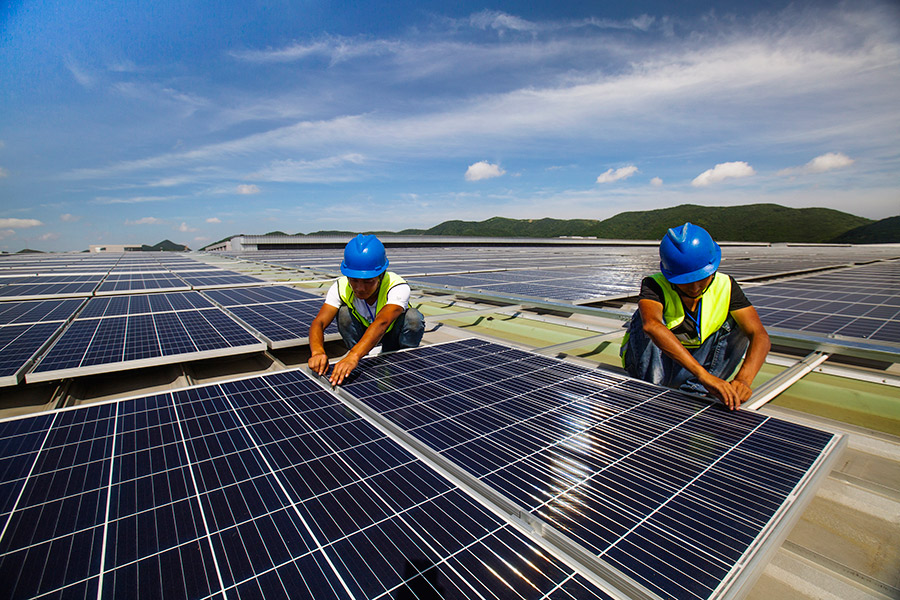
At present, China's international assistance on climate change is focused on building clean energy infrastructure, mainly hydropower, as well as solar, wind and geothermal power facilities.
According to the IPAC-Emission model-a global model developed for the study of greenhouse gas emission scenarios-to keep global warming at less than 2 C above pre-industrial levels by 2100, an investment of $1.6 trillion will be needed for developing a low-carbon power industry by 2050 and increasing renewable energy and nuclear power capacity.
China's outbound investment is expected to reach $300 billion by 2030, of which over $150 billion will be used for low-carbon infrastructure and industry.
This fund, which will have a significant influence on global low-carbon development, is much bigger than the $100 billion fund that developed countries have pledged to give the developing countries each year to fight climate change.
China has rich experience in developing alternative energy, leading the world in renewable energy technology as well as management and policymaking. Compared with the practices of developed countries, China's experience may be more suitable for the developing countries.
Low-carbon and green investment will also help China build its image as a responsible nation and create a better environment for foreign investment.