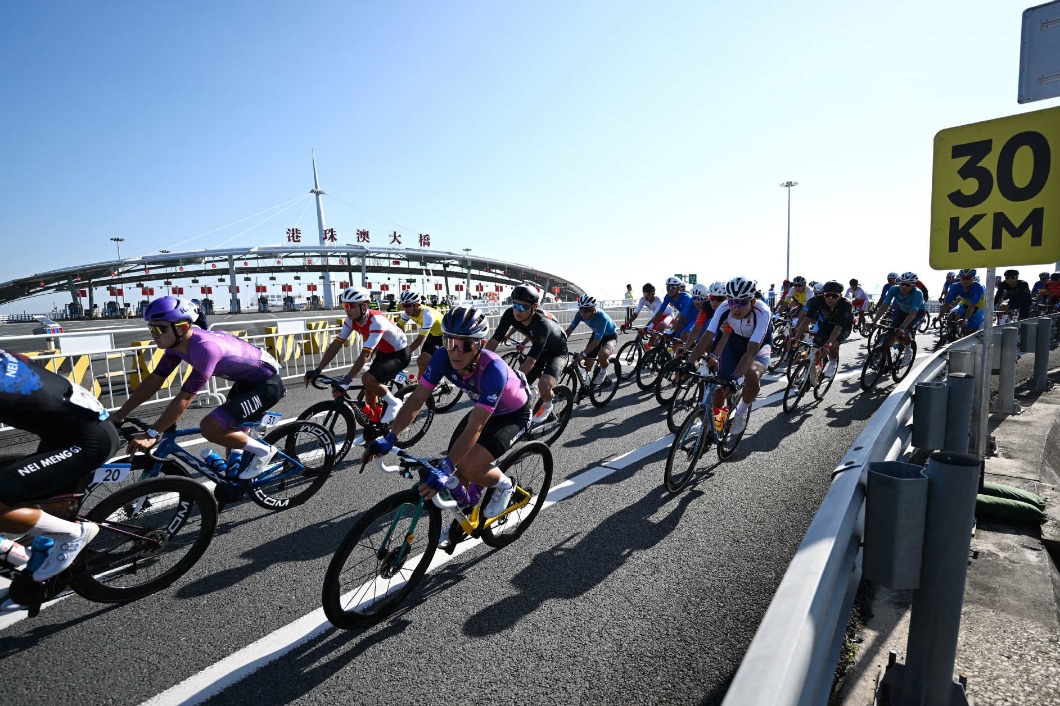
Hong Kong's residents hold the key to their future








A recent newspaper article said the passing of the National Security Law for Hong Kong means "the West has lost Hong Kong". Many media throughout the West have been tirelessly repeating for weeks that this law means the "death" of Hong Kong, in the same way that the handover was peddled in 1997 as "a death sentence for Hong Kong".
And yet here we are, with Hong Kong as prosperous and vibrant as ever.
Part of this problem stems from the misconception that Hong Kong is some sort of foreign concession. To those who hold this view, Hong Kong does not belong to China, even though China has undisputed sovereignty over it.
July 1 marked the 23rd anniversary of the handover-that is, of the return of Hong Kong to China. Note the word "return", because before the arrival of the British in 1841, Hong Kong was part of China. It should not be forgotten that Hong Kong, as well as other foreign concessions and colonies in China, was acquired through a series of unequal treaties that would be completely unacceptable under current international laws and modern democratic norms.
Why does the West forget now that Hong Kong Island was ceded to Britain in 1842 under the Treaty of Nanking to put an end to the First Opium War?
In 1839, the Qing Emperor instructed Lin Zexu, an incorruptible senior Chinese official, to end the opium trade with Britain. Lin ordered a large amount of opium seized and publicly destroyed and sent a letter to Queen Victoria about the problems caused by opium, saying: "We have heard that in your own country opium is prohibited with the utmost strictness and severity-this is a strong proof that you know full well how hurtful it is to mankind. Since then you do not permit it to injure your own country, you ought not to have the injurious drug transferred to another country."
Isn't this the same kind of hypocrisy that we are seeing now, when we see Britain offering millions of Hong Kong people residency rights and a path to citizenship, despite Britain not doing any democratic reform in almost 156 years of its colonial rule over Hong Kong?
In 2017, to mark the 20th anniversary of the handover, I conducted some research comparing the Hong Kong of 1997 with Hong Kong in 2017. Hong Kong was in better shape, from a socioeconomic perspective, in 2017 than in 1997.
So if people in Hong Kong had no real democracy under British rule, and if Hong Kong is in better shape in 2020 than it was in 1997, what has the street violence and political agitation been about? Not knowing what the new national security law will mean in practice may worry some people, but the fact remains that 99.9 percent of Hong Kong people will not be affected by this new law, since it targets only separatist activities, subversion of State power, terrorism and foreign/external interference.
Given the fact that an immense part of Hong Kong's society is pacific and reasonable, this law should not worry Hong Kong residents. What should worry them right now is how to make Hong Kong flourish again after a year of protests and riots, and after the COVID-19 pandemic's devastation.
People can take assurance from the fact that Hong Kong went through the Asian financial crisis, the SARS outbreak, the global financial crisis and the current pandemic without any significant outflow of capital. Hong Kong is resilient and self-confident.
Despite Hong Kong being part of China (and therefore neither an independent territory nor a foreign concession), Hong Kong's future depends entirely on the residents of Hong Kong. The city's residents can show Beijing that Hong Kong can be part of China while maintaining its special characteristics.
The Macao Special Administrative Region has chosen this path. For example, Macao will try to diversify its economy by creating a stock exchange and embracing both the Belt and Road Initiative and the Guangdong-Hong Kong-Macao Greater Bay Area project.
Hong Kong residents must grasp the city's future now by embracing the many opportunities that will further integrate its economy with that of the mainland.
The author, who has a doctorate in real estate law and economics, has worked as a business analyst for a Hong Kong publicly listed company.


- Exhibition commemorating the epic relocation of universities opens in Fujian
- Twelve punished for scaffold collapse that killed 7 in Shandong
- Slovenian official visits whole-process people's democracy practice site of CPPCC committees
- China's commercial rocket maker puts two satellites into orbit
- People in Taiwan commemorate victims of White Terror period
- China successfully launches new test satellites