Sino-Indian ties must get beyond 'rough edges'







The reality of the Sino-Indian relationship is sobering, despite projections of stability amid limited productivity, and the tenuousness of the ties hasn't been spared during the pandemic period.
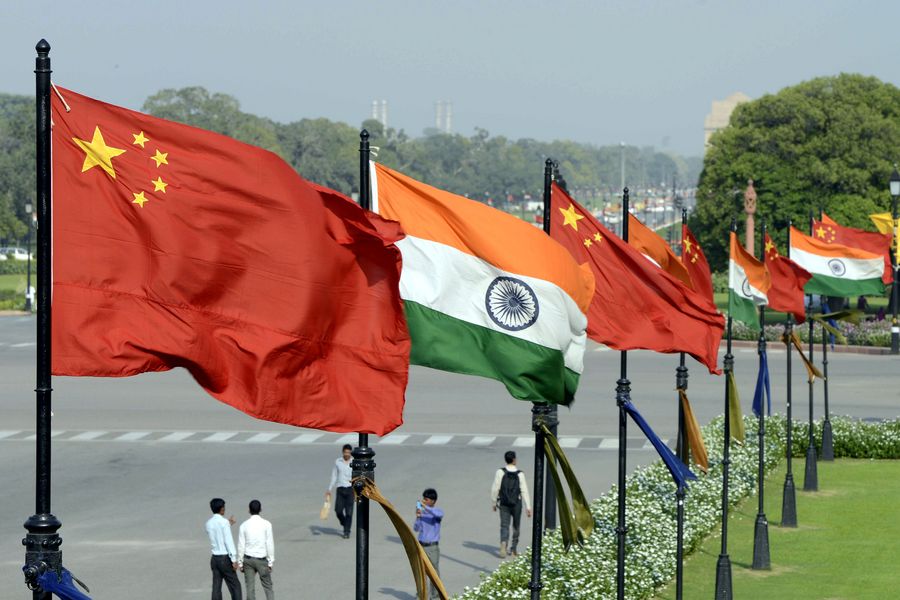
It is imperative to improve exchanges on bilateral and pluralized platforms to resurrect and sustain a mutually beneficial relationship.
India's strategic reappraisal of equations is suggestive of a trinity of trends pointing to a mutually costly long haul.
First, notwithstanding formal diplomatic and military negotiations aimed at defusing the prolonged military standoff, the inveterately preserved benignity of the border through peace and tranquility arrangements and confidence-building measures seems to be meeting denouement.
The institutionalizing hue of intensified militarized deployments along most parts of the border alignment, coupled with revised terms of engagement authority for troops in self-defense, is spurring a potential prospect of sporadic physical confrontation.
Second, a significant thinning of economic interaction and interchange is unfolding, with New Delhi's pincer actions of instituting stringent executive scrutiny of cross-border corporate investments, proscribing Chinese apps and tech platforms, and tweaking of domestic regulations to automatically circumscribe exposure of critical sectors of the economy, in the extractive, industrial manufacturing, and civilian infrastructure spaces, to potential Chinese suitors.
Third, New Delhi seems ready and willing to shed its enduring hedge of the dichotomous Chinese "opportunity" vis-a-vis "threat" syndrome. It is moving to decisively cast its lot in favor of participative crafting of bulwarking and competitive coalitions, to normatively and operationally impugn the Chinese footprint across the oceanic continuum.
The aforesaid three dimensions, bedeviling Sino-Indian engagement, appear aimed at raising the costs on Chinese actions, with a view to extracting policy course correction, and as India's External Affairs Minister Subrahmanyam Jaishankar put it, to strategically "occupy a greater mind-space of China".
The task seems onerously cut out for interlocutors to resurrect the relationship on the issues of the vexatious border, canvass of trade and investment, and broader landscape of working concord in each other's strategic intentions.
For all the 21st century spin of creating multiple tracks and layers of mechanisms for fruitful dialogue toward productive engagement, the fact remains that Sino-Indian dialogue and sovereign interchange, given its intricateness, sensitivity, and high stakes, is overwhelmingly centralized within governmental structures at either end, anchored within the national security deep state, and driven by the foreign office establishment.
The inception of the informal summits format in 2018 was meant to be an alternative to the structured processes at negotiation that had run their course, as well as an exploratory exercise for the strong personality leaders on both sides, to develop a chemistry that could possibly break the mold on the stagnating trajectory of the relationship.
Sino-Indian conversations since then have distilled down to two marquee tracks of strategic communication: the Special Representatives dialogue process, which also embeds within it the larger security dialogue, and the Foreign Ministers' Strategic Dialogue mechanism.
As the border issues are being fairly addressed, the template of what ought to have been mutually beneficial economic ties between two Asian economic giants has instead been a storied anomaly of lopsided commercial interchange and breeding of aggravating structural dependencies, not always conforming to India's national development imperatives.
Any picking up of the gauntlet on trade and investment would require genuine redressing of the trade imbalance and reciprocal market access for India, failing which, New Delhi sees the process as non sequitur in the India growth story.
On the larger question of decoding mutual strategic intentions and increasing trust, especially at the highest level, the imperative for principals to reinitiate purposeful conversations on minimizing divergences is ostensible.
At a time of bilateral griping, it is the common partake in pluralized forums that could proffer the latitude for pivoting the relationship back on course.
With India and China chairing BRICS-an association of the five major emerging national economies of Brazil, Russia, India, China and South Africa-in the successive years 2021 and 2022, and India helming the G20 in 2022, its multilateral settings coalesce around realms of global commons that need to be harnessed.
Some whiffs of encouragement exist on the horizon, with Indian participation within the multilateral Asian Infrastructure Investment Bank having not suffered amid the bilateral aggravations, and with reports of increased lending approval for Indian infrastructure needs. Indeed the two should move forward beyond "rough edges" or "razor's edge" relations.
It is imperative for both countries to build on these green shoots, as the virtues of pragmatism and coexistence must override portents of the relationship descending into a structurally adversarial framework, in perpetuity.
The author is assistant professor of international relations and strategic studies at the School of International and Area Studies, Goa University, Goa, India. The views do not necessarily reflect those of China Daily.