Xinjiang benefits from dean's textile training project







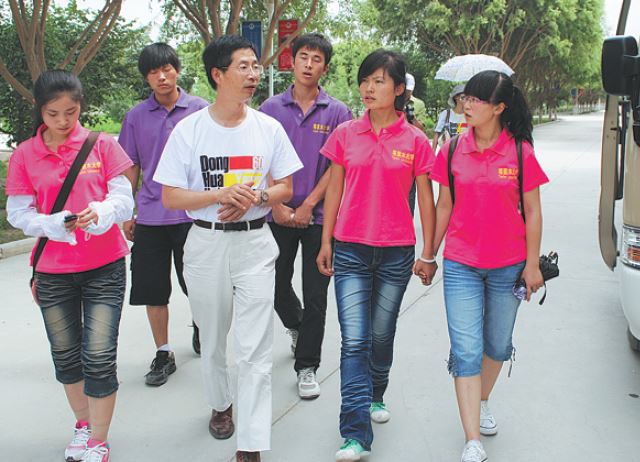
As the dean of the textiles and clothing school at Quanzhou Normal University in Fujian province, Qiu Yiping always has a full work schedule.
But regardless of how busy he is, the 65-year-old finds time every July for an annual trip to the Xinjiang Uygur autonomous region to do volunteer teaching.
Since 2011, when he was dean of the textile college at Donghua University in Shanghai, Qiu has been leading volunteers to assist in the development of the textile industry in the autonomous region.
Qui and his team teach local cotton growers and factory workers both theoretical and practical skills and introduce them to new technology to improve production efficiency. The volunteers also conduct industrial research while they are there.
One of the team's recent accomplishments was the introduction of eco-friendly dyeing technology to Alar city in Aksu prefecture. Qiu said the technology has helped address the problem of a shortage of water for cotton dyeing.
"Xinjiang is one of the driest areas in the country. Water in the region is mostly used for agriculture, meaning there is little left for cotton dyeing," he said.
Qiu said about 140 kilograms of salt are generated and discharged along with wastewater when dyeing a metric ton of fabrics the traditional way.
"In contrast, this new dyeing technique uses almost no water and does not produce any salt. It also results in a 20 percent reduction in dyeing costs. Using such technology will accelerate the development of the industry and in turn improve local employment," he said.
According to Qiu, around 700 teachers and students from more than 10 universities and colleges have participated in the volunteer teaching program over the past decade.
Qiu said the volunteer program has helped nurture talented people and provide them with practical skills, which is beneficial to society and the economy and the construction of Xinjiang's textile industry.
As one of the first batch of students to receive a higher education in 1977, when China resumed the national college entrance exam, or gaokao, Qiu has devoted the past 42 years to the study of textiles.
He first studied at the Zhejiang Sci-Tech University in Zhejiang province, where he worked as a teaching assistant after graduating in 1982.
Qiu then studied extensively in the United States, gaining a master's degree at Auburn University and a doctoral degree at Cornell University, before completing his postdoctoral research in mechanical engineering at the Massachusetts Institute of Technology.
After working as an assistant professor at North Carolina State University for seven years, he returned to China in 2003 with the aim of helping the development of the country's textile industry.
"After polishing my professional skills and independent-thinking ability abroad, I was eager to dedicate my life, knowledge and experience toward the development of China's textile industry," he said.
During his tenure at Donghua University, Qiu came up with the idea of setting up a volunteer team after the university assisted with the introduction of a textile engineering and clothing major at Xinjiang Tarim University.
"I wanted to go to Xinjiang to help with the students' practical skills and contribute to local development. It was meant to be a one-off thing. I'm surprised that this has since become an annual event," he said.
Although the volunteer event was canceled due to the COVID-19 pandemic this year, Qiu said he will still travel to Xinjiang this month to follow up on the progress of the project.




- Senior Xi'an official facing probe by China's anti-corruption watchdogs
- Philippines risks creating trouble for itself: China's defense ministry
- Newborn with congenital heart disease receives life-saving surgery in Yunnan
- Hong Kong charity signs diplomatic talent deal with Beijing university
- Aircraft carrier Fujian, commissioned
- Erdos offers 10,000 yuan subsidy for families having third child