China shows how to stop the virus and keep the economy running








Again, a Chinese city shows the way to bring COVID-19 under control, and as fast as possible.
The coastal city of Qingdao in Shandong province, East China, has successfully stopped the spread of the virus in about a week after 12 locally transmitted cases were confirmed, the first transmissions in the country in months.
Authorities have responded by initiating a mass testing regime which covered the entire population of about 10 million people. The city’s Chest Hospital has been placed on a strict lockdown, with 114,000 associated workers and patients in the area having already been tested.
As Qingdao’s mass testing regime got underway, European cities and the West at large were succumbing to second waves of the virus. Countries such as the United Kingdom, France and Germany were forced to adopt tougher restrictions after registering record number of positive cases every day. Meanwhile, the United States has also still not come to grips with the initial wave of the virus, counting up to roughly 50,000 cases daily.
Despite the fact that public opinion in Western countries continues to repeat political smearing to scapegoat China for their COVID-19 woes, in reality the situations in the two areas could not be further apart and the developments in Qingdao are another testament to that.
China’s mass coordinated testing and targeted containment model, as shown with recent outbreaks in Beijing, Dalian and Urumqi, has proved continually successful in quashing a return of the virus, which has allowed life to continue as normal. This contrasts sharply to the “rapid relaxation” of the West which failed to take sufficient precautions.
What is the “targeted containment model” of the virus being utilized in Qingdao?
Ever since the initial COVID-19 wave was overcome in China, the government’s strategy to any new outbreaks has involved firstly a universal testing regime in the affected area, and then secondly targeted mini-lockdowns in the contaminated area.
For example, when Beijing suffered an outbreak in the Xinfandi Market, the reaction of the authorities was to first lock down the neighbourhoods impacted, suspend transport links to them and then conduct a universal testing regime of not just those in contact with the cases, but extending to everyone. Life in Beijing returned soon to normal.
The United Kingdom’s approach to the virus might be described as the opposite of this, which has been termed as “rapid relaxation”. Once the initial wave ended the government did not take precautions, but instead placed priorities on the rapid reopening of businesses and establishment of tourism, such as the infamous “everyone eat out campaign” which ended in disaster.
In contrast to China, their attitude to new outbreaks was to use restrictions only as a last resort, than as a preventative targeted measure, and even that they has been reluctant to do so. It anticipated that the new environment could be sustained by people simply following the rules, this was a non-starter.
As a result, open borders, tourism and rapid socialization with little adherence to regulations inevitably brought the virus back and the British government refused to do anything about it until it was too late.
In China, a handful of cases in Qindao were enough for punitive action to be taken, with two leading health officials of the city removed. In Britain the government refused to do anything until cases started reaching April’s numbers, which by then was already too late. It is the obsession with the economy which is driving the reluctance to act.
However, acting against the COVID-19 and saving the economy is not a zero-sum choice of one or the other. This is what Western governments get wrong.
China’s targeted and instantaneous micro-lockdowns and universal testing response are pre-emptive measures which contain the virus early and therefore bigger measures, which prove damaging to the economy, are not needed.
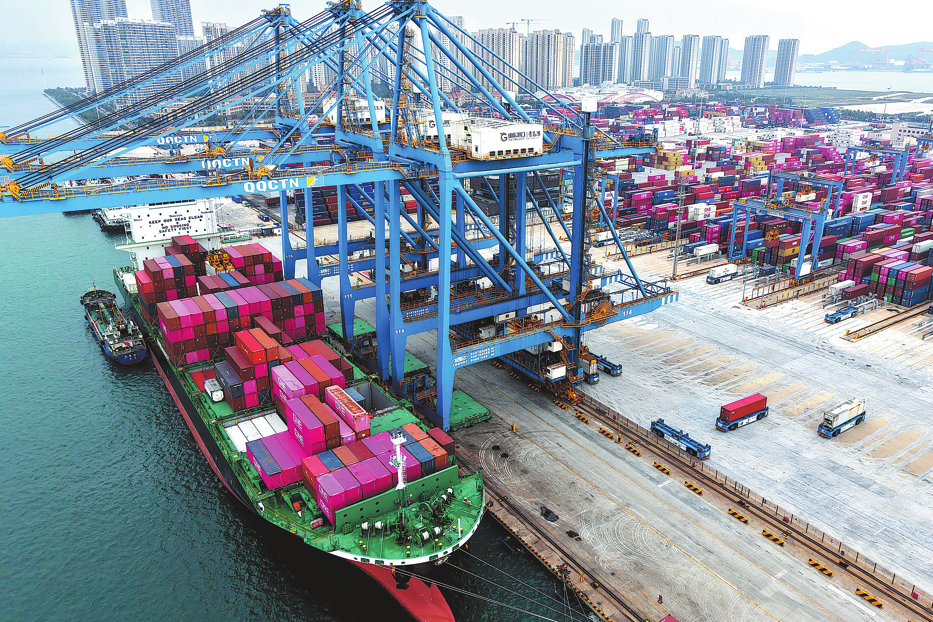
Saving the economy does not mean the virus has to run rampant, and 600 million journeys during China’s Golden Week, scenes of a packed Great Wall and a growing economy ultimately prove this.
Prosperity hinges upon fast action. The country is actively and swiftly preventing a “second wave” while the Western world falters.
Thus rather than pointing fingers at China, they should observe what is being done at Qingdao. Universal testing regimes for everyone and micro-lockdowns in affected areas are successful methods of combating the virus without resorting to widespread economic damage.
The author is a British political and international relations analyst.
The views do not necessarily reflect those of China Daily.