Torchbearer for climate governance







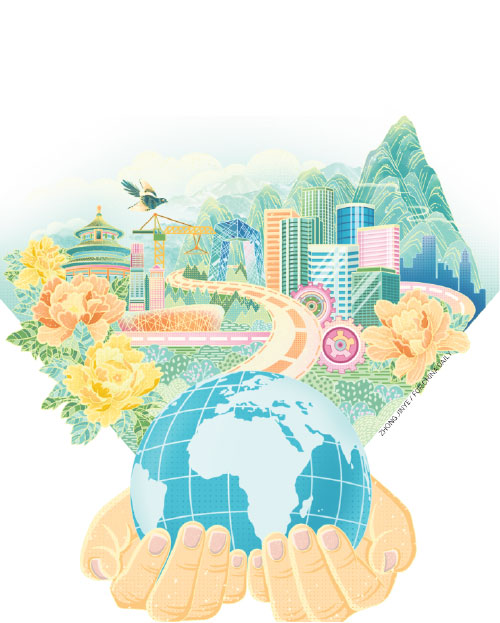
'Beautiful China' goals should maintain domestic focus on green growth but also promote the building of a global ecological civilization
The incorporation of ecological protection into China's goal of building a moderately prosperous society in all respects has been the major driver of the country's efforts to realize our ecological civilization since the 18th National Congress of the Communist Party of China in 2012. As the country is set to realize the goal of building a moderately prosperous society in all respects in 2020, achieving the "Beautiful China "goals by 2035 will become the next priority task. Different from the goal of building a moderately prosperous society, the Beautiful China 2035 goals need to be developed from a perspective of global ecological civilization.
Facing the threat of climate change, a well-functioning global environmental governance system is needed by 2035 to ensure a smooth transition from the Paris Agreement's 2030 goals to its 2050 long-term low-emission development goals.
Under the Paris Agreement countries are expected to submit their Nationally Determined Contributions outlining their commitments to reduce greenhouse gas emissions and strengthen resilience to climate change by 2030.While countries that have signed the agreement are stepping up efforts to hold true to their NDCs, action plans with even greater commitments by 2035 have already been unveiled.
The European Union plans more ambitious 2035 climate targets under the framework of the European Green Deal. A number of European countries have also unveiled action plans with goals to be achieved by 2035. For instance, Germany was inclined to bring forward its deadline to fully phase out the use of coal from 2038 to 2035; the United Kingdom plans to end the sale of new diesel and gasoline cars by 2035 and Finland has vowed to become carbon neutral by 2035 and carbon negative soon after that.
China is expected to be the world's largest economy by 2035, with even greater economic power and therefore a bigger responsibility in global environmental governance. China's pursuit of an ecological civilization is not just important for its own sustainable development, it will also exert an impact on the progress of sustainable development worldwide. Since its ecological civilization cannot be separated from the rest of the world, China needs to work more closely with countries, regions and organizations to address the grave environmental and climate challenges facing the whole of humanity.
On Sept 22, President Xi Jinping stated in his speech at the general debate of the 75th session of the United Nations General Assembly that China aims to "achieve carbon neutrality by 2060". As the world's largest developing country, this commitment reflects China's international responsibility to address climate change and also China's unwavering determination to follow the path of green and low-carbon development. However, how to achieve this goal? That is a question needed to be considered by China and it also attracts global attention.
The goal of 2035, which connects the CO2 emissions peak and carbon neutrality, will determine to what extent the speed and path of China's greenhouse gas control in the future. By 2030, China needs to fulfill two major climate commitments-bringing national carbon emissions to a peak, as stated in the Paris Agreement, and the UN Sustainable Development Goals. The 2035"Beautiful China" goals will exert a great impact on their implementation path and progress. The "Beautiful China "goals will also decide which path the country can take to fulfill its carbon neutral pledge. After the peak of CO2 emissions, how China will align its domestic goal of a "Beautiful China "with its international commitment of carbon neutrality, and how to position itself to play a leading role in the international climate governance system. The goal-setting of 2035"Beautiful China" will give an answer.
China has made notable progress in ecological and environmental protection, making concerted efforts to realize an ecological civilization. From the development concept of "Lucid waters and lush mountains are invaluable assets" to the idea of building a shared future for all life on Earth with a holistic approach to conserving the mountains, rivers, forests, farmlands, lakes and grasslands, China's vision of an ecological civilization has shifted from being merely an abstract concept to practical actions to realize it.
Indeed, the construction of China's ecological civilization for 2035 should be planned from the perspective of strengthening global endeavors to form an ecological civilization for humanity, with broadened scope and integrated solutions for both domestic and global environmental issues.
Domestically, the 2035 "Beautiful China" environmental protection goals should be set to match China's social and economic development goals. The quality of the ecological environment should be substantially improved with stricter environmental standards from the perspective of safeguarding health.
Internationally, China should have sustainable development goals and emissions control targets matched with China's development level. China should ensure a smooth transition from the 2030 climate goals to the 2050 and sustainable development goals and become a torchbearer for global climate governance.
The key to formulating the "Beautiful China" goals lies in upholding the concept of green development and maintaining a strategic focus of green growth in the face of the complex international political landscape. China needs to use the concept of "Lucid waters and lush mountains are invaluable assets" to guide its climate actions, turn the "burden" of emissions reduction into a precious opportunity to enhance its competitiveness in green development and make climate actions benefit sharing rather than cost sharing as before. These will ensure that China formulates ambitious 2035"Beautiful China" goals.
The COVID-19 pandemic and rise of anti-globalization sentiment have brought about great uncertainties to the construction of a global ecological civilization, but also created opportunities. We are currently seeing a rapid acceleration in the development pace of 5G communications technology and other digital technology and their application, which has quickened the process of digitalization of the Chinese economy and provided new momentum for the green and low-carbon transformation of energy and manufacturing sectors. Since May, China has introduced a dual-circulation development pattern, in which the domestic market takes a dominant role while the domestic and global markets boost each other. Beefing up investment on green infrastructure, adjusting the global industrial chain and promoting green consumption domestically when fighting against the pandemic and restoring economic growth will help China lay a solid foundation to formulate and achieve more ambitious "Beautiful China" goals.
The author is the chief representative for the Beijing office and vice-president at the Environmental Defense Fund. The author contributed this article to China Watch, a think tank powered by China Daily. The views do not necessarily reflect those of China Daily.