


Apportioning nostalgia








Acclaimed novel delves into China's not-too-distant past to tell the stories of ordinary people at an extraordinary period in the nation's development.
The role of gongxiaoshe, or China's rural-area supply and marketing cooperative, as the outlet for people to exchange corresponding ration coupons for goods in the planned economy era has long since faded into people's memory.
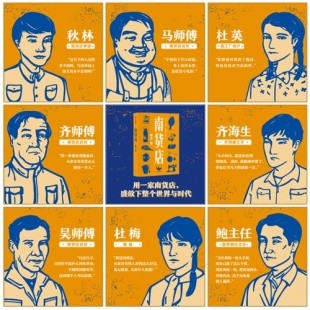
However, the novel, Nanhuodian, (roughly translated as "the shop that sells goods produced in the South"), published this year, has re-created the lively scenes found at gongxiaoshe outlets in a dramatic, and somewhat fictionalized, account of this oft-forgotten period.
From the early 1950s to the late 1980s, or roughly the period known as the planned economy era, when manufacturing and distribution of products were decided purely by government, the public's ability to purchase goods was based mainly on a variety of ration coupons, limited in quantity and issued by authorities for rice, flour, oil, seafood, clothes and soap, among other things. Back then, gongxiaoshe was the place that people were able to make these exchanges and it played an essential role in everyone's daily lives.
The novel tells the stories of different people from the perspective of its protagonist, Lu Qiulin, who works his way up from being an apprentice at a village shop to become the manager of a county-level specialty company within the rural cooperative system of gongxiaoshe between the 1970s and the 1990s.
On Dec 10, the book was listed by the country's National Press and Publication Administration as one of the 15 outstanding realistic publications of the year.
What motivated the author Zhang Ji, 40, to write the book was his curiosity about his grandfather's life.
In 2016, at his grandfather's funeral, Zhang's father told him some stories about the departed that he'd never heard before. Zhang realized that he didn't know much about the lives of people who he is closely related to.
"That's when I decided to write the novel, to probe into the experiences of the previous generations of my family," recalls Zhang.
"Many young people today are not familiar with gongxiaoshe, which was an important aspect of China's planned economy era, and therefore the life of the last generation," says Zhang, adding that stories related to the system provide a glimpse into the China of yesteryear.
To gather raw materials for the novel, he talked with his father who was once a salesman at such a cooperative outlet, and interviewed many elderly people to learn more about the operation of the gongxiaoshe system and the working practices of its staff members.
For instance, when selling liquor, the salesclerk should softly dip the ladle into the jar at a low angle, rather than drop it straight into the liquid, as the latter might stir the wine, agitating the lees and other deposits at the bottom of the jar, which the customers wouldn't like.
In Zhang's book, he gives a detailed description of how a salesman skillfully calculated items with an abacus he held aloft by resting it on the top of his head. He also writes comprehensively about the speed at which those working at the outlet rolled or cut cloth to be sold and folded wrapping paper into the different shapes required to pack white sugar, red dates, dried longan and other loose ingredients.