


Apportioning nostalgia








As an apprentice in the book, the character Lu is told by an experienced businessman of a superstition whereby when sweeping the floor, one should hold the broom toward inside of the shop, which would bring good fortune.
The way people arranged their lives and work, and the local customs in the Jiangnan area-south of the lower reaches of the Yangtze River-have been given a vivid account in Zhang's book, which is written in the local dialect of Ningbo, Zhejiang province.
Additionally, much ink is employed in the novel's descriptions of local food and its preparation, such as how to salt fish with pure sodium chloride, how to cook pork with pickled vegetables and how to stew an appetizing seafood casserole.
Zhang says that people who lived in the 1970s would care a great deal about the number, texture and quality of certain goods, when food and other commodities were scarce and hard-earned. For example, instead of buying a pack of cigarettes, smokers would have to buy one cigarette or a handful at a time; when they bought sugar, they'd have to have it weighed on the spot and wrapped with paper.
"In those days, the amity between people was carried by food," says Zhang, adding that people felt a deeper bond with the precious food that was available to them, arguably cherishing it more than people do today, and would often love to cook for friends at home, instead of dining in restaurants.
Personally, the author loves "descriptions of eating food", in literature. "I believe the changes of time are hidden behind the trifling details of people's everyday lives, such as food," Zhang adds.
Separately, the novel, with a plot and stories spanning some two decades, also shows how ordinary people fared during the changes brought about by the launch of China's reform and opening-up in 1978.
"Not all of them could cope with the changes effortlessly; many were at a loss as to what to do back then," says Zhang.
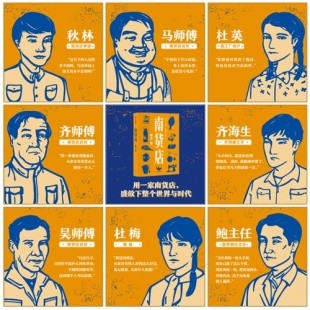
In the novel, a woman named Du Mei is a tailor who does fine work and is popular with her customers in the town. However, with the surge of clothing manufacturers in the 1990s, the influence of tailors gradually diminishes and Du is left feeling lost and confused.
The author holds that the woman's confusion was probably shared by many people at that time. "To some extent, I want to write the biographies of ordinary people," Zhang adds. "In the novel, each individual character has a story worth telling."
Lin Peiyuan, a friend of Zhang and a fellow author, comments that the novel provides a strong flavor of town life back then and offers an air of nostalgia that will take readers back to bittersweet days of the 1970s and 1980s.
"When reading the book, people will find that Zhang has carried on the tradition of such classical Chinese novels as Wu Jingzi's The Scholars and Cao Xueqin's A Dream of Red Mansions," says Lin.
In Zhang's novel, the story of each staff member in the shop-and even each of their family members-is told, weaving a web of tales that creates a wider picture of society at that time.
"The novel introduces the origins of each character and deals well with the multifarious connections that link them all," Lin says.