New opportunities for world in higher-level opening-up







Editor's Note: Starting March 1, China Daily will invite scholars and experts to take part in a weekly "China and the World Roundtable" to discuss important issues concerning China's development and its impact on the world. In the first of the series, experts share their views on the challenges and opportunities arising from China's new economic development paradigm.
There are some misunderstandings about China's "dual circulation" development paradigm.
Dual circulation? Why? Circulation with what? And how? To answer these questions, it is important to understand the three dimensions.
The first dimension comprises reform and opening-up which China launched in the late 1970s. In 1987, the reform and opening-up policy was elevated to an international circulation development strategy. It yielded good results, but also gave rise to certain problems.
Since the 2008 global financial crisis, China's economic reliance on exports and external demand has been declining, with the ratio of the current account surplus to GDP dropping from 10.1 percent in 2007 to about 1 percent in 2019. So it is now necessary to change the "market for technology" (by means of introduction, digestion and absorption) to a "market cultivating technology" (strengthening industrial chains by encouraging domestic industries to "go abroad" through infrastructure projects) to boost the domestic market and promote innovation.
The second dimension is the rise of a great power. Dual circulation reflects the objective law of development and growth of major economies. The rise of a major power cannot depend on external markets. For example, 87 percent of the US' economic growth is driven by domestic demand. As such, China should depend more on the domestic market and less on the external market for sustainable development.
As President Xi Jinping said, China is heading into a high-quality development phase. And with China's per capita GDP crossing $10,000, the urbanization rate exceeding 60 percent and the middle-income group being 400-million strong, the country's main social contradiction now is between the people's growing need for a better life and unbalanced and inadequate development.
But despite enjoying many institutional advantages in governance efficiency, growth potential, human resources and domestic market, China still needs to address the problems of unbalanced development, unstable agricultural foundation, a large urban-rural development and income gap, and environmental pollution.
The third dimension is globalization. Evolution theory emphasizes that those who better adapt to the changes have a better chance of survival.
Globalization no longer enjoys a favorable tailwind, instead it faces strong headwinds. So the economies that have better adapted to the changes have a higher chance of flourishing in the new economic era. And since China has a complete industrial chain and a massive domestic consumer base, and adapted well to the changing economic situations, it will become a world market, a shared market and an energized market.
Coming back to "dual circulation", it is centered on the domestic economy (or "internal circulation") and aimed at integrating the domestic economy with the global economy (or "external circulation") to develop new advantages for China in global cooperation and competition, and promote global growth.
In the aftermath of the global financial crisis, many economies started shifting from globalization to "localization" or "regionalization". So the Chinese economy first needs to circulate with the neighboring economies of Japan, the Republic of Korea, and the 10-member Association of Southeast Asian Nations. ASEAN, which has become China's largest trade partner, and the Eurasian continent-European Union countries and those along the Belt and Road-are now pivotal to dual circulation.
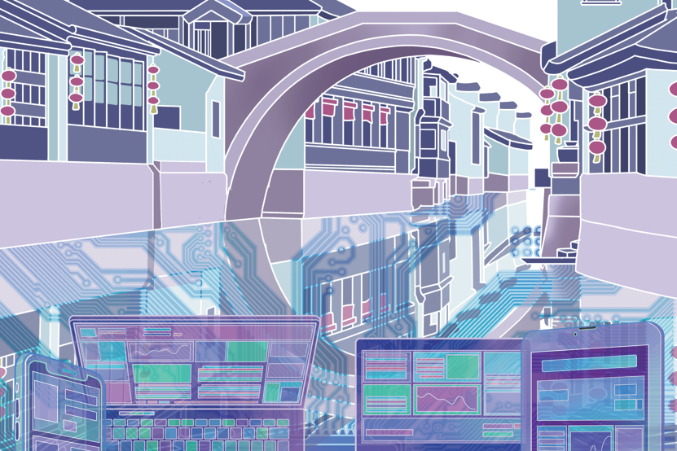
What to circulate? Originally, it was mainly about circulation of goods. But now it is more about services, particularly e-commerce. So coordinated regional development, construction of smart city clusters and synergized industrial development along the Belt and Road can all be influential drivers of dual circulation.
As Xi said, dual circulation is by no means a closed domestic circulation, rather it's a more open two-way circulation. It will not only serve China's needs but also benefit people in other countries, and create new opportunities for cooperation with China's economic partners.
In this regard, China and the EU could be natural partners in the digital economy, green industry and service trade. China has nearly 1 billion internet users, and the EU enjoys certain advantages in setting standards. So the two sides can team up in areas such as e-commerce, digital trade and global data security.
Also, China and the EU are leading the world toward carbon neutrality. China has pledged its carbon emissions will peak before 2030 and it will achieve carbon neutrality before 2060, while the EU has vowed to realize carbon neutrality by 2050. So there is every reason for China and the EU to work together and help other economies reduce emissions and follow the green development path.
Also, the fact that China and the EU have concluded negotiations on the Comprehensive Agreement on Investment will help China establish high-quality cooperation with other economies. According to the "Report on China's Services Import (2020)" released by the Ministry of Commerce at the Third China International Imports Expo, China's cumulative service imports are expected to reach $2.5 trillion in the next five years, accounting for more than 10 percent of the global share. And since Europe has a developed service industry, there is huge potential for Sino-EU cooperation in the service sector.
In short, China is entering a new development stage in which it will change itself and expand and improve cooperation with the world, in order to create new, bigger opportunities for all.
Courtesy: chinausfocus.com
The views don't necessarily represent those of China Daily.
Wang Yiwei is Jean Monnet chair professor at Renmin University of China.
If you have a specific expertise and would like to contribute to China Daily, please contact us at opinion@chinadaily.com.cn, and comment@chinadaily.com.cn.