Political system free of West's partisan politics







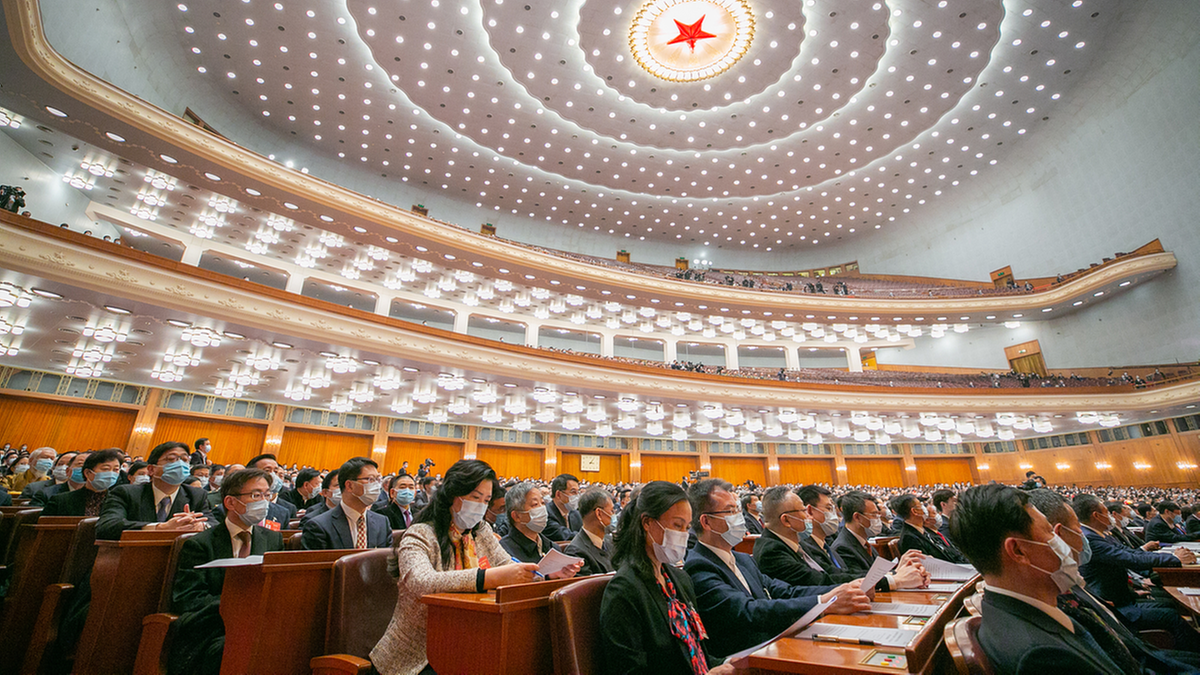
Editor's Note: Every year during the two sessions, some Western media outlets describe the National People's Congress and the National Committee of the Chinese People's Political Consultative Conference as "rubber stamps". Three scholars with the Party School of the CPC Central Committee explain how such labels expose the bias of the Western media and why socialist democracy with Chinese characteristics is best suited to the country.
The vast majority of the countries in the world have either a two-party or a multi-party political system with partisan competition or rivalry at its core. The competitive political system has its historical basis and cultural tradition, but we should not reject other political systems that have benefited human society. The competitive party system is followed widely.
Many Western scholars have highlighted the problems with the competitive political party system. For example, to oppose for the sake of opposing is the "Achilles' heel" of the competitive party system in many Western countries.
In sharp contrast, China's cooperative political party system, which focuses on "full cooperation" instead of "vicious competition", can be called a "new political system"-a system of multi-party cooperation and political consultation under the leadership of the Communist Party of China. This political system was developed gradually based on the real conditions during the course of the country's development.
The CPC's leadership was established during China's long struggle to achieve national independence and end semi-colonialism and semi-feudalism.
During the process of rebuilding the country after the founding of New China in 1949, non-Communist parties recognized the CPC's outstanding contribution to the country and its people, voluntarily accepted its leadership and political program, and agreed to work with it to realize the great rejuvenation of the Chinese nation. China's political system, in fact, suits its national conditions, as it can unite all political parties under the CPC's leadership and make them work together, rather than opposing each other, for the benefit of the country and the people.
Under the principle of "long-term coexistence, mutual supervision, sincere treatment, and sharing weal and woe", China's political system represents and realizes the fundamental interests of all ethnic groups in China. It can unite all non-Communist parties, as well as individuals without any party affiliation to work for the common good. It can pool diverse opinions and suggestions to promote scientific and democratic decision-making and prevent social divisions.
The basic functions of non-Communist parties in China are to participate in the deliberation and administration of State affairs, and supervise and participate in political consultations led by the CPC on a wide range of issues. Over the past more than 70 years, non-Communist parties have provided constructive and positive suggestions on many important issues, such as Constitutional revision, public governance, people's livelihoods, environmental protection, healthcare system reform, financial system reform, and relations with other countries, which have boosted China's economic and social development.
The non-Communist parties' participation in State affairs ranges from the legislature and administration to the judiciary and other State organs, and is supported and guaranteed by China's Constitution. Compared with opposition parties in Western countries that follow the two-party system or multiparty system in which small parties have little say in coalition governments, the participation of non-Communist parties in the State affairs in China is far deeper and more extensive.
Conducting research on "significant issues" and providing positive suggestions for the CPC is an important way non-Communist parties participate in State affairs in China, and non-Communist parties that have professionals and experts as members can better understand the real situation in the social, political, economic and cultural fields, identify the problems and suggest ways to solve them.
Since the 1990s, with the CPC's support, the central committees of the non-Communist parties, the All-China Federation of Industry and Commerce, and individuals without party affiliation have studied major issues, and put forward many constructive suggestions on development issues of strategic importance, such as the development of the Pudong New Area, and the development strategy for the country's western region and the Qinghai-Tibet Railway. The non-Communist parties' proposals are often submitted directly to the CPC Central Committee and the State Council and, if found feasible and constructive, are used by the Party and the government in decision-making.
Mutual supervision is a necessary component of China's political system. But the purpose of such mutual supervision is not to "drive one (party) out of power and bring another to power", but to help the CPC to improve its work. Different from the supervision of political parties in a two-party or multiparty system, the nature of China's democratic supervision is supportive, although it includes criticisms and diverse opinions. No wonder the unity and cooperation between the CPC, the non-Communist parties and individuals without party affiliation have become stronger.
Democracy is not for political decoration, but to solve the problems facing a country and its people. And socialist democracy with Chinese characteristics enables the CPC, the non-Communist parties and individuals without party affiliation to think and work together to do exactly that: solve the problems facing the country and the Chinese people, and achieve their goals as scheduled.
The author is a professor of Politics and Law, Party School of the CPC Central Committee. The views don't necessarily reflect those of China Daily.
If you have a specific expertise and would like to contribute to China Daily, please contact us at opinion@chinadaily.com.cn, and comment@chinadaily.com.cn.