A successful journey







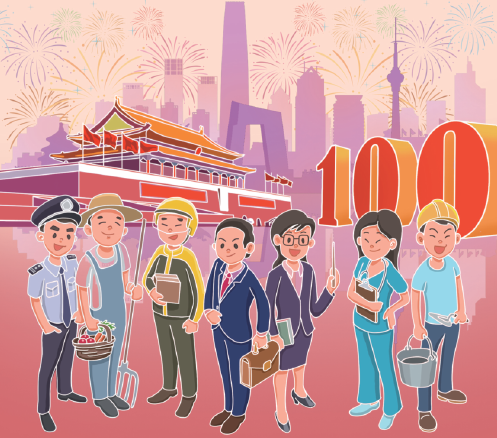
100th anniversary of Communist Party of China offers wealth of experience for developing countries to reflect on
This year marks the centenary of the founding of the Communist Party of China. The country has undergone profound political, ideological, philosophical and economic changes over the past 100 years.
Regarding economic development, there are three periods that are particularly notable. The first period starts from the foundation of the People's Republic of China in 1949, which stands out for the construction of China's industrial base, with the emphasis on the extraction of coal and the creation of industries such as steel and materials, construction, heavy engineering, chemistry, power generation, among other things.
The second period is the structural reforms starting from the late 1970s when the country introduced special economic zones, attracted foreign investment, developed foreign trade and generated great employment.
Since 2013, the country has embraced a new era that stands out for the pursuit of systemic development based on a modern governance model for China. This model is composed of themes, objectives and actions. Its basic premises are "focus on the well-being" of the Chinese people and realizing the Chinese Dream of national rejuvenation. In other words, it aims to eradicate poverty, reduce social inequalities and create better living conditions for all Chinese people.
Although this model is not formally known, the consistency and effectiveness of its objectives and actions have been verified.
The pillars of current Chinese governance are national sovereignty, reforms, education and culture, economy and the environment, foreign policy, institutional standards and monitoring.
The reforms are an important governance issue. They are generally not easy to implement, as changes will not appeal to some segments of the population. However, they are essential for the development of any developing country. The Chinese government and the CPC have worked hard to deepen reforms in the tax, security, and judicial system, humanitarian assistance, housing, healthcare, intellectual property, and the energy matrix, State-owned companies, agriculture and regional planning, among other areas.
Educational institutions must produce talent that meets the changing needs of society.
The economy and the environment are vital issues for the country's development. The approach determined by the following issues: macroeconomic policies, infrastructure development, markets, investments, innovation and technology.
Regarding foreign relations, the government and the CPC seek to establish multilateral relations and encourage global structuring projects such as the Belt and Road Initiative.
In short, this is how the CPC has managed to lead the country to become what it is today.
Unfortunately, the world has suffered heavily from the COVID-19 pandemic. However, under the leadership of President Xi Jinping, China has shown the world how well-structured plans and the unity of the whole of society can successfully control the novel coronavirus, protect people and revive the economy.
This success corroborates the importance of the CPC, as its leaders have united the country and determined the actions appropriate to overcome this public health threat.
The experience and knowledge of the Party's 100 years of existence serve as a precious source of Chinese wisdom, where developing countries can be inspired and adapt successful experiences to the characteristics of their countries.
For example, the adoption of global planning with technical consistency for developing countries is fundamental. This planning must be independent of political, ideological, ethnic, religious, or other characteristics. The main problems facing developing countries are the same everywhere. However, to carry out this planning, it will be essential to customize objectives and actions according to the characteristics of each country.
The logistics of developing countries has always had an inadequate systemic structure to optimize the flow of trade and people. China's experience is fundamental to understanding how to connect locations with the most appropriate logistical modalities to obtain better results.
China's experience in poverty eradication is also essential because the concept of poverty eradication is not simply to increase per capita income but to create better living conditions through improved healthcare, sanitation, housing, education, and income-generating jobs, among other needs. All developing countries are in great need of improving these policies.
The author is president of the Center China Brazil: Research & Business. The author contributed this article to China Watch, a think tank powered by China Daily. The views do not necessarily reflect those of China Daily.