Luding Bridge proves a crossing point in history







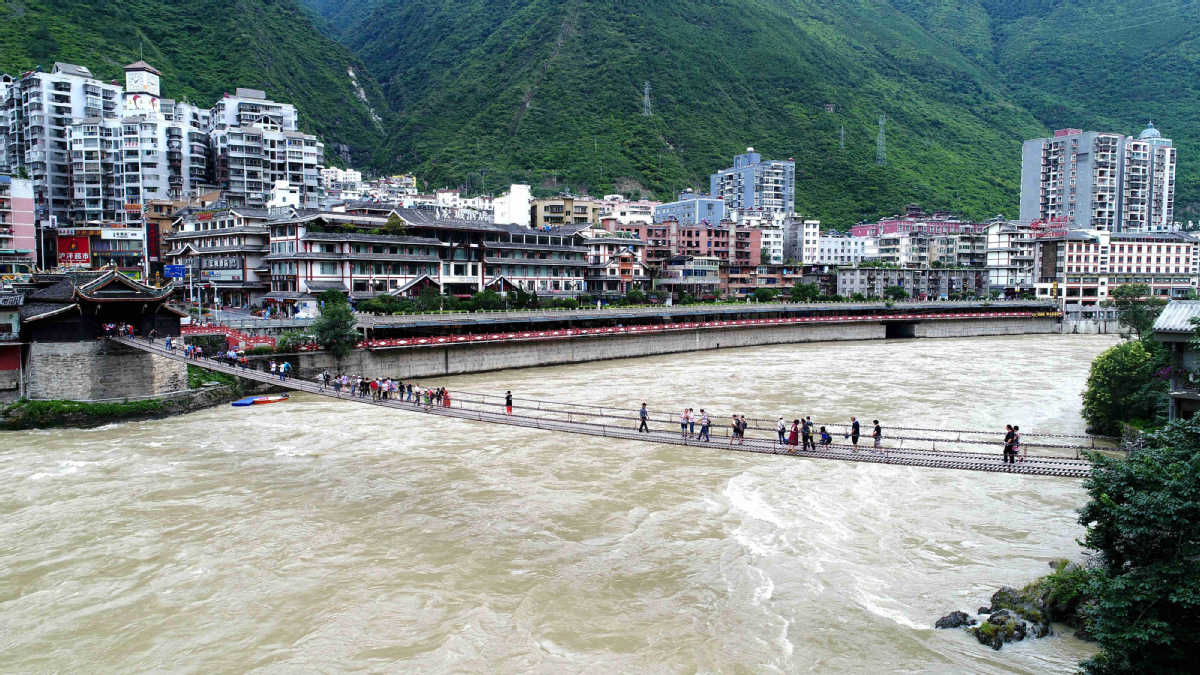
One of the most important maneuvers of the Long March still has great resonance for tourists and locals
When Sun Guangjun explained that Red Army soldiers had marched a grueling 120 kilometers in a single day in May 1935 to reach the west bank of Luding Bridge on the Dadu River by 6 am the following morning, the visitors were astounded by the words of the Red Army history expert.
Xiao Bao, one of two visitors who spoke with Sun during a recent visit to the bridge in Luding county, Ganzi Tibetan autonomous prefecture, Sichuan province, said: "It seemed like a 'mission impossible'. I wondered if the soldiers had been divine troops descending from Heaven, like in a legend."
Seizure of the bridge on May 29, 1935, became a famous incident in a story filled with heroes, because its planks had been removed by Kuomintang troops. They had converged on the river's east bank to cut off the troops of the Red Army, a predecessor of the People's Liberation Army, leaving just 13 iron chains.
Despite that, the Red Army soldiers crossed the bridge, suffering only a few deaths from their 22-strong force.
Mao Zedong met Edgar Snow, the first Western journalist to introduce Red China to the world, in Yan'an, in the northwestern province of Shaanxi in 1936.
At their first meeting, Mao said the Red Army's crossing of the Dadu River had been the most important event of the Long March (1934-36). If the maneuver had failed, the Red Army might have been wiped out, Mao told Snow, a writer from the United States.
At the time, China was engaged in the War of Resistance Against Japanese Aggression (1931-45). After cooperation between the Kuomintang and the Communist Party of China broke down, the Kuomintang started a campaign to "cleanse" the CPC. That led the Central Red Army to embark on the Long March, which finally saw the troops arrive in Shaanxi in October 1935.
Located in Shaanxi's north, Yan'an, the CPC's base, was surrounded by the Kuomintang's military and information blockade. The world knew little about the CPC and the Red Army except for the unflattering image propagated by the Kuomintang.
With the help of Soong Ching Ling, widow of Sun Yat-sen, Snow arrived in Yan'an on July 13, 1936. He spoke with Mao and over 100 Red Army commanders, interviewed soldiers on the front line and engaged extensively with local people. Snow's reports gave a vastly different picture to the one presented by the Kuomintang.
In October 1937, his newly published Red Star Over China became an instant hit in London, with more than 100,000 copies sold in just a few weeks and it was still a much sought-after item following three additional printings.
Every Chinese learns about the importance of Luding Bridge from history books at a very young age. Eighty-six years ago, the bridge was crucial to the survival of the CPC-led Red Army during the Long March, which began in Ruijin in East China's Jiangxi province, where the Provisional Central Government of the Soviet Republic of China had been established in 1931.
The central Soviet area had to be abandoned in 1934 after the Red Army failed to break through a yearlong blockade launched by Kuomintang leader Chiang Kai-shek, who built blockhouses with machine guns to close all routes out of the area.
Despite that, the Red Army managed to find a way out. Initially, the evacuation of 86,000 people was a difficult operation. Disorganized and ill-equipped, the first leg of the Long March was accomplished at an enormous cost, with the Red Army fighting every inch of the way.
The Red Army was left with just 33,500 troops after fighting 400,000 Kuomintang soldiers in late November and early December 1934 at the Battle of the Xiangjiang River, which lies on the border of Central China's Hunan province and the Guangxi Zhuang autonomous region in the south.
Historians say the failures were the result of dissent within the Red Army's central command, but note that the turning point of the Long March emerged in Southwest China's Guizhou province, where the troops recuperated and moved on from setbacks to victories.



- National Games vibe is everywhere in Guangzhou
- Forum unites global experts to enhance city image communication
- Miao New Year celebrations get underway in Guizhou's Leishan county
- Mainland spokesman reiterates stand on Taiwan
- Fujian county's rural development becomes a big draw for Taiwan investors
- Nobel laureate in chemistry: Give young scientists more independence