Transportation improvements the key to growth







As a young woman, Li Mingzhen, a resident of Ning'er Hani and Yi autonomous county in Pu'er city, Yunnan province, ran a hostel for travelers, whose horses were stabled separately.
"When a horse caravan stopped by, the village got very lively. Back then, we all lived in thatched-roofed cottages," the 92-year-old recalled.
As the volume of road traffic rose and access to the village became easier, the local thatched-roof cottages were upgraded and now all have tiled roofs.
"I used to walk everywhere. Then I rode a horse. Now, my grandson drives me around when I'm in good health. My life has changed dramatically," Li said.
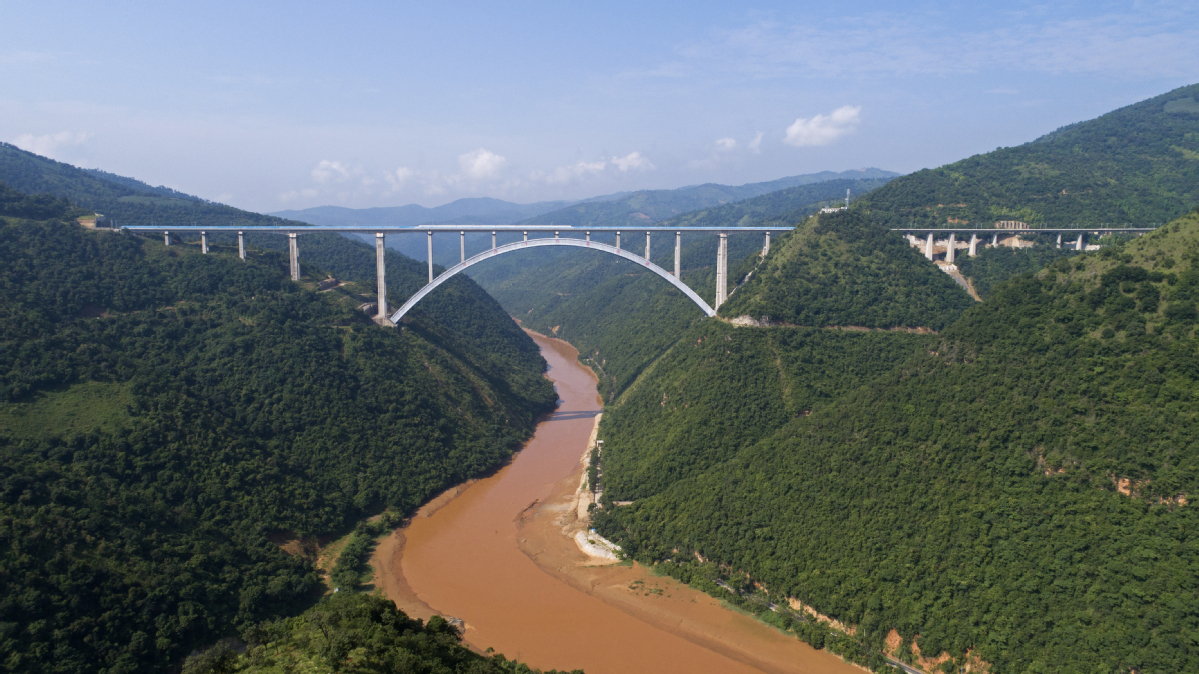
Confined by natural barriers, the Yunnan government laid roads on mountains and built bridges across rivers.
From steam locomotives to high-speed trains, from climbing across mountains to flying over them, from fishing boats to cargo ferries, and from walking to post letters to express delivery and logistics, the improvements in Yunnan's transportation infrastructure have brought significant benefits to people's lives in the past century.
After the 18th National Congress of the Communist Party of China in 2012, Yunnan began building a high-quality, modern, comprehensive transportation system and started a journey of socialist modernization in an all-around way.
By last year, the length of expressways in the province exceeded 9,000 kilometers, the second-longest in China.
During the period of the 13th Five-Year Plan (2016-20), the province built and rebuilt 105,000 km of rural roads and converted 199 zip tracks into bridges, accounting for 61 percent of the national total.
The development of transportation in Yunnan has strongly promoted local economic development and raised living standards in poverty-stricken areas.
During the 13th Five-Year Plan, Yunnan's transportation infrastructure saw investment of 1.15 trillion yuan ($180 billion), 2.4 times the figure during the period of the 12th Five-Year Plan (2011-15).
Fixed asset investment in the province's highways and waterways was the highest in the country from 2018 to last year, which helped Yunnan achieve rapid economic growth and historic breakthroughs in GDP.
Even in the face of the COVID-19 outbreak, Yunnan made every effort to promote the resumption of work and comprehensive transportation construction projects.
In April last year, the province took the lead in realizing year-on-year growth in fixed asset investment in the area of comprehensive transportation, turning a negative into a positive.
With the support of special national policies, priority was given to the implementation of a project to build 25,000 km of roads to villages that are the traditional homes of ethnic groups, whose lifestyles were undeveloped, and ancient settlements in areas around the province's border with China's southern neighbors.
The differences in conditions in the mountains and outside have been eradicated, providing a solid foundation to fulfill the transportation requirements of members of several ethnic groups, allowing them to eradicate poverty and embark on the road to prosperity.
They also provide easier access to and from neighboring countries and provinces and offer strong support for the construction of a radial transportation center for South and Southeast Asia.
Yunnan has built 15 civil airports, and Kunming, the provincial capital, has flights to the largest number of destinations in South and Southeast Asia.
The improvements have also benefited Yunnan's tourism industry, as both expressways and railways have been built to connect sites of interest in the province.
The Simao-Xiaomengyang (aka Sixiao) Expressway is a prime example of the developments, because environmental considerations were given priority during the construction process.
The expressway, which has a total length of 97.7 km, was completed and opened 75 days ahead of schedule on April 6, 2006. It was China's first "eco-expressway" as 37 km of it passes through a tropical rainforest in the Xiaomengyang Nature Reserve.
During the design process for the route, the engineers fully considered the mountain topography, so the layout was flexible and diverse, and workers avoided damaging or cutting down trees wherever possible.
When constructing the bridge piers, they tried their best to leave the vegetation and trees below the structure untouched to form a unique landscape in which the flora can grow under the bridge.
Distinct ethnic features are also highlighted throughout the route. For example, the entrances to tunnels were designed in the shape of the traditional hats worn by the Dai people, and the architecture at service zones also reflects Dai aesthetics.
According to Li Fuchen, assistant general manager of the Sun River National Park in Pu'er city, before the Sixiao Expressway was completed, many attempts to develop forest ecotourism had been carried out locally, but they all ended in failure due to constraints such as the limited transportation infrastructure and poor management.
"Since the expressway was completed, access to the park has continued to increase, and the number of tourists entering the scenic spot has risen, which has greatly promoted the development of the regional economy," he said.
The park provides an average of 300 jobs in the community every year, which has also encouraged local people to offer more than 20 farmhouses to guests, creating more than 400 jobs.
The facility is actively expanding the range of tourist products it offers by cooperating with players in many other fields, including health, sports, culture and education, to launch related items, such as those focused on forestry and environmental health, international competition, nature study tours and areas where cars can be test-driven, he said.
"We are exploring the sustainable development of forest tours that will protect nature and benefit society," Li added.
In 2008, the Xinhe Expressway was opened to traffic, the first such route connecting Yunnan with members of the Association of Southeast Asian Nations. In the same year, the Kunming-Bangkok International Highway was completed, making it China's first large cross-border road.
Shu Yang, general manager at the Yunnan International Coffee Exchange in Pu'er, said the growth of expressway logistics has played an important role in coffee transactions and the development of the entire industry.
He added that Pu'er's coffee production areas are mostly located on the border, so convenient transportation is essential for supplies of raw materials and to allow local products to feed the domestic market.
"As the Kunming-Bangkok International Highway continues to improve, Pu'er city can better connect with markets in South and Southeast Asia, allowing it to become the best trading and industrial center for Asian coffee," he said.
The post routes of the ancient Tea Horse Road were mostly dirt tracks, so freight cargo was reliant on mules, horses, oxen and human porters.
In 1974, the Kuming-Daluo road was sealed with asphalt, making it the first such road in Ning'er. With continuous construction and the development of road traffic, Ning'er's Nakeli has become an important southbound station.
"Here, the provincial highway, the national highway, the Kunming-Mandarin Highway and the Yumo Railway, which is currently under construction, form parallel lines. The ancient route has gradually changed from a narrow, dangerous and bumpy track to a flat and spacious road," said Tang Chunli, deputy director of the Ning'er county culture and tourism bureau.
"It can be said that Nakeli is the epitome of the development of China's road transportation."
Last year, Nakeli saw tourism revenue of 153 million yuan. The creation of visitor attractions has seen the founding of an environmental tourist destination that features ancient tea-horse routes, caravan culture and ethnic customs and culture.
According to the Yunnan government's 14th Five-Year Plan (2021-25) for Economic and Social Development and the outline of the 2035 long-term goals issued in February, the province's comprehensive transportation strategy will take the path of "networking, integration and intelligence" and promote the transportation system from "basic adaptation" to "moderately advance the transformation".






- National Games vibe is everywhere in Guangzhou
- Forum unites global experts to enhance city image communication
- Miao New Year celebrations get underway in Guizhou's Leishan county
- Mainland spokesman reiterates stand on Taiwan
- Fujian county's rural development becomes a big draw for Taiwan investors
- Nobel laureate in chemistry: Give young scientists more independence