Nation set to launch online carbon trade
Over 2,000 companies in the power generation sector involved in program







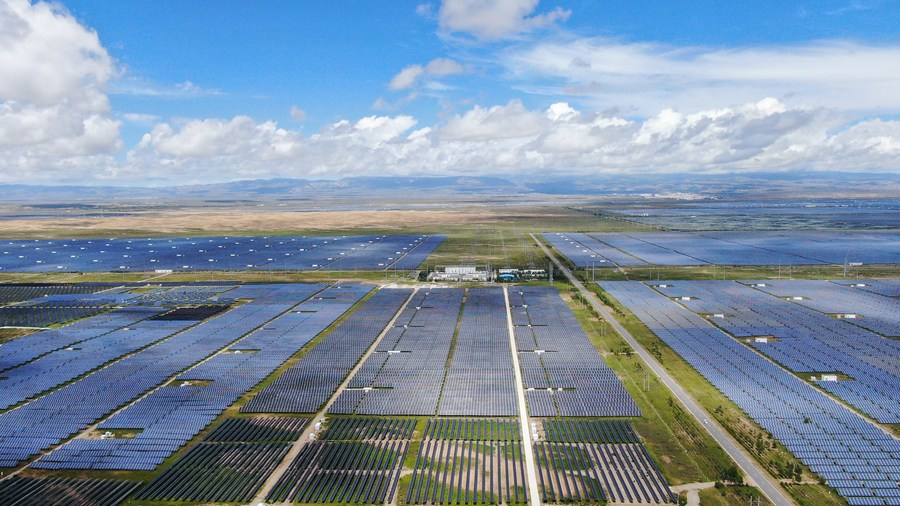
In a move to further tap the potential of market mechanisms in promoting low-carbon transformation, China's national carbon market will launch online trading this month, Zhao Yingmin, vice-minister of ecology and environment, said on Wednesday.
The decision to launch online trading was made at an executive meeting of the State Council, the country's Cabinet, on July 7, Zhao told a news conference organized by the council's information office.
The national program currently involves over 2,000 companies in the power generation sector that emit over 4 billion metric tons of carbon dioxide a year, he said.
"The sector is a major contributor to carbon dioxide emissions in the country and also a major coal consumer," he said. "Including the sector in the market first will help yield synergistic results in pollution control and carbon emissions reduction."
Adequate emission monitoring facilities in the power generation industry guarantee accurate data, which is key for the market's operation, Zhao said.
He said the Ministry of Ecology and Environment has conducted data collection, reporting and verification for years in seven other major carbon-emitting industries, including steel, chemicals and papermaking, in preparation for the extension of the national carbon market.
Carbon trading is the process of buying and selling permits to emit carbon dioxide or other greenhouse gases.
Designated emitters will be given the right to release a certain amount of greenhouse gases. At the end of each cycle, emitters will have to buy unused permits from the market if they emit more than the amount they are allowed.
Carbon trading is "a key policy instrument" in the country's endeavor to reach peak carbon dioxide emissions before 2030 and go carbon neutral before 2060, Zhao said.
With financial incentives, aside from guiding investment into industries or enterprises with big potential in reducing carbon emissions, the mechanism could motivate innovations in low-carbon technology development, he said.
Zhao said the market is also expected to be a financial instrument that provides financing support to the country's efforts to meet its climate commitments.
China has been preparing for the national carbon market for almost 10 years, with pilot programs in seven areas, including Hubei province, Beijing and Shanghai, the ministry said.
Li Gao, head of climate change at the ministry, said the pilot market had involved almost 3,000 major emitters in over 20 industries by last month.
With total turnover of more than 11 billion yuan ($1.7 billion), the greenhouse gas emissions the programs have covered are equivalent to 480 million tons of carbon dioxide, he added.
Carbon trading practices at home and abroad have proved the mechanism is an effective instrument that can help reduce the cost of reaching carbon reduction targets.
Zhao said China is also promoting the establishment of an international carbon market.
"The inauguration of online trading of China's national carbon market is an important step forward for global climate action," he said, adding it will not only inject impetus and confidence into the world's endeavor to tackle climate change but also provide references for other nations and regions.
Quoting a report from the World Bank, Zhao said there are now 61 national or regional carbon pricing programs around the world. Thirty-one are carbon trading markets, while the others involve carbon taxes.
It's complicated to bridge different markets because of a range of issues, including laws, policies and standards, he said. Despite that, China is promoting the negotiation process around Article 6 of the 2015 Paris climate agreement and the establishment of an international carbon trading mechanism under the framework of the agreement.
The Paris agreement entered the implementation phase last year, but parties have yet to reach consensus on the highly technical Article 6, which includes a market-based mechanism.
Upholding the principle of common but differentiated responsibilities and respective capabilities, which is included in the United Nations Framework Convention on Climate Change, parties should stick to multilateralism and make joint efforts to cope with the climate challenge, Zhao said.
"We should encourage and support parties that really need help to roll out actions on climate mitigation and adaptation, including carbon trading," he said.



- Countdown to 15th National Games: On-site warm-up entertains audience
- Eight missing after cargo ship collides with fishing vessel near Shandong
- Investing in people: a worthwhile investment
- Exhibition commemorating the epic relocation of universities opens in Fujian
- Twelve punished for scaffold collapse that killed 7 in Shandong
- Slovenian official visits whole-process people's democracy practice site of CPPCC committees