Essential to ease parenting burden







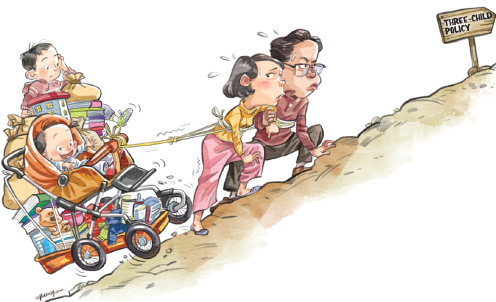
Policies reducing education, healthcare and housing pressures and protecting the rights and interests of working mothers can encourage families to have more children
The heavy cost of parenting is an important factor stopping families from having more than one child. The nationwide two-child policy introduced in 2016 served as a short-term stimulus, resulting in a significant increase in the number of births in 2016 and 2017. However, since 2018, the number of births has been on a downward trend.
In 2020, the number of newborns in China was only 12 million. The cost of parenting covers other aspects besides the direct costs of child raising, including housing, healthcare, education, and working women's rights to employment and career growth.
With the skyrocketing house prices in cities, the housing pressures on parents are immense. The care of infants and young children is also an important factor influencing a family's decision to raise multiple children. Parents planning to have a third child may no longer be able to rely solely on help from the children's grandparents. As a result, one of the parents may need to quit his or her job to take care of the infants. The decision by the Communist Party of China Central Committee and the State Council, China's Cabinet, on July 20 to optimize birth policies is a substantial step toward effectively reducing the burden on families. The latest policies focus on addressing the burden of parenting from aspects such as education, healthcare, housing and protection of the rights and interests of working mothers in a bid to encourage families to have more children and improve the social demographic structure.
First, it is important to improve the level of prenatal and postnatal care services. Women planning to have a third child are generally older, which increases the risks involved with pregnancy, necessitating the provision of quality prenatal and postnatal care and services with strong medical support throughout the pregnancy and birth.
Second, a transformation must take place so that society assumes a more important role than families in the care of infants so as to reduce the burden of parenting.
In the planned economy era, employers generally offered childcare services to employees, effectively alleviating the parenting burden on dual-earner families. What is different from the time of the planned economy is that people's housing is now decentralized, with commuting distances greatly increased. Therefore, it is not an easy task to fully restore the model of childcare services that were offered in the planned economy era, with some employers also encountering various obstacles in offering such services.
A more feasible way of socialized childcare is to rely on the community to offer reliable childcare services at a reasonable price, so that people can safely hand over their infants and young children to community-level institutions.
In addition, many communities have developed their own kindergartens. If such kindergartens can admit children at a younger age, it would greatly reduce the burden of family care.
Third, the policy proposed in the decision that encourages employers to formulate measures helping employees to balance the relationship between work and family is of particular pragmatic significance. Pregnancy is a huge challenge for working women. This is not only manifested in various psychological and physical discomforts, but also in the interruption to their careers. Only when the employment rights and interests of working women are truly guaranteed will it be possible to encourage families to have three children.
Working women who are preparing to have a third child are generally older and often at an important stage of their careers. Interruptions in career development are very costly for them, as they face greater competitive pressures when they return to work.
Fourth, it is necessary to promote the high-quality and balanced development of compulsory education and integration between urban and rural areas to solve the problem of fierce competition for school enrollment. Providing quality education to children is also a family's core consideration when raising children.
House prices in school districts are rising, and off-campus tutoring has long been regarded as a competitive necessity, which cause huge anxiety for families. Since the beginning of this year, a series of decisions by the CPC Central Committee have effectively curbed the chaos of off-campus tutoring activities. The latest decision highlights the need to reduce the education burden on families while enabling schools to play a principal role in the education process, thereby effectively reducing the education anxieties of parents and providing a good foundation for families to raise more children.
In order to better implement the three-child policy, some of these measures need to be set out in detail and carried out as soon as possible. In cities, housing is the heaviest economic burden, so easing this burden should be a priority. Families can do with their original living conditions if they have a second child. For a third child, however, it is almost inevitable that their living conditions must improve first.
Increased and improved pediatric medical resources should also be prepared in advance. Pediatricians generally face greater pressure than ordinary doctors, so there is need to plan ahead to avoid further aggravating the demand on pediatric resources.
In addition, from the perspective of ensuring the incomes of two-child and three-child families, it is recommended that effective policies be adopted to offer families financial subsidies directly to alleviate the financial pressure on families.
The author is a professor at the Institute of Population and Labor Economics at the Chinese Academy of Social Sciences. The author contributed this article to China Watch, a think tank powered by China Daily. The views do not necessarily reflect those of China Daily.
LI MIN/CHINA DAILY