Five centers of stability
Poverty alleviation and development integral to the deradicalization efforts in Xinjiang







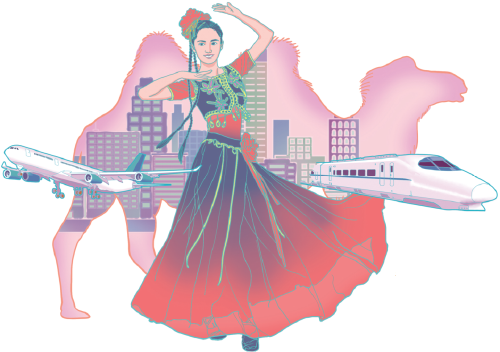
At the end of last year, the Xinjiang Uygur autonomous region was able to announce that the final 3 million impoverished people had been lifted out of poverty and that it had achieved success in the decades-long fight against extreme poverty.
In 2013, the region was identified as one of the tough nuts of the nation's targeted poverty alleviation strategy, especially the southern part whose poverty incidence rate was 33.6 percent, almost 23 percentage points higher than the national average.
Administrative guidance and macro readjustments from the central government have played a crucial role in the region's battle against poverty. According to China's financial transfer payment system, an annual budget of nearly 400 billion yuan ($61.7 billion) has been allocated to Xinjiang by the central government since 2015, with annual supporting counterpart funds of 15 billion yuan provided by 19 other provinces and cities.
It is not just government efforts that are making a difference in the region. Take Tashkurgan, a small county with about 40,000 residents on the Pamirs Plateau, as an example. Shenneng Futa, a giant photovoltaic plant supported by the government, was established in 2018. It is expected to contribute no less than 5 million yuan to the local budget over the next 20 years, including providing 3,000 yuan every year to 800 impoverished households. Traditional local husbandry, which has flourished thanks to government subsidies, has been injected with vigor by technological and marketing support from enterprises. Herdsmen can earn on average an extra 2,000 yuan from each of their yaks, as the upgraded infrastructure in the county means their yak products can be transported to more affluent and bigger markets such as Shenzhen in coastal South China.
Similarly, the concerted efforts by the government and enterprises have boosted new points of economic growth in other counties based on their natural endowments, including apricot and almond cultivating in Yengisar county, long staple cotton planting and processing in Kuqa county, and the assembly of electronic products in Shule county. These fledgling industries enable the impoverished counties to strengthen their indigenous sustainable development, instead of being dependent on aid.
Poverty alleviation has also uprooted the menace of extremism to stability through people-centered development. The rampant terrorist violence that previously plagued Xinjiang was in essence a development issue closely linked with extreme poverty. Therefore, empowerment of vulnerable groups, especially the impoverished population, has topped Xinjiang's counterterrorism and deradicalization agenda.
To help local residents better adapt to the job market, the local government has supported vocational education and training programs, similar to the Desistance and Disengagement Programme of the United Kingdom, in which trainees are encouraged to sign up for free courses to learn the national standard language, legal knowledge and vocational skills.
Moreover, the local government has financed the relocation of the poverty-stricken population from remote areas unfit for human habitation. This has enabled impoverished households to move to places with more clement weather and better resource endowments. The largest of its kind in Xinjiang, Aktash town in Yecheng county was established by the local government in 2017 with a budget of 840 million yuan. It has welcomed nearly 170,000 people who used to live in the Kunlun Mountains, an area that experiences a high occurrence of mud slides in summer and has unstable supplies of drinking water, and where residents used to have to trek 30 to 50 kilometers to get to access basic medical services and education. The new residences in Aktash, which are provided free for those who were living in poverty, are well equipped and there is convenient access to basic public services as well as employment opportunities at factories and cooperatives. People-centered ideas in poverty reduction have helped to eradicate the hotbed of extremism, and Xinjiang has not suffered any terrorist violence for four consecutive years.
Poverty alleviation has consolidated Xinjiang's geographical advantage as China's westernmost gateway to Eurasia. By 2020, Xinjiang had made every prefecture capital accessible to networks of expressways and railways, and strengthened infrastructure connectivity with the neighboring provinces of Gansu and Qinghai. Meanwhile, the inauguration of comprehensive bonded zones of Alataw, Kashgar and Khorgos, the launch of the freight assembly center in Urumqi for transporting goods from China to Europe, the upgrading of Karakoram Highway, and the envisaged plan for the China-Kyrgyzstan-Uzbekistan Railway further highlight Xinjiang as an integral part of the Silk Road Economic Belt.
Especially amid the impacts of the global spread of the novel coronavirus in 2020 on air cargo and ocean shipping transportation, the number of international freight trains via Xinjiang hit a new record, and the trains have played a key role in stabilizing China's connection with global logistics network.
In the period of the 14th Five-Year Plan (2021-25), Xinjiang will further explore the synergy between its rural revitalization efforts and international cooperation under the Belt and Road Initiative by giving full play to its comparative advantages, and provide new incentives to consolidate poverty alleviation achievements through its strategy of building "five centers"-for transportation, commercial logistics, finance, medical care, culture and education-along the Silk Road Economic Belt.
The author is deputy director of the Security Studies Division at the China-Africa Institute. The author contributed this article to China Watch, a think tank powered by China Daily. The views do not necessarily reflect those of China Daily.