Veteran archaeologist sees life as 'a pretty smooth ride' despite personal setbacks







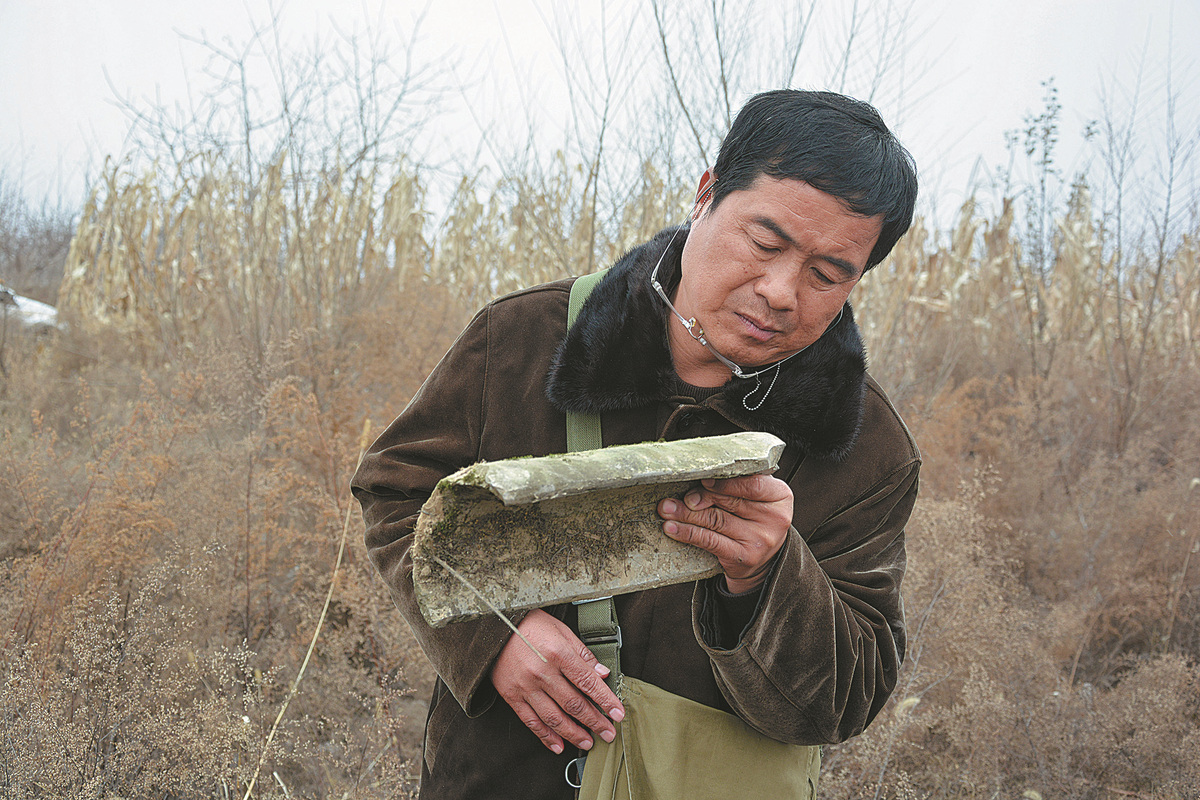
Tian Jianwen, a veteran archaeologist at the Shanxi Archaeology Institute, summarized what many might see as a bumpy path in life: "Actually, I've had a pretty smooth ride," he said.
Outwardly, only his weathered skin indicates how much archaeological work in the field for three decades can change a man.
In August 1982, Tian and his classmates from the archaeology department of Peking University arrived for field practice in the small town of Houma, Shanxi province, home to the most important relics and ruins of the Jin principality of the Western Zhou period (1046 BC-771 BC).
It was this early experience that captured Tian's imagination, and he turned to a serious, long-term study of the Western Zhou period and the Jin culture, with all their inclusiveness and diversity. He would spend 30 years in Houma after graduation.
For Tian, the memory of his first encounter with Houma is still fresh. He and his classmates spent months piecing together the ceramic pottery fragments they unearthed, in a test of eyesight, knowledge, skill and patience.
Upon his graduation in 1984, Tian turned down a job offer from a university in Shanxi and opted to work at the Shanxi Archaeology Institute's branch in Houma, which had once been the capital of the late Jin Dynasty. In the eyes of Tian, many unsolved mysteries remained.
After immersing himself in a sea of pottery fragments and other relics unearthed in Houma, Tian obtained his master's degree from Jilin University in 1989. He passed up job opportunities in Beijing and Taiyuan, Shanxi's capital, after graduation and returned to Houma again to look for archaeological evidence of Neolithic culture.
Xue Xinmin and Yang Linzhou, two of Tian's co-workers, were surprised to see him come back. He was "a funny guy," they teased.
In May 1991, the three accidentally discovered ruins more than 7,000 years old in Zaoyuan village east of Jicheng county near Houma. These were later identified as Neolithic ruins, the first to be discovered in the province.
"I have known Tian for more than 30 years," Xue said, adding that Tian always maintained the simplicity and curiosity of a country boy and never pursued lofty goals for himself. "You can see it in the military-style satchel he has carried for three decades. His dedication to archaeology has never changed."
Fate intervened, however. A traffic accident in April 1997 forced him to stop working. After two cranial surgeries, Tian could not speak coherently or walk on his own. He decided to move his sickbed to the archaeological site for rehabilitation.
A year later, he had recovered sufficiently to speak in broken tones and managed to walk on his own. People attributed his quick recovery to the magic of archaeology. Tian called it the beginning of his second life.
In 1999, he was appointed curator of the Shanxi Jin Tomb Museum, a post less physically demanding than the one he held in Houma. Nevertheless, he came back to work at the archaeological sites in southern Shanxi again in 2004, with Houma at the center of inquiry.
He has presided over more than 10 archaeological excavation projects in the region since then.
The "cultural revolution" (1966-76) had thrown the country into a decade of chaos. Now, years later, he wants to recover lost ground.
"We must make up the time that was wasted," Tian said, reiterating the message his teachers had delivered to him and his classmates. "If we cannot achieve something, we will fail across two generations of archaeologists."
In a seminar on field archaeology technology he hosted in Yuncheng, Shanxi, Tian encouraged the young archeologists in attendance to show more passion and persistence in their profession.
"I want to be a good example for them so they can play a pivotal role in future projects," he said.
His co-workers say the reason he called his path of life "a smooth ride" is that he was focused so intensely on archaeology that he could ignore other ups and downs. It's a quality the next generation would do well to emulate.






- First cross-border event debuts at the National Games
- China Focus: National Games enhances coordination under 'one country, two systems'
- China's Fujian aircraft carrier to make regular appearances on high seas: spokesperson
- A decade of dialogues
- HK: a stage for art and cultural dialogue
- Tapping truly unknown wonders