What ails it?
Rather than representing the end of history, US style-democracy seems to be in terminal decline







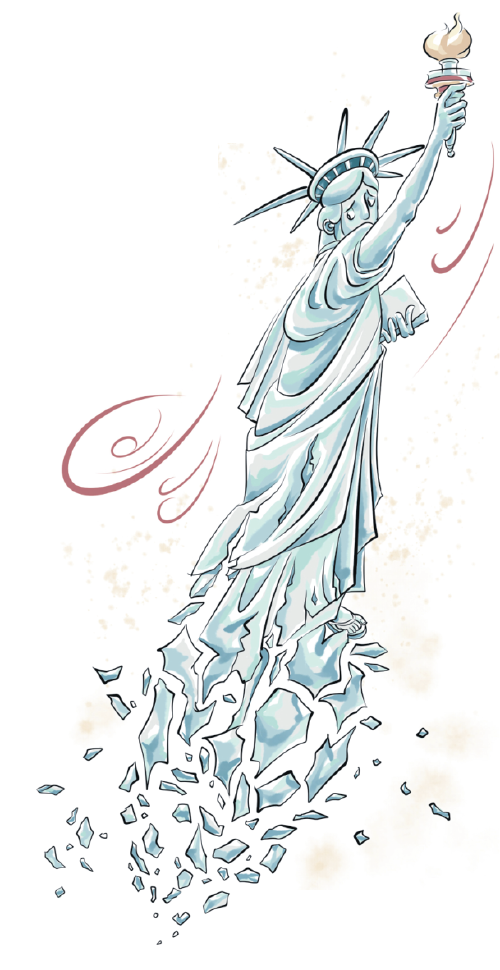
Americans are proud of their political system, believing that its strong vitality can not only help them overcome any difficulties, but also set an example for other countries. In other words, US-style democracy is a proposition inherent in modernity. What is the present for the United States will be the future of other modernizing countries and the realization of US-style democracy in all countries will be "the end of history".
However, liberal elites in the US believe today's US-style democracy is "sick", with the root cause being Trumpism, a unique contemporary manifestation of populism mixed with nativism, racism and some fashion of fascism. The Capitol Hill riot on Jan 6 showed that a large number of Trump supporters have lost confidence in the authenticity of today's American democratic system. Their refusal to recognize the legitimacy of the presidential election result has fundamentally shaken US democracy. No wonder many of them have been defined as "domestic terrorists". In recent years, social networking apps in the US have seen increased political polarization, which has led to conflicts over national identity and the direction the country should take. This has made the bipartisan struggle more fierce and uncompromising, deeply worrying the liberal elites.
This bipartisan struggle has resulted in a governance crisis. Entering the 21st century, the US government has been less efficient, with unresolved major national issues, uncivil bipartisan squabbles in Congress and weakened legislative power. The governance of US-style democracy is facing increasing criticism, and the voices calling for reform of the current system are becoming louder. But the reforms that really matter-such as adoption of open party primaries, abolition of gerrymandering and ensuring voting rights for all groups-are difficult to fulfill and often fail halfway.
But compared with the above political differences and challenges, the COVID-19 pandemic is by far the biggest test for US-style democracy in the 21st century. Of the 5 million people who have died of the COVID-19 worldwide so far, the largest number of deaths has been reported in the US which can boast of having the most advanced medical system. Obviously, the reason for the huge number of deaths is not lack of medical resources or technology. Instead, the cause is the failure of the US political system in the face of major crises. Completely hijacked by domestic political duels, the US government has proved woefully incompetent in dealing with the pandemic.
Another surprising but reasonable fact is that a number of post-Cold War democracies in central and eastern Europe, especially in the Balkans, rank high in the COVID-19 death rate. Bosnia and Herzegovina, Bulgaria, North Macedonia, Montenegro, Hungary, the Czech Republic, Romania, Slovakia, Slovenia and Croatia are among the top 20 countries in terms of mortality per million population. The West views many of these countries as "successful examples" and "top students" of democratization. However, the reality is that although they have joined the European Union and NATO, serving as Europe's emerging economic markets, labor sources and buffer zones for military security against Russia, both the US and EU powers thrust them aside when they needed life-saving vaccines the most.
Now there is a credibility crisis for US-style democracy. For a long time, there has been a dispute between realism and idealism in US foreign policy. Transplanting US-style democracy to other countries has gradually become an important mission for the global hegemon. The US often flaunts the transformation of Germany and Japan after World War II and the post-Cold War "Color Revolutions "in some European countries as achievements in promoting global democratization. After the Sept 11,2001 terror attacks, neoconservatives in the US took the opportunity to wage anti-terrorism wars, intended to use force to change the political systems of some Islamic countries in the Middle East and promote US-style democratization in regions with different religions, nationalities and cultures by means of "regime change".
However, the messy US withdrawal from Afghanistan in August has highlighted the failure of the US to promote US-style democracy elsewhere. Other US allies have become restless and repeatedly seek security "reassurances" from the US, fearing it will abandon them as it has done to Afghanistan.
In September, the US suddenly announced the establishment of the AUKUS alliance, which rendered null and void an agreement for Australia to buy submarines from France, instead purchasing the technology for nuclear-powered submarines from the United Kingdom and the US. This not only resulted in a rift between the US and Europe, but other US allies and partners were also dissatisfied with the discriminatory "Anglo-Saxon Alliance". The Biden administration's policy of building a global "democratic alliance" thus seems an even more remote possibility than it already was.
The contemporary right-wing populist movement represented by Trumpism has the potential of giving rise to a large number of illiberal democracies, even autocracies, and Western liberal elites fear that the whole world is being transformed from a post-Cold War liberal order to an illiberal order. In their view, the theme of today's world is no longer peace and development, but the struggle between democracy and autocracy. They thought that in this struggle, the democratic regimes must huddle together before they can finally win the systemic competition. However, the view of making ideological confrontations as the priority of the world will not be accepted by all, especially developing countries. As for the Western liberal elites, they are like a drowning man trying to clutch at a straw.
The author is director of the Department of International Political Studies at the National Institute for Global Strategy at the Chinese Academy of Social Sciences. The author contributed this article to China Watch, a think tank powered by China Daily.
The views do not necessarily reflect those of China Daily.
Contact the editor at editor@chinawatch.cn