'Barefoot doctors' safeguard health of villagers







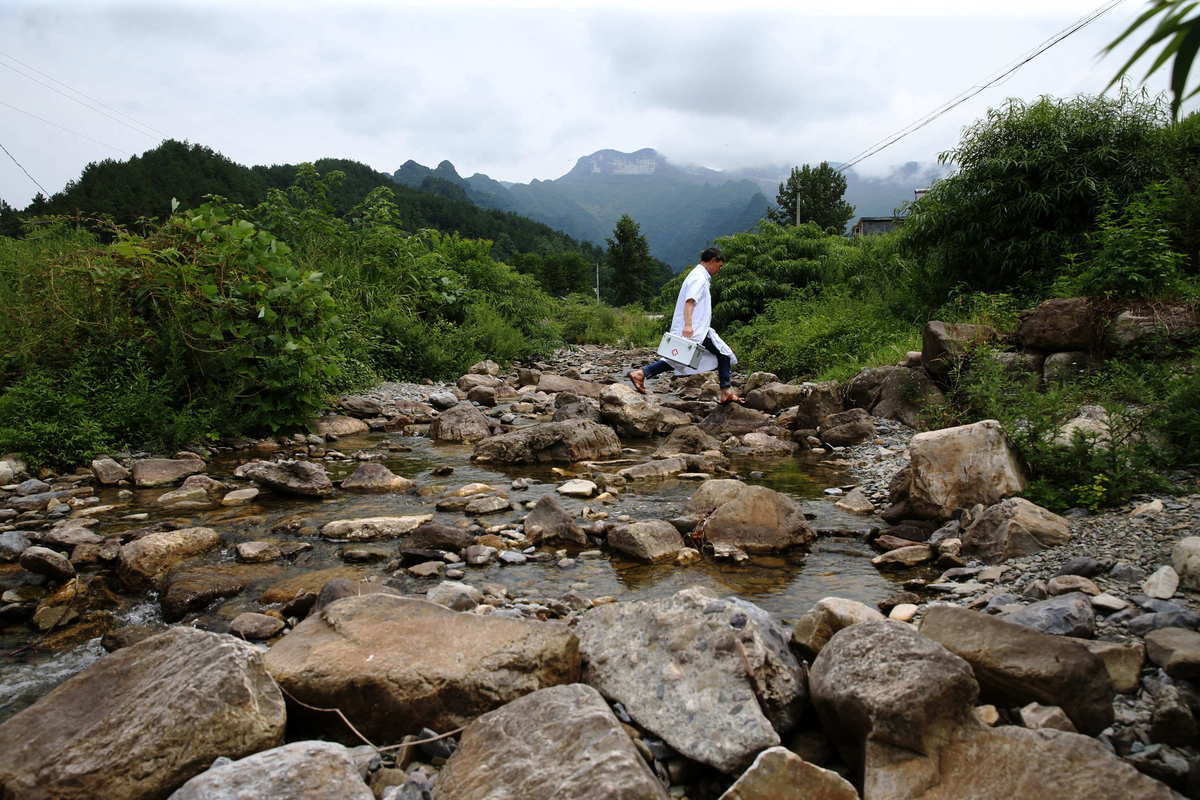
Ma said barefoot doctors could earn more work points than ordinary villagers. They sometimes could garner 10 points, the maximum for a day's work. And at the end of a month, they received food from the production brigade based on the work points they secured.
A cooperative medical system was adopted in rural areas at the time, in which individuals paid a small sum. In Ma's case, it was 0.1 yuan (1.5 cents) every month. The rest of the medical bills were covered by the village collective economy.
However, with only rudimentary medical knowledge, barefoot doctors could provide no more than basic healthcare services.
Ma said barefoot doctors mainly dealt with slight and common illnesses such as cold and heatstroke, whereas patients with severe diseases such as acute appendicitis had to be transferred to bigger hospitals for treatment.
By the mid-1960s, after continuous practices and training, the country's rural health workers were able to cure scores of common diseases, and practiced acupuncture and dozens of herbal medicine.
Since most farmers could not afford Western medicines, they mainly relied on self-cultivated herbal medicines to heal diseases. Ma also ground herbs into powders and made pills himself.
The wide use of herbal medicines, which were affordable and accessible to rural residents, helped mitigate the financial burden on patients.
Ma won the trust of patients through his devotion and hard work.
In the 1960s, malaria was rampant in rural areas and villagers had little knowledge about disease prevention. Ma visited his village's 360-odd households one by one to educate them about malaria. If someone was not at home, Ma would go to the fields to look for him or her.
When he met villagers who refused to take the anti-malaria drug, Ma would persuade them into accepting it, and saw to it that they took the drugs on site.
A course of anti-malaria drug treatment lasted for a week, and the whole process continued for two years until the infectious disease was eliminated in the village.
Ma recalled that the rural roads were rugged at the time, and without bicycle, he had to walk to the homes of patients. One day, when he was out seeing a patient, his wife went into labor. He barely made it home to help deliver the baby. Until today, Ma still feels guilty to his family for his absence during such critical moments.
In fact, barefoot doctors were also responsible for all hygiene-related work such as ensuring sanitation of drinking water, proper disposal of human feces, and pest control.
"The barefoot doctors, most of whom were poor farmers, were filled with enthusiasm in serving farmers who belonged to the same category of class as them, and thus worked selflessly and tirelessly," said Yang Nianqun, a history professor at the Renmin University of China.
"The barefoot doctors and the rural cooperative medical system were products in the context of scarce medical resources and severe uneven distribution of them," said Li Decheng, a professor at Jiangxi Normal University.
Yang said the system of barefoot doctors also contributed to the implementation of the government's health campaigns, such as massive vaccination and distribution of anti-epidemic medication.

- Outrage, rebuke from across China as Japanese PM's erroneous remarks boil over
- Taiwan youths discuss paths to peaceful reunification
- Tunpu culture: A collision of civilizations
- China begins preparations for Shenzhou XXII launch
- New teaching materials to aid international Chinese language education released
- CHTF features innovative tech that coverts seawater into plastic