Relics recovered from ancient tombs in Beijing







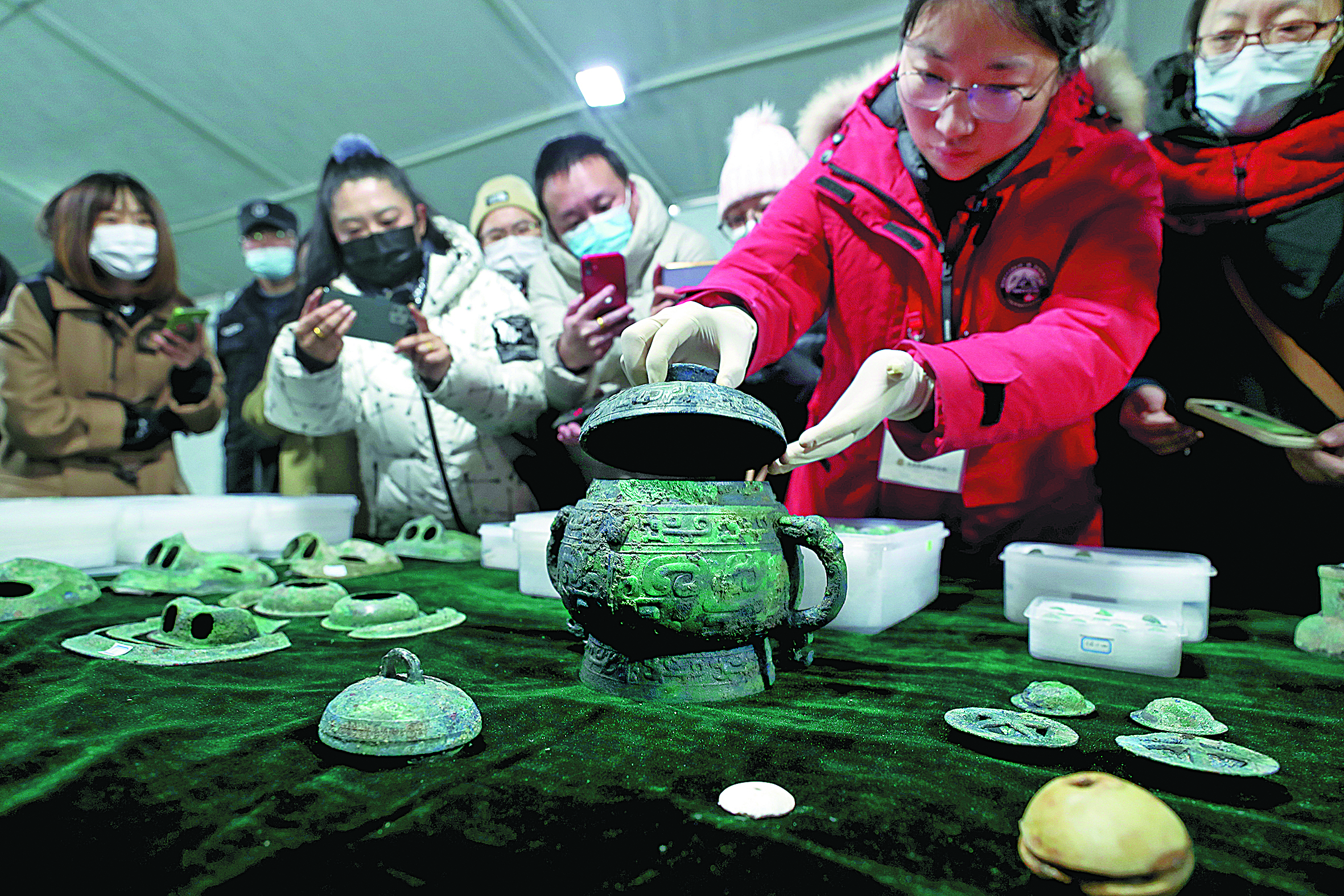
More than 100 cultural relics were recently discovered in five tombs at 3,000-year-old archaeological ruins on the outskirts of Beijing, the city's cultural heritage administration said on Tuesday.
The relics, including bronze ware, lacquer ware, pottery and pieces of silk, were retrieved from the Liulihe site in Fangshan district, which dates back to the Western Zhou Dynasty (c.11th century-771 BC), said Wang Jing, the leading archaeologist working on the site, from the Beijing Archaeological Research Institute.
"Many types of artifacts had never been unearthed in Beijing," she said. "The excavated bronze ware, for example, has vivid details and exquisite decorations.
"We've recorded the original position of these artifacts. That will greatly help our understanding of burial customs at that time."
The latest round of excavations at the tombs, which began in October, followed a 40-odd-year hiatus at the site, which was discovered accidentally in 1945.
A series of excavations in the 1970s showed it to be the earliest city in Beijing. Historical documents said Beijing was the location of the capital of the Yan vassal state during the Western Zhou Dynasty, and studies at the site finally proved that to be the case.
In 1974 a bronze ware ding, an ancient form of Chinese cauldron that was used in rituals and showed the aristocratic status of the owner, was unearthed from a grave in Liulihe. It remains the biggest bronze ware ever found in an archaeological excavation in Beijing. A bronze ware li, an everyday cauldron, that was found in another tomb is now among the most important exhibits at the Capital Museum in Beijing.
However, the high level of ground water at the site disturbed the research work in the 1970s, leaving the exploration of the tombs unfinished. To prepare for the establishment of an archaeological ruins park planned for the site, excavations resumed this year.
Bronze ware pieces have remained the highlights among the new findings, while decorated chariots, masks and weapons have also been retrieved from the tombs.
"In these tombs, bronze weapons were more widely used than their contemporaneous counterparts in Central China," Wang said. "That is probably due to Beijing being located on the frontier area of the Western Zhou and weapons, as symbols of defending home, were thus more emphasized in burial objects."
Some artifacts feature styles typical of southern China, indicating frequent cultural communication.
A newly unearthed storage vessel, known as a gui, was even coincidentally linked with a similar finding four decades ago. Inscriptions on the lid of the recently found gui matched those carved inside the body of a similar artifact found in the 1970s.
"A reasonable explanation is that a confused artisan set the wrong lids on the two vessels," Wang said. "The mistake was finally found by us after 3,000 years."
The development of conservation technology since the earlier excavations has made prompt conservation possible, with precious lacquer ware retrieved from the tombs enriching people's knowledge of burial objects. Methods for properly handling such items were previously unknown. Also thanks to technology, a silk piece with decorative patterns from the early Western Zhou Dynasty was retrieved for the first time in Beijing.
Further study is needed to identify the tomb owners, but Wang said the burial objects showed they could have been of extraordinarily high status.
In October, the Liulihe site was listed by the National Cultural Heritage Administration as being among the top 100 archaeological discoveries in China in the past century. This year marks the centenary of modern Chinese archaeology.
"The ongoing excavation will offer much crucial information on studies of the ritual and feudal systems of the Western Zhou period," Chen Mingjie, director of the Beijing Municipal Cultural Heritage Administration, said. "It is also a key to see how early-stage cities were planned in China."
Four rammed earth architectural foundations and seven large water wells have also been excavated in Liulihe this year, indicating that full use of ground water was considered by the city's planners.
"The new findings in Liulihe will further portray a panorama of the Yan vassal state, which was a historical foundation of the Beijing-Tianjin-Hebei coordinated development today," Shan Jixiang, head of the Chinese Society of Cultural Relics, said. "It will also demonstrate how diverse cultures mixed with each other and formed a united Chinese civilization."






- National Games vibe is everywhere in Guangzhou
- Forum unites global experts to enhance city image communication
- Miao New Year celebrations get underway in Guizhou's Leishan county
- Mainland spokesman reiterates stand on Taiwan
- Fujian county's rural development becomes a big draw for Taiwan investors
- Nobel laureate in chemistry: Give young scientists more independence