Cooperation only way US can ease supply crisis








The supply chain crisis that has hit the United States is likely to continue into 2022. The crisis has already led to the highest inflation in the US in 30 years, which in turn has deepened the supply chain problem.
The COVID-19 pandemic drastically reduced global production and disrupted the supply chains. As a result, the supply chains were overstretched when demand boomed with the normalization of economic activities.
The pandemic overshadowed global supply and production, and the US can hardly solve the global supply problem without global cooperation. What has complicated the US' problems is the supply chain bottleneck caused by the US' inadequate domestic policies and measures.
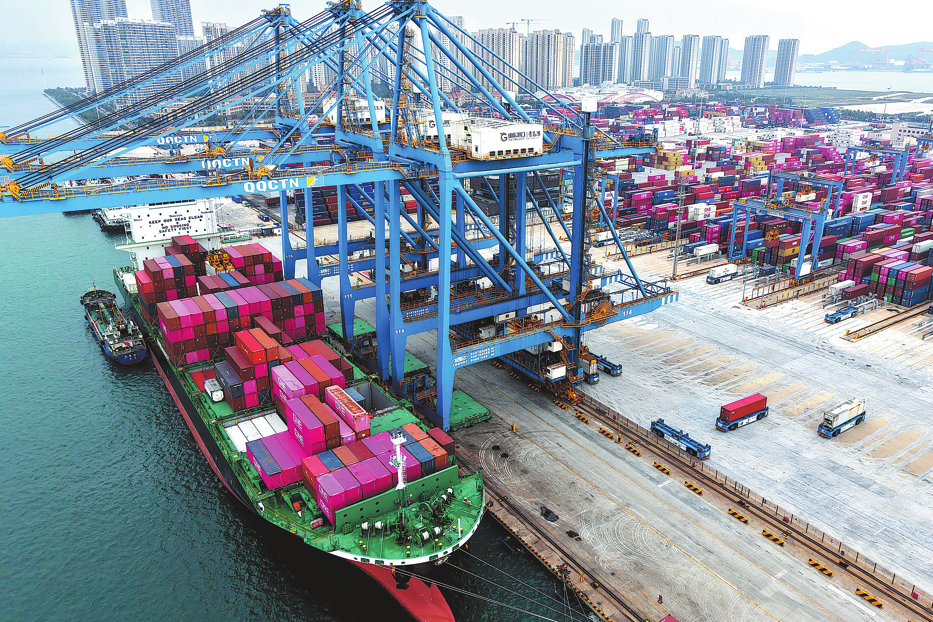
First, the US did not timely respond to the supply shortage, as its economic system is more rigid than expected. Such was the supply logjam that at Long Beach, one of the busiest ports in the US, the stacks of containers increased from two to four in October.
This prompted the Joe Biden administration to ask the ports of Los Angeles, another of the US' busiest ports, and Long Beach to operate 24/7 in October and then negotiated with retail and logistics companies such as Walmart and FedEx to work longer and faster to clear the merchandize from the ports. Still, the Los Angeles and Long Beach ports operated only 16 hours a day while most ports in Asia are operating 24 hours a day.
No wonder congestion at US ports remains a problem, although smaller in scale, due to the shortage of truck drivers, and rising warehouse and logistics costs. Also, production is falling behind schedule because spares and accessories are stuck outside the US because of the supply chain crisis.
Second, the US administration's interference has undermined the efficiency of the global supply chains. The US is highly dependent on economic globalization and has a key role to play in the international division of labor; it is also the world's largest final consumption market.
The previous US administration promoted reshoring (the process of returning the production and manufacturing of goods back to a company's country of origin) and the localization of industry. However, the measures to localize industry have not been able to proportionally stimulate productivity. Costs have increased, and according to the Institute for Supply Management, US manufacturers had to wait up to 92 days in September for parts and raw materials due to supply congestion.
Third, US protectionism has hindered not only the global trade system but also the interests of the US. In particular, the former Donald Trump administration raised tariffs on Chinese goods several times and imposed strict export controls on Chinese goods and services.
Developed economies, for example, especially the US, have benefited from efficient and low-labor-cost production bases overseas that produce a wide range of inexpensive but quality products. Such production bases have also helped the US to keep inflation under control and increase consumption.
The supply chain crisis, including the congestion at ports, since the end of last year has delayed the delivery of raw materials and finished products. This has led to a shortage of finished products in the market, forcing goods prices to rise sharply, which has affected ordinary people's lives. Rising inflation has also made festival celebrations such as Thanksgiving costlier. It is also likely to make Christmas celebrations much expensive.
The US can overcome the supply chain crisis by deepening cooperation with other countries. And if it is sincere about restoring the global supply chains to their normal state and boosting economic recovery as it claims, it should strengthen cooperation with global suppliers.
Especially, the US should abandon its decoupling efforts, and take the path of fair cooperation and mutual respect, because what it is encountering are the inevitable outcomes of the international division of labor, not the effects of other countries' economic success, especially China's success.
US Trade Representative Katherine Tai said on Oct 4: "We need to take a new, holistic, and pragmatic approach in our relationship with China that can actually further our strategic and economic objectives-for the near-term and the long-term."
If she means what she says, the US needs to engage in self-reflection and reconsider its position in the global supply chains and China-US trade, and strike a balance between economic resilience and efficiency.
The US should also realize that one single country cannot localize supply of goods and services, because it will lead to lower economic efficiency and inefficient resource allocation, so it should follow the theory of comparative advantage and continue cooperating with other countries, in order to maintain its competitiveness in the global market.
The author is an associate research fellow at the Institute of American Studies, Chinese Academy of Social Sciences.
The opinions expressed here are those of the writer and do not necessarily represent the views of China Daily and China Daily website.
If you have a specific expertise and would like to contribute to China Daily, please contact us at opinion@chinadaily.com.cn , and comment@chinadaily.com.cn