Solving China's population puzzle







Editor's Note: China Daily's Chen Meiling interviewed Yuan Xin, a professor of demography at the Population and Development Research Institute, School of Economics of Nankai University in Tianjin, on the significance of the latest population data. Following are the extracts from the interview:
Q: The Chinese mainland's population reached about 1.41 billion at the end of 2021, an increase of 480,000 over 2020, according to the data released by the National Bureau of Statistics in mid-January. What is your view on the mainland's birth rate data?
A: The number of newborns last year-10.62 million-is the lowest birth rate since the 1960s. When deaths are stable at around 10 million per year and births continue to drop, it suggests that China is entering a zero population growth period. After staying at zero-growth for a few years, it will go into a stable, normalized negative growth. In other words, China's population may reach its peak of about 1.42 billion.
Q: What do you think led to the decrease in the number of newborns?
A: The family planning policy and the rapid social and economic development promoted the trend. With the increases in income, education and employment, especially among women, the birthrate naturally declined. It conforms to the law of development in every country in the world.
The trend of a dropping fertility rate was evident as early as the 1970s and 1980s. Since 1992, the fertility rate has stayed at a low level. Due to the longer period of education in China, people are getting married, and having children, at a later age.
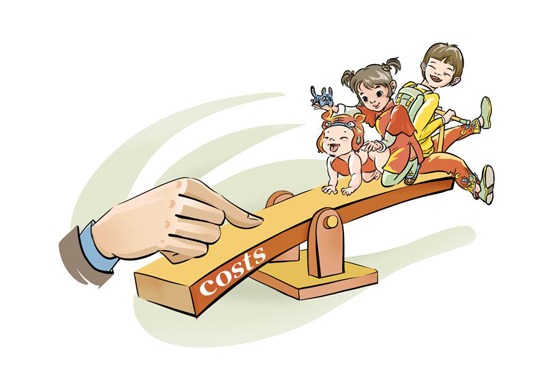
With economic growth, the costs of living and raising children are increasing, putting more pressure on families. Moreover, families have weaker demand for a certain number of children and stronger demand for quality. They tend to centralize their limited resources to cultivate "brilliant" children.
Q: What are the most serious challenges facing China?
A: The willingness to have children is weak. The fertility base is contracting. Reproductive behavior is negative.
For example, the number of women of childbearing age is about 330 million and is expected to drop to 200 to 240 million by 2050. The average age for first marriage is 26, and the age of first childbirth is about 28. Mothers of second or third children are much older, which means higher risks.
Longevity and a low fertility rate lead to an aging population. With the rise of elderly people's population, and the decline of the labor force, the structure of the population will change. And that will pose challenges to social development.
Q: What impact will the shrinking population have on China's social and economic development?
A: We don't need to be overly pessimistic on this issue. Population is important, but it doesn't determine the rise or fall of a country.
The impact will only manifest two or more decades later, because babies born today will join the labor force after 20-30 years. In the short and medium time frame, we will continue to enjoy the "demographic dividend" brought about by earlier generations.
Although it's turning toward negative growth, China's population will still be about 1.2 billion to 1.3 billion in 2050, which is very large. Five years later, India may replace China as the country with the largest population in the world, but China will remain a close second. For a long time, the pressure of population on the economy and society will not change. The tension between the large population and limited resources will remain strong.
Even though the number of people of working age will decline, it will still be about 720 million by the middle of this century, which is much larger than developed countries. Employment pressure will still be strong, as China goes into a more technological, digital and intelligent industrial era. Artificial intelligence and robots will replace a lot of jobs. And the demand for human labor will focus on quality instead of numbers.
But long-term low fertility may threaten national security. We must be vigilant about the long-term risks of a low fertility rate.
Q: What steps should be taken to overcome the challenges posed by the declining population?
A: We need to ask young people what are their requirements for having a child, and what public services they want. Since 50-70 percent of the children are cared for by their grandparents, public nurseries should help address part of the problem.
Policies should take people's needs and worries into consideration. Many provinces have extended maternity leave to encourage reproduction. However, the longer the leave, the harder it is for a new mother to return to the workplace. If a wife loses her job, how can a family raise children?
Companies will also be under greater pressure to pay workers that do not work for a long time. As a result, it becomes more difficult for women to rejoin their post or find a job. It would be great if preferential tax rates could be introduced to decrease the costs of employers.
More supporting policies that meet youngsters' demands and expectations are needed.
About the interviewee
Yuan Xin is a professor of demography at the Population and Development Research Institute of the School of Economics, Nankai University in Tianjin. He is a director of the university's Aging Development Strategic Research Center as well as director of the aging society governance strategic research base of the China National Committee on Aging. Yuan has 39 years of experience teaching population science, with a focus on population economics, policies, sustainable development and aging society. He has been taking part in key national research projects aimed at finding ways to tackle issues such as aging population, and facilitate long-term planning for age-related industries and reforming the family planning policy. Yuan has joined more than 100 national, provincial and international projects, and has published 30 books and more than 200 essays, and received multiple awards for his research in social sciences.
The views don't necessarily represent those of China Daily.
If you have a specific expertise, or would like to share your thought about our stories, then send us your writings at opinion@chinadaily.com.cn, and comment@chinadaily.com.cn.