Hope springs again: Chunyun will be back soon







I have been feeling somewhat frustrated lately, as a prediction I had made a year ago has failed to come true.
In an opinion piece I wrote before the Spring Festival holiday last year, I had predicted that "Chunyun will resume its merry hustle and bustle next year as COVID-19 is expected to die away." However, it has not. In fact, it seems unlikely that the virus will go away anytime soon.
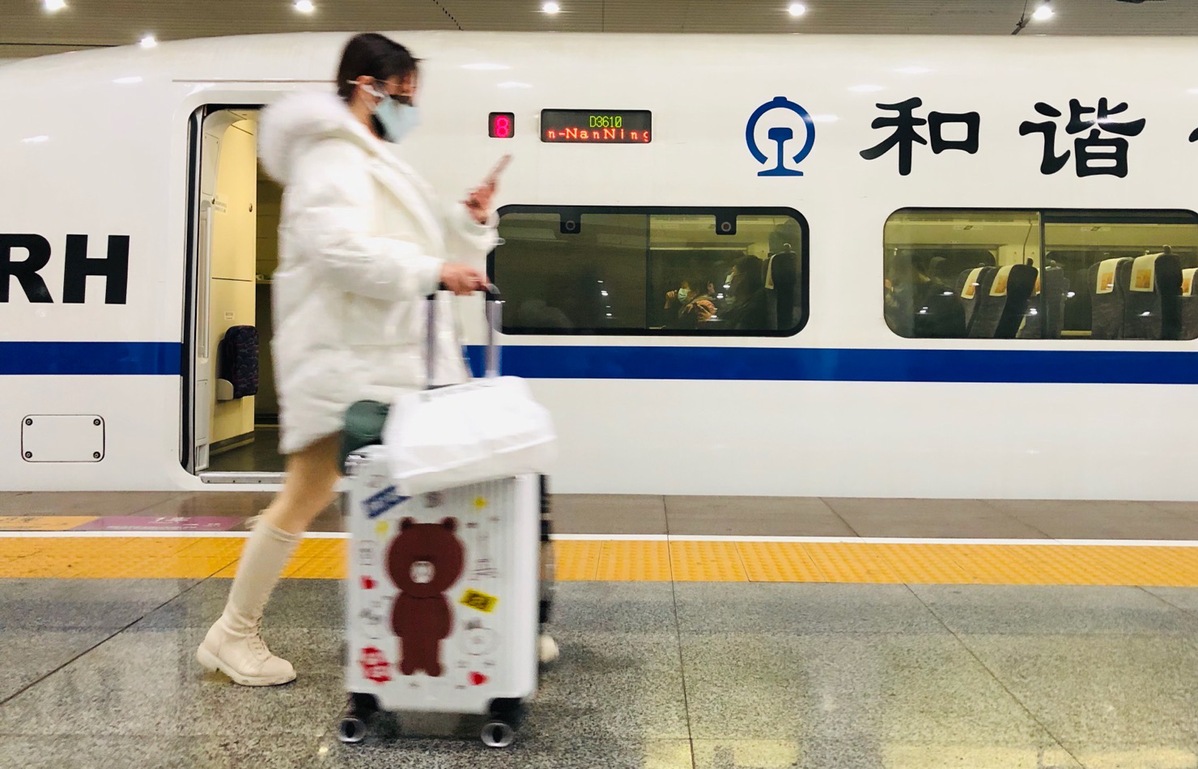
Chunyun, which literally means "spring transportation", refers to the annual mass migration around the Lunar New Year. For people who work and live far away from their homes, the word evokes memories of family reunions and, the essential, home food. It means scrambling for train or plane tickets and transiting between various means of transport, but it carries with it a feeling of happiness. The COVID-19 pandemic ruined that feeling in the lunar New Year of 2020 and cast its shadow on the festival last year too.
The pandemic has disrupted normal life in the world for two years now. In China, despite its phenomenal success in limiting the spread of the virus, the fear of a resurgence of the pandemic is still keeping people from traveling without fear.
The latest outbreaks of Delta and Omicron strains of the virus in a few cities have prompted many local authorities to adopt stricter measures to prevent the situation from worsening, although the number of infections is still low – the daily increase of confirmed cases remains within two digits – as compared with other parts of the world, where the figure ranges from hundreds to thousands to hundreds of thousands.
The fresh measures have inevitably caused inconveniences for Spring Festival travelers.
Western critics have been blaming China's "dynamic zero-COVID policy" for "infringing on people's personal freedoms" and "violating human rights". But the fact that China has effectively contained the spread of the virus and has the lowest rates of infections and deaths in the world has made them admit, though affectedly, that China's fight against the pandemic "seems like an enormous success."
Unable to deny the facts, China-bashers have now found a new way to embarrass the country. They claim that "China's zero-COVID strategy is becoming increasingly unsustainable" and are lecturing China on the need to give up this approach and "learn to live with the virus" like certain Western countries are doing.
I'm not writing to debate with them, as my focus is on how the new restrictions will affect the way Chinese people celebrate the Spring Festival holiday and how the measures can be exercised to keep the impacts to the minimum. What well-known American writer Jacob Bacharach said recently may have best answered the above-mentioned China critics: "The coordinated effort to discredit and deride the world's most successful COVID response by the world's least successful is the most extraordinary, and the dumbest, media blitz we've seen in quite a while."
After two years of fighting the COVID-19 virus and its variants, the Chinese people have learned, and become accustomed to, the effective ways of protecting themselves – wearing face masks, keeping social distance, and cooperating with the authorities when restrictive measures must be enforced to stop the viruses from spreading. For instance, people went for "all-member" nucleic acid testing repeatedly, as required by the local authorities, with understanding for the necessity.
Cooperation from the public is the best guarantee for the success of epidemic-fighting policies. This cooperation should be cherished rather than abused.
However, some local governments have adopted virus-containing measures that are much harsher than what is needed, causing unnecessary inconvenience to the public.
A few days ago, a video went viral on social networking sites showing two young sisters from Beijing being prevented from exiting the Harbin railway station and being allowed to see their locally residing grandparents, who had come to the station to receive them, for only a few minutes and that too from a distance.
The girls were in Harbin to spend the Spring Festival holiday with their grandparents. After their 10-hour journey by train, they were told to either return to Beijing or undergo a 14-day quarantine. The girls had no option than to obey. Their grandparents, who have been waiting to receive them, were only able to see them from a bridge over the railway platform briefly.
The reason the local authorities gave for not letting the girls stay with their grandparents was that they came from Haidian district of Beijing, where a certain community has reported COVID-19 cases. However, Haidian is a large area comprising numerous sub-districts, and except for the sub-district in question, the rest of Haidian has been listed as "low-risk areas". So, how could the girls have constituted any threat to Harbin?
Such overreaction is not confined to Harbin. A few days ago, a couple from Hangzhou decided to drive to their hometown in Lanzhou, 2,000 kilometers away in Northwest China. However, after driving for two days and 1,300 kilometers, when they reached Xi'an, they received a call from Lanzhou, which told them to return to Hangzhou because new COVID-19 cases had been reported in the East China city.
Another man flew from Hangzhou to Xi'an only to be sent back after the Xi'an airport denied him entry. "I spent a whole day flying in the air," he said.
The people blame these tough measures on what they call "lazy governance". Certain officials desist from taking more precisely targeted measures. They are content with exercising uniformity in all cases without caring one bit how much they inconvenience people by doing so. All they care about is retaining their career by ensuring that no unexpected scenario arises for them to account for.
They need to sincerely answer the call to keep in mind their "aspiration and mission" to serve the people.
Finally I would like to repeat the expectations I had made for last year, that "Chunyun will resume its merry hustle and bustle next year as Covid-19 is expected to die away." I hope that with it officials' "lazy governance" too goes away.
Postscript: The State Council's COVID-19 prevention and controlling unit on Saturday announced "Five Must-Nots", warning local governments against "arbitrarily forbidding people from returning to their hometown for the Spring Festival," "forcing travelers to return to their starting place which is a 'low-risk area'," and "extending at will the scope of areas under travel-restriction ordinance."
The author is a retired senior editor with China Daily
The opinions expressed here are those of the writer and do not necessarily represent the views of China Daily and China Daily website.
If you have a specific expertise, or would like to share your thought about our stories, then send us your writings at opinion@chinadaily.com.cn, and comment@chinadaily.com.cn.