Holistic solution







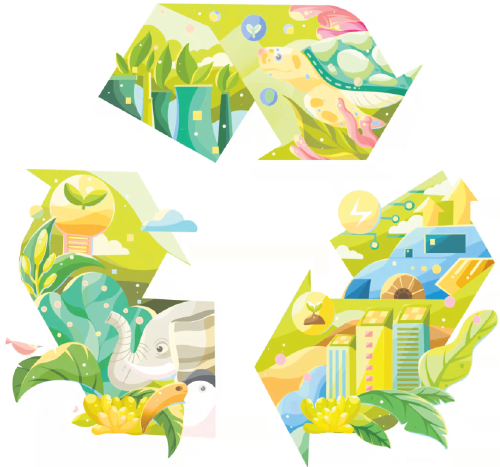
Building a community of life for mankind and nature entails a shift from industrial civilization toward ecological civilization
World Environment Day falls on June 5, and this year marks the 50th anniversary of the convening of the United Nations Conference on the Human Environment. Despite growing global efforts to address ecological and environmental issues, global climate change, biodiversity loss, escalating desertification and frequent extreme climate events pose severe challenges to human survival and development.
According to the Human Development Report released by the United Nations Development Programme, the COVID-19 pandemic and rising global temperature suggest that humans are putting unprecedented pressure on the Earth. The report said that the greatest issue facing human beings in the 21st century is to coexist with the nature. Therefore, human-nature relations are the key for ensuring the sustainable development of human beings in this century.
China has set "building a clean and beautiful world" as the theme of the 2022 World Environment Day. In the next five decades, countries need to uphold and launch multilateralism and jointly build a community of life for mankind and nature.
Chinese President Xi Jinping proposed to build a community of life for mankind and nature at the Leaders' Climate Summit on Earth Day on April 22, 2021. He pointed out solutions to the dilemma of global environmental governance and offered theoretical references for addressing human-nature relations. Human-nature conflicts will be mitigated and harmonious coexistence will prevail, which can maintain ecological balance and bring benefits to humans.
The preservation and continuation of human civilization rely on the balance of materials and energy and between human activities and the natural environment. Since human-nature conflicts, especially climate crises, are posing challenges to the survival and development of civilization, efforts are needed to strike a balance between human society and the natural environment, of which the fundamental goal is to achieve harmonious coexistence between humans and nature. The new landscape of harmonious coexistence will generate new productivity, promote humans to drive economic growth through green innovation, boost the energy transformation and industrial upgrading, and transform social production and consumption mechanisms to promote the shift from the industrial civilization to an ecological civilization featuring sustainable development.
China has incorporated the goal of building an ecological civilization into its Constitution and incorporated it in the overall plan of socialism with Chinese characteristics. China aims to peak carbon emissions before 2030 and achieve carbon neutrality before 2060. The 30-year period is much shorter than that of developed countries, which calls for great efforts. China will control coal-fired power projects, keep coal consumption from growing during the 14th Five-Year Plan period (2021-25) and reduce coal consumption during the 15th Five-Year Plan period (2026-30). An action plan unveiled by the State Council, China's Cabinet, in October 2021 proposed to involve the carbon peaking and neutrality goals into China's socioeconomic development, peak carbon emissions steadily, promote green transformation of production and lifestyles, as well as the efficient utilization of resources and low carbon economic and social growth to ensure the goals are achieved as scheduled.
Over the past five years since the Paris Agreement was signed, many involved countries have failed to launch sufficient measures, and some big emitters have even pulled out. Adhering to the agreement is the only right policy path to address climate change. China has been steadily carrying out actions to fulfill the Paris Agreement. Before the 26th United Nations Climate Change Conference of the Parties was held last November in Glasgow, Scotland, China issued a white paper titled "Responding to Climate Change: China's Policies and Actions", which has improved its nationally determined contributions. To peak carbon emissions, the country plans to make the share of non-fossil energy consumption account for around 20 percent of its energy consumption by 2025, and reduce its energy consumption per unit of GDP by 13.5 percent from 2020. It also eyes cutting carbon dioxide emissions per unit of GDP by 18 percent compared with 2020.By 2030, China will increase the share of non-fossil energy consumption to about 25 percent, and reduce carbon dioxide emissions per unit of GDP by over 65 percent from the 2005 level. In further increasing its NDCs, China is working hard to fulfill its commitments under the Paris Agreement.
China is also driving the development of a new blueprint for global biodiversity governance. In October 2021, President Xi delivered a keynote speech on building a community of all life on Earth at the 15th meeting of the Conference of the Parties to the Convention on Biological Diversity (COP 15), proposing that humans need to respect, adapt to and protect the nature, and build a home where humans and nature coexist in harmony. At the COP 15, China announced that it would take the lead in investing 1.5 billion yuan ($225.2 million) in establishing the Kunming Biodiversity Fund to support biodiversity conservation in developing countries. Attaching great importance to biodiversity conservation, China has promoted the development of protected natural areas, and accelerated to establish a system of protected natural areas with national parks at the core. China is one of the first countries to propose and implement a redline system for ecological protection, and its initiative of "drawing a redline for ecological protection to mitigate and adapt to climate changes" has become one of the 15 cases of the UN "Nature-based Solutions", gaining great recognition from the international community.
Ensuring harmonious coexistence between humans and the nature is the only way for mankind to address the climate crisis and ensure climate security in the 21st century. It is also the only solution to improving energy utilization, and promoting the green economy, ecological security and better global climate governance. Countries should uphold and launch multilateralism, ensure ecological preservation, and jointly build a clean and beautiful world.
The author is deputy director of the Center for Climate Change and Ecological Security Studies at the China Institutes of Contemporary International Relations. The author contributed this article to China Watch, a think tank powered by China Daily.
The views do not necessarily reflect those of China Daily.
Contact the editor at editor@chinawatch.cn