BRICS steering development into new era







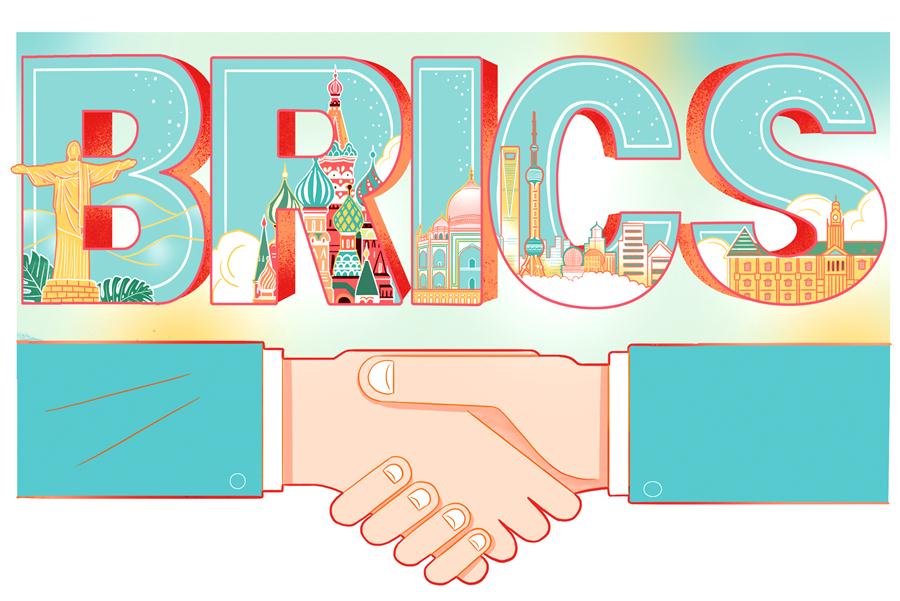
BRICS provides an alternative mode of financing for development, is a platform for South-South cooperation, a game changer in the North-South dialogue, and a balancing mechanism in the context of building a fair global economic order.
The just-concluded BRICS Summit, chaired by China, was the 14th since 2009. What can we learn from these 14 top-level meetings among the BRICS countries?
Indeed, there has been skepticism over, even criticism against, BRICS. After all, the grouping of the five countries (Brazil, Russia, India, China and South Africa) seems quite unusual. They are dispersed geographically, their economies are in different stages of development, and they follow different political systems.
Yet the grouping has not collapsed due to those differences. Instead, cooperation among the BRICS countries has become in-depth and diversified over time. BRICS promotes South-South cooperation and North-South dialogue. Its internal mechanism and external interaction with other states or organizations inspire multilateral cooperation and promote the UN-centered global order.
The first decade of BRICS saw the member states establish or deepen cooperation in various fields, achieve convergence, and strengthen relations. On the financial front, the BRICS countries established the New Development Bank, providing infrastructure financing for member states and other emerging market and developing economies.
In the healthcare sector, the BRICS health ministers' annual meetings have already been institutionalized, where practical subjects and issues are widely discussed, and BRICS initiatives are considered by the World Health Organization as part of the voice of the developing countries.
And on the agriculture front, China, India, Russia and Brazil are among the top food producers in the world.
These are all examples of the relevance of BRICS, and cooperation within the bloc regardless of the member states' ideological and political differences. The BRICS countries walk together on a mutually beneficial path.
The BRICS mechanism is also seen as an attempt by emerging market and developing economies to increase their say in global governance. For example, all the BRICS countries are members of the G20 and have established the unofficial practice of meeting right before the G20 Summit, so as to achieve convergence on major issues. For another example, the BRICS countries pushed for the reforms of the International Monetary Fund and the World Bank. And although the results of the reforms were not so satisfactory, they at least signaled the start of change.
The voice of BRICS is also heard in global security governance. All the five BRICS countries were members, either permanent or non-permanent, of the United Nations Security Council in 2011, and expressed their opinions on international security through their votes in the Security Council. It is true that the developed countries still dominate global governance, but the BRICS countries have made the world realize the fact that the voice of developing countries can no longer be ignored.
After the first decade, BRICS cooperation has already made remarkable achievements. Yet a deeper partnership and a long-term mechanism need to be built if the BRICS countries want to enhance their international influence. The NDB, the "BRICS Plus" mechanism and the inclusion of new members are three significant directions for the future development of BRICS.
The NDB, a core part of the BRICS mechanism, has turned a forum into an institution. The NDB does not impose harsh conditions while providing infrastructure financing for the member states or other emerging market and developing economies. Internally, the NDB is a platform for better integration of resources of the BRICS countries, enlarging the effect of investments. Externally, the NDB brings the member states and other developing countries closer, and promotes mutual development.
The NDB aims to foster greater financial and development cooperation among the BRICS member states as well as other developing countries, and supplement the efforts of multilateral and regional financial institutions such as the IMF, the World Bank and the Asian Development Bank for global development, and thus give BRICS a bigger say in global governance.
The "BRICS Plus" mechanism was introduced at the BRICS Summit in Xiamen, Fujian province, in 2017. Although the global influence of the BRICS countries has increased significantly, given the trade war and the financial war launched by the United States, it may be a wise choice to turn BRICS into an open platform to forge cooperation across continents. That would be not only beneficial to the economic development of countries, but also help build a better world order, in which emerging market and developing economies can compete and coexist on an equal footing with their developed counterparts.
This year is ideal to talk BRICS' expansion, because it's been five years since China proposed to start the expansion process. Although explorations and procedures continue, unofficially the United Arab Emirates, Saudi Arabia, Egypt, Nigeria, Senegal, Kazakhstan, Indonesia, Argentina and Thailand are among the countries that could join the grouping.
All in all, BRICS' importance to the global economy is noteworthy in terms of population (40 percent), GDP(25 percent nominal), land area (30 percent), world trade (18 percent), and foreign exchange reserves ($4 trillion). And BRICS enlargement will help the grouping more soundly steer global development toward a more fruitful and mutually beneficial new era.
The author is an associate professor at, and associate dean of, the Institute for Research on Portuguese-speaking Countries, City University of Macau.
The views don't necessarily reflect those of China Daily.
If you have a specific expertise, or would like to share your thought about our stories, then send us your writings at opinion@chinadaily.com.cn, and comment@chinadaily.com.cn.