Clear and present danger







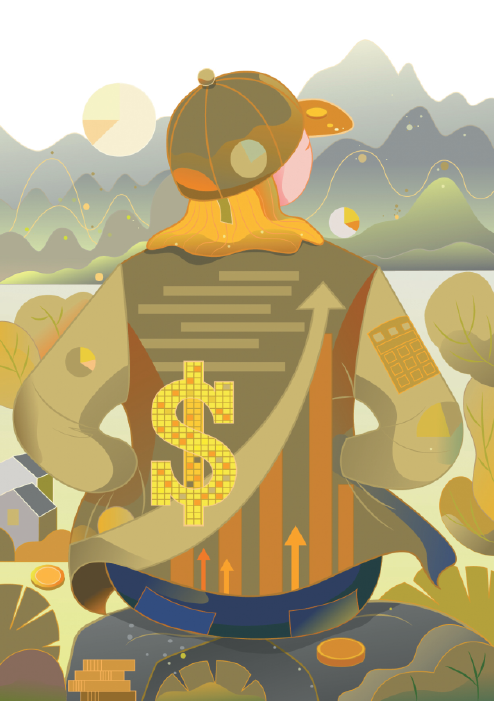
YANG MEINI/FOR CHINA DAILY
The US economy is staring at a stagflation similar to that of the 1970s
As inflation unexpectedly rose in May, the United States Federal Reserve raised interest rates by 75 basis points at its June rate-setting meeting, the highest increase since 1994. The Fed hoped to curb excess demand by raising interest rates and look for a possible path to a soft economic landing in the future. But experience over the past half century or so shows that the odds of a soft landing against the backdrop of Fed rate hikes are less than 30 percent.
Since 1965, the Fed has gone through 11 interest rate hike cycles. Among them, the Fed managed to reduce inflation three times-in 1965, 1984 and 1994-without triggering a recession. Across these relatively successful landings, the US economy had several things in common: the labor market was not very tight; the inflation level was relatively low; the supply chain was relatively stable; and the interest rate level was higher than the inflation level.
Why are these conditions so important? A relatively loose labor market means businesses can respond to interest rate hikes by cutting wages, thus preventing spiraling inflationary pressure on the economy. Low inflation also reduces the pressure on the Fed to tighten its monetary policy, leaving greater room to balance employment and inflation. Moreover, the relatively stable supply chain means there is no risk of stagflation in the economy, and the Fed's monetary policy can cool the economy by suppressing demand. Finally, the fact that interest rates were above inflation suggests that the Fed acted ahead of the wage-price spiral, instead of choosing not to raise rates until inflation got out of hand. In such cases, the tightening of monetary policy will be more effective, otherwise the effectiveness of tightening will be uncertain and the cost will be greater.
Experience from the past half century shows that the US economy will fall into recession within the next two years once inflation is above 4 percent and unemployment below 5 percent. Former US treasury secretary Lawrence Summers pointed out this phenomenon in his latest co-authored paper.
In the 1970s and 1980s, the US raised interest rates four times in response to stagflation, and the four hikes had all triggered recessions. Several other failed landings were: the recession from July 1990 to March 1991, mainly caused by Fed interest rate hikes, coupled with the savings and loan crisis and Iraq's invasion of Kuwait, the recession from March 2001 to November 2001 caused by the Fed raising interest rates to burst the internet bubble crisis and the Sept 11 terrorist attacks; the recession from December 2007 to June 2009 triggered by the Fed's interest rate hike that burst the housing bubble, which evolved into the subprime mortgage crisis.
Compared with the three situations when the US economy achieved soft landings, the current pressure on the US is far greater. The US labor market is tighter than the jobless rate suggests. In April, the job openings rate in the US was as high as 7 percent, and job turnover rate, which shows the number of people quitting their jobs, was as high as 2.9 percent, both significantly higher than pre-pandemic levels. The unemployment rate was as low as 3.6 percent in May, which is almost equal to the pre-pandemic level. All the factors will lead to accelerated wage growth on a continuous basis.
The consumer price index, a main gauge of inflation, continued to rise month-on-month, and the basis for inflation became stronger. In May 2022, the year-on-year CPI growth rate unexpectedly climbed to 8.6 percent, which not only exceeded the expected 8.3 percent, but also grew by 1 percent on a monthly basis. This shows that prices are still rising, and that inflation has not yet peaked.
The Fed misjudged the inflation situation and acted too slowly, which kept the real interest rates negative for a long time, leading to rising prices and excessively high asset valuations.
Finally, the repairing of supply chains has been slow and the economy is at risk of stagflation. The supply side of the US economy has been hit harder, especially the instability of the manufacturing supply chains caused by tensions between China and the US, and the volatile commodity prices caused by the Ukrainian crisis and sanctions on Russia imposed by the US and the European Union.
The US economy is now facing the risk of stagflation similar to the 1970s under the continued negative shocks on the supply side. As mentioned earlier, historical experience shows that the Fed has never succeeded in managing stagflation without causing a recession. The Fed is trying to reduce excessive demand by sharply raising interest rates to curb the pull of demand on inflation. However, it is difficult for the Fed's interest rate hikes to affect the supply side. The Fed hopes to rein in inflation without triggering a sharp rise in unemployment. While that's a possible scenario, it's becoming increasingly difficult. Data from the June meeting show that the Fed is likely to raise the federal benchmark interest rate to around 3.4 percent by the end of 2022, a restrictive level that is likely to give the US economy a hard landing. Of course, the future path of the Fed's interest rate hikes will hinge on inflation and new changes in the economic situation, but the Fed will have to take the risk of going too far or not going far enough.
Yang Zirong is an associate researcher of the Institute of World Economics and Politics at the Chinese Academy of Social Sciences. Xu Qiyuan is a researcher and deputy director of the IWEP at the CASS. The authors contributed this article to China Watch, a think tank powered by China Daily. The views do not necessarily reflect those of China Daily.
Contact the editor at editor@chinawatch.cn