Xinjiang harnessing clean energy for a better future








This year marks the 70th anniversary of the founding of the Xinjiang Uygur autonomous region, a land that covers onesixth of China's territory. Over the past seven decades, Xinjiang has undergone some remarkable transformations — economically, socially, and culturally. Once primarily associated with coal, oil and cotton, the region is now emerging as a national and global hub of innovation in clean energy. Its story is no longer about resources extracted; it is about energy re-imagined, harnessed responsibly, and shared broadly.
Xinjiang's energy mix used to be dominated by coal. Coal not only underpinned the region's local economic growth but was also transported via trains to other parts of the country, making a vital contribution to China's national development. Coal did power the economy, but it also caused heavy environmental damage, and led to inefficiency and high transportation costs.
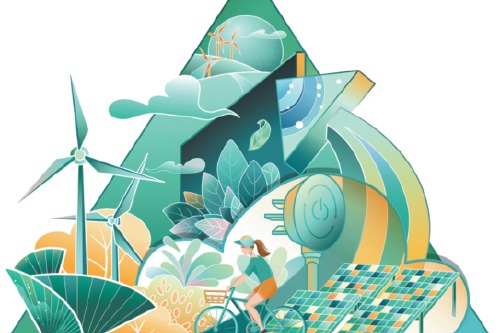
In China's quest to achieve its ambitious "dual-carbon" goals — of peaking carbon emissions before 2030 and realizing carbon neutrality before 2060 — Xinjiang is playing a key role. The region's focus is now on wind and solar energy, transforming both its landscape and role in the national energy system. Over the past decade, vast stretches of desert have been blanketed with solar photovoltaic panels, while wind turbines now punctuate valleys and the Gobi plains. Xinjiang has moved from "transporting coal" to "supplying electricity", a revolutionary shift that signals the region's readiness for a cleaner, smarter energy future.
Xinjiang's natural conditions make it ideal for clean energy development. Long hours of sunlight and vast open stretches of land create the perfect condition for solar farms, while the Tianshan Mountains' abundant strong winds have given rise to expansive wind energy projects. The combination of favorable geography and climate has put the region at the forefront of the country's clean energy revolution.
Yet clean energy comes with its challenges. Solar and wind power, while sustainable, are inherently variable. Xinjiang once faced the frustrating reality of "electricity only when the sun shines or the wind blows". To overcome this, the authorities have adopted a multi-pronged approach: ultra-highvoltage direct-current (UHVDC) transmission lines now carry surplus electricity thousands of kilometers away to central and eastern China to meet the high demand there and prevent waste.
Also, energy storage systems and smart grid optimization have boosted efficiency, turning formerly idle wind and solar power into reliable energy streams. The once-common phenomenon of "abandoned wind and solar power" has been drastically reduced. Every ray of sunlight and gust of wind is now put to maximum use.
The increasing production of clean energy in Xinjiang is not only about technology; it is also about creating a local ecosystem. An increasing number of homegrown companies are engaged in manufacturing, installing and maintaining wind and solar power infrastructure, fostering a thriving industrial cluster, generating employment and driving high-quality economic development. Clean energy has become a new engine of prosperity for the region.
Xinjiang's clean energy transformation has also reshaped the region's role in national energy distribution. Previously, coal and oil required long-distance rail and road transport, which was costly, energy-intensive and environmentally damaging.
Today, UHVDC transmission allows electricity to flow directly from Xinjiang's wind and solar power farms to the central and eastern regions, making energy supply more efficient, sustainable and reliable.
The region is transitioning from a resource-exporting hub to a modern energy powerhouse, where invisible streams of clean energy are replacing the rumble of coal-carrying trains. This structural shift has enhanced Xinjiang's strategic importance in China's energy landscape while injecting fresh momentum into the region's development.
Looking ahead, Xinjiang's clean energy ambition aligns seamlessly with the Belt and Road Initiative. Apart from serving the country, the electricity the region generates could also be exported to Central and South Asia, and even other global markets, through cross-border grids. Xinjiang's green energy is no longer just a local asset; it is a part of the global energy transition and lowcarbon development, reflecting China's commitment to sustainability and global cooperation.
The benefits of clean energy extend beyond the economy. Many parts of Xinjiang have fragile ecosystems, and face desertification and water scarcity. Energy-intensive development models are unsustainable. Clean energy offers a path to balance growth with ecological stewardship. Solar power farms help reduce evaporation and sandstorms, while wind power projects integrate with agriculture and pastoral practices, creating a model of efficient, multifunctional land use. These projects also create jobs and improve people's livelihoods.
A key hub on the ancient Silk Road, Xinjiang now leverages its strategic location in the Belt and Road Initiative to advance cross-border energy cooperation. Through partnerships with neighboring countries, Xinjiang not only exports electricity but also drives the development of new energy equipment, technological services and financial collaboration, facilitating economic diversification and strengthening the region's role in the global energy transformation.
In the past seven decades, Xinjiang has transformed into a "region of wind and sun", creating a model for resource-dependent regions seeking sustainable transformation. With wind and sunlight as partners, Xinjiang is charting a future that combines environmental responsibility with economic vitality. Clean energy is not a slogan — it is tangible productive power, a choice for protecting the environment, and enhancing development potential.
To countries pursuing green development, Xinjiang's experience offers valuable lessons. Even in deserts, respecting nature and harnessing technology can create paths that are both ecologically sustainable and economically prosperous. After 70 years of challenges and achievements, Xinjiang stands at a new historic juncture, embracing a future that is better, brighter and cleaner.
The author is a professor at the School of Electrical Engineering, Xinjiang University.
The views don't necessarily reflect those of China Daily.
If you have a specific expertise, or would like to share your thought about our stories, then send us your writings at opinion@chinadaily.com.cn, and comment@chinadaily.com.cn.