Cutting the cake fairer







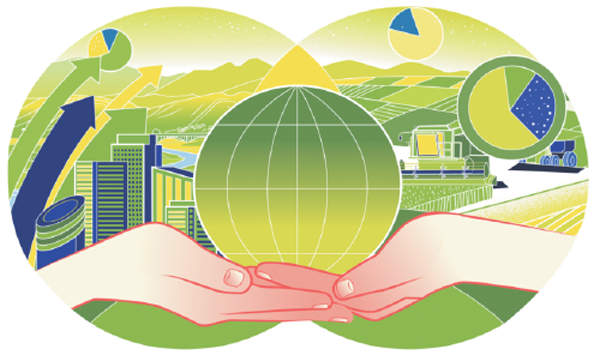
Through South-South cooperation, China can help ensure more resilient and balanced global development
Editor's notes: The world has undergone many changes and shocks in recent years. Enhanced dialogue between scholars from China and overseas is needed to build mutual understanding on many problems the world faces. For this purpose, China Watch Institute of China Daily and the National Institute for Global Strategy, Chinese Academy of Social Sciences, jointly present this special column: The Global Strategy Dialogue, in which experts from China and abroad will offer insightful views, analysis and fresh perspectives on long-term strategic issues of global importance.
The world has entered a new period of volatility and transformation. In the fallout from the COVID-19 pandemic, the global wealth gap has widened, partly reversing the progress on eradicating poverty.
According to the Global Wealth Report 2022 recently released by Credit Suisse, total global wealth grew by 12.7 percent in 2021, the fastest annual rate ever recorded. By comparison, the wealth share of the global top 1 percent has risen for two consecutive years, from 43.9 percent in 2019 to 45.6 percent in 2021. The number of ultrahigh-net-worth individuals with net worth above $50 million rose by 46,000. Meanwhile, at least 75 million additional people are facing extreme poverty this year.
According to the World Bank's Poverty and Shared Prosperity Report 2022, the COVID-19 pandemic has resulted in the biggest setback in global poverty-reduction efforts since 1990. The pandemic has hit impoverished groups the hardest, with the bottom 40 percent of the population suffering an average 4 percent loss of income, twice as much as the wealthiest 20 percent. As a result, global inequality has risen for the first time in decades. According to a report released by the Food and Agriculture Organization of the United Nations, hunger affected 46 million more people in 2021, and the number has grown by about 150 million since the outbreak of the COVID-19 pandemic. The widening gap between the rich and the poor has caused more serious harm to certain regions in Africa and Asia, as well as to disadvantaged groups such as low-income individuals, women, and children. If this trend cannot be reversed, the implementation of the UN 2030 Agenda for Sustainable Development will face even greater obstacles.
In fact, even in a world without the pandemic, external shocks often have a disproportionately negative impact on vulnerable groups and less developed countries. As in the spillover effects of the current Ukraine crisis, the food crisis mainly threatens vulnerable groups and less developed economies, further exacerbating global inequality. At present, there is still a serious deficit in global development governance, and the polarization of the rich and the poor caused by external shocks needs to be urgently addressed so as to achieve more resilient and balanced development at both the global and national levels. To this end, China can and should play a greater role through South-South cooperation.
First, at the multilateral level, China continues to unite the Global South to bring poverty reduction and development back to the center of the international agenda. The pandemic and geopolitical conflicts have presented some developing countries with greater difficulties in the field of public well-being, with many people in developed economies also being hit hard. What is even more worrying is that a few countries have marginalized and weaponized development issues in order to maintain their own economic strengths and technological monopoly. They have even attempted to make their own will and standards universal rules that all countries need to abide by, in total disregard of the development stage of developing nations, which have posed growth barriers for late-developing countries and further widened the divide between the North and the South.
In the face of the huge shortfall in global development resources, China has proposed the Global Development Initiative to jointly build a global community of development. China convened the Ministerial Meeting of the Group of Friends of the GDI in September, which further consolidated the global development consensus. On the one hand, China, together with other emerging economies and developing countries, has strengthened policy coordination under multilateral frameworks such as the United Nations, the World Bank, and the G20 to jointly tackle global poverty. China is the country that has provided the most vaccines to the international community and ranks first among the G20 members in terms of loan deferrals under the G20 Debt Service Suspension Initiative for the Poorest Countries. China is also the developing country offering the largest amount of financial assistance, dispatching the largest number of experts and conducting the largest number of projects under the South-South cooperation framework of the Food and Agriculture Organization. On the other hand, China remains committed to speaking up for developing countries in multilateral platforms and improving the representation and voice of developing countries in the international governance system.
Second, at the bilateral level, China has expanded and deepened South-South cooperation and leveraged its own advantages to forge pilot projects for common prosperity. Compared with the global financial crisis in 2008, developed countries have greatly reduced their contribution to international development cooperation since the onset of the pandemic. With the exception of a few countries, the official development assistance of the vast majority of OECD Development Assistance Committee member countries has declined markedly. Meanwhile, emerging economies, including China, continue to undertake international responsibilities in keeping with their own development stages and actual capabilities, and actively promote the upgrading of international development cooperation with greater investment.
China is both a beneficiary of and an increasingly active contributor to international development cooperation. Beijing hosted the High-level Dialogue on Global Development in June and pledged to upgrade the South-South Cooperation Assistance Fund to the Global Development and South-South Cooperation Fund, which has injected strong impetus to accelerate the implementation of the 2030 Agenda for Sustainable Development. In South-South cooperation, China emphasizes high standards, people-centered and sustainable development, and focuses on creating new highlights in cooperation, such as clean energy, the digital economy and smart cities. Going forward, China can work with other developing countries to make better use of developmental financial instruments such as the Asian Infrastructure Investment Bank, the Silk Road Fund and the BRICS New Development Bank to strengthen international development cooperation, implement livelihood projects, carry out poverty alleviation demonstrations and help developing countries reduce poverty.
In addition, at the knowledge level, China should help develop a system of theories on development economics that is suitable for latecomers, especially the least developed countries, so as to strengthen their sustainable development capacities and enhance the effectiveness of international development cooperation. It only takes a tiny fraction of global GDP to lift the world out of extreme poverty, and it is imperative to increase the effectiveness of poverty reduction efforts.
This year, China established the Global Development Promotion Center, released its Global Development Report, and announced that it will establish a Global Knowledge Network for Development. In order to bridge the development gap between the North and the South, it is important for international development finance and international economic rule books to better accommodate the realities of developing countries and further benefit least developed countries and the poor. China has the ability and responsibility to contribute knowledge, theories and solutions to solving global poverty and promote the realization of global common prosperity through more effective technology transfer and knowledge sharing.
The author is an assistant researcher with the Institute of World Economics and Politics at the Chinese Academy of Social Sciences. The author contributed this article to China Watch, a think tank powered by China Daily. The views do not necessarily reflect those of China Daily.
Contact the editor at editor@chinawatch.cn