Joint efforts for the future of the Global South








China-IFAD SSTC Facility is effectively promoting knowledge exchange to achieve the global SDGs
Over the recent decades, we've seen China becoming an increasingly influential actor on the global development stage and actively contributing to the realization of the United Nations' Sustainable Development Goals. Many countries in Africa, Latin America and the Caribbean region, Asia and the Pacific, the so-called Global South, have witnessed from China's support and the outcomes of both bilateral and multilateral cooperation.
Financial contributions and knowledge sharing appear to be the two main ways in which this role has been played out. In 2020, for instance, China's support to the United Nations system rose to almost $2 billion, making China the fifth-largest government donor. That was more than a 10-fold increase over the figure in 2010, when China ranked the 21st. This is a paradigmatic shift in the development sector, which demonstrates the great potential of emerging markets and middle-income countries in promoting the sustainable development of the Global South.
China is also a major partner to the South-South and Triangular Cooperation, a model where a third party, such as a UN agency, acts as an interlocutor between two or more countries in the Global South to facilitate knowledge exchange. While the developed countries of the Global North certainly hold much knowledge and technologies, there is a particular added value for countries in the Global South to mutually share their experiences of recent development, including the application of new technologies, in the development context, for example, agricultural digitalization.
China in particular holds a rich endowment of such experiences, having made tremendous advances in many areas of development in the last four decades. Since the launch of the reform and opening-up in 1978, nearly 800 million Chinese have managed to lift themselves out of poverty, culminating in the announcement of the complete eradication of extreme poverty in 2020. The lessons learned from this development journey constitute a valuable "global public good" that holds the potential to benefit many countries which are still struggling with providing sustainable solutions for the 657 million people around the world still living in extreme poverty, which has increased by around 15 million compared to pre-pandemic times.
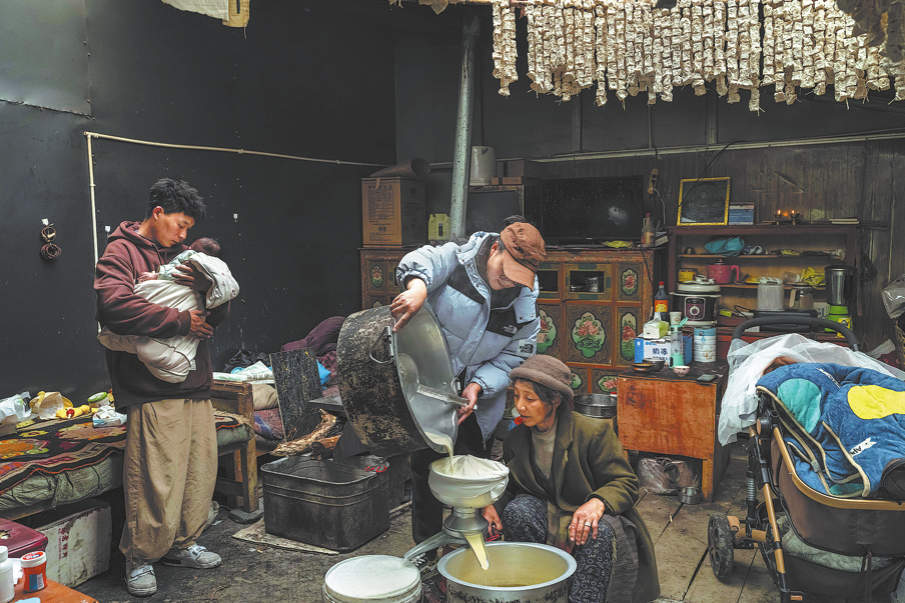
Global poverty remains a largely rural phenomenon, with almost 80 percent of the impoverished population living in rural areas, the majority of whom work in agriculture. In this regard, China's achievements are largely a testimony of successful rural development policy and agricultural research, which are some of the most crucial areas to focus on through South-South and Triangular Cooperation.
Since 1980, the International Fund for Agricultural Development of the United Nations has been working closely with the Chinese government to fight poverty and empower vulnerable rural people in China, particularly women, young people and minorities, including through the application of new technologies, promotion of value chain development, rural finance, among others. In tandem with China's swift development progress, the cooperation with the IFAD has progressively transitioned from focusing on improvements of production to more comprehensive system-level innovations, such as the increased partnership between the public, private, and smallholder producer sectors. Furthermore, in 2018, through the initial contribution of $10 million, China and the IFAD established a dedicated SSTC Facility, with the purpose of providing grants for projects focusing on knowledge exchange between countries in the Global South. So far, 19 such projects have received grants through the SSTC Facility through open calls for proposals from a variety of development actors, including academia and the private sector, with implementation taking place across all regions of the Global South.
One example being implemented in Tanzania is "Strengthening Agricultural Resilience through Learning and Innovation".The project was specifically designed to respond to global value chain disruptions of essential food products, which was firstly triggered by the COVID-19 pandemic and further exacerbated by the Ukraine crisis. The project focuses on three locally produced agricultural products in high international demand: beans, sunflower and cassava chips. Being implemented by the International Institute of Tropical Agriculture in partnership with Chinese and Tanzanian private sector entities, the project aims at increasing Tanzanian smallholders' production through adopting modern knowledge of manufacturing and processing, and promoting international trade.
Another example is a SSTC project implemented in Vietnam, which seeks to foster knowledge sharing cooperation with Cambodia, China and Laos with the goal of promoting climate resilient value chain innovations. Through this project, farmers' groups, processing units and enterprises have been supported through the identification and development of climate resilient value chain initiatives. A similar approach has also taken place in Pakistan, where Chinese and Pakistani academia and key government actors have mutually exchanged best practices in climate-resilient agriculture, with the outcome of concrete recommendations in the areas of policy and technical solutions to mitigate and respond to climate change.
Through the China-IFAD SSTC Facility, effective methods of knowledge exchange between countries of the Global South have been piloted in areas crucial to achieve the global Sustainable Development Goals. SSTC and China's support continues to be ever more essential as many SDGs have fallen alarmingly off-track following the onset of the pandemic and recent devastating conflict, particularly in relation to SDG1, no poverty; SDG2, no hunger; and SDG13, climate action. Through continued mutual learning efforts, countries in the Global South can turn negative trends around and achieve a more resilient future.
Peter Ekblad is program analyst at the International Fund for Agricultural Development. Zhang Xiaozhe is Regional South-South Triangular Cooperation manager at the International Fund for Agricultural Development. The authors contributed this article to China Watch, a think tank powered by China Daily. The views do not necessarily reflect those of China Daily.
Contact the editor at editor@chinawatch.cn