Scholz visit to strengthen mutual trust








German Chancellor Olaf Scholz is on a much-debated visit to Beijing on Friday, his first in his new role as head of the German government. Also, Scholz becomes the first G7 leader to visit China since the COVID-19 pandemic broke out in early 2020.
As China is Germany's largest trade partner, he is accompanied by a group of business leaders. But this is much more than business as usual: The scheduled talks with President Xi Jinping and Premier Li Keqiang come at a most crucial point in time. While the pandemic still poses a threat to global economic development, the military conflict in Europe has raised concerns about breaking economic relations and the end of the current global political order.
Besides, the European Union and Germany feel the need of a new China strategy. But there is not one yet. There are only China-dependent German and EU car and chemical industries. Hence, the challenges are immense and expectations high.
Given these facts, can the short, one-day visit of Scholz strengthen mutual trust and understanding?
Scholz is known to be a man who first carefully considers the stakes before he acts. And when he acts cautiously, it is difficult to change his chosen path. He believes in sustainable government and long-term realistic planning. Therefore, he should not be underestimated.
True, he faces disagreement within the ruling German coalition, particularly over relations with China, and weakening support for his government among the German people. The case for Scholz in the EU is similar. And given the fact that he will have a decisive impact on the bloc's future position on China, it's natural for him to raise issues such as human rights and a further opening up of the Chinese market to European businesses.
President Xi has a strong record as a leader with a long-term strategy and a global vision. The Belt and Road Initiative he has proposed can be understood as a strong development plan for the world. Just re-elected as the general secretary of the Communist Party of China Central Committee at the 20th National Congress of the CPC, he is ready to assume new responsibilities.
And since there is a basis for respect and understanding between the Chinese and German leaders, they can strengthen trust in a reliable partnership beyond all systemic competitions. This is indeed the right moment for the meeting, as it can have an impact on history at an important crossroad.
The Belt and Road Initiative is a powerful plan to access resources and develop global markets to sell goods and services, and promote innovations in technology. China's envisioned success depends on technology and trade. But a world of bipolar globalization with economic "decoupling" through regulating and restricting trade and technological exchanges could arise from the current situation, which would hurt investments in Belt and Road projects, and deal a blow to the German economic model of strong export orientation, as well as global well-being.
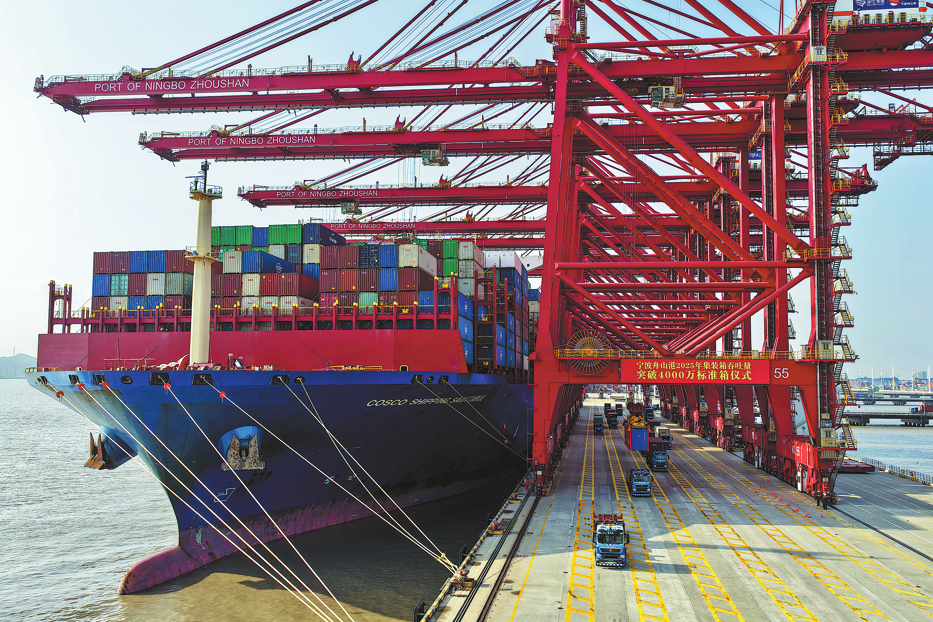
Europe's trade with China, too, has a significant role to play. In 2021, the share of Chinese goods in EU's imports was 22.4 percent (the largest partner), while 10.2 percent of the EU's exports went to China (the third-largest destination country). Germany itself ranks fifth — behind the United States, Japan, the Republic of Korea and Vietnam — among China's largest trade partner countries.
Germany and China have common interests to secure past successes. Extending diplomatic help to each other in order to persuade Russia and Ukraine to end the conflict would serve this purpose.
But the perceived coupling of economic and political interests, which is of increasing concern in bilateral relationships, could pose a challenge to this. Respecting the reality of competition between systems will help improve common understanding and trust. China is investing in critical infrastructure in countries around the world and therefore needs to understand the limits of those activities.
Signaling compromise, Scholz has recently taken a moderate position in discussions on the issue, allowing a Chinese State-owned company to acquire a stake in Hamburg's port. This took place despite an October 2022 German opinion poll, in which more than 80 percent of the respondents said they "agree that becoming more independent of China is important".
China and the EU have a common interest in rationally dealing with the huge demographic changes expected to take place over the next four decades. During that period, China and Europe will face quickly aging societies, while their total populations are likely to shrink significantly. And while the demography of the US and Australia will remain fairly stable, India's and Africa's will grow heavily.
As a result, India will need to create 10 million extra jobs every year, while Africa has to create up to 20 million extra jobs. Since the labor markets are very unlikely to expand at the same pace, China and the EU could face huge immigration pressures. In such a scenario, development collaboration, education and qualification strategies as well as appropriate migration policies might be useful responses to boost the China-EU partnership.
These are demanding times for policymakers globally. The exchange of views and a better understanding of the positions and values of others are even more important during severe crises. Consequently, the German delegation's visit to Beijing to explore the potential of further collaboration is of high value.
The author, a professor at Free University of Berlin, is the president of the Global Labor Organization, a Germany-based world-wide network of researchers investigating the path of globalization.
The views don't necessarily reflect those of China Daily.