Far-reaching policy support helps more young people join nation's talent pool







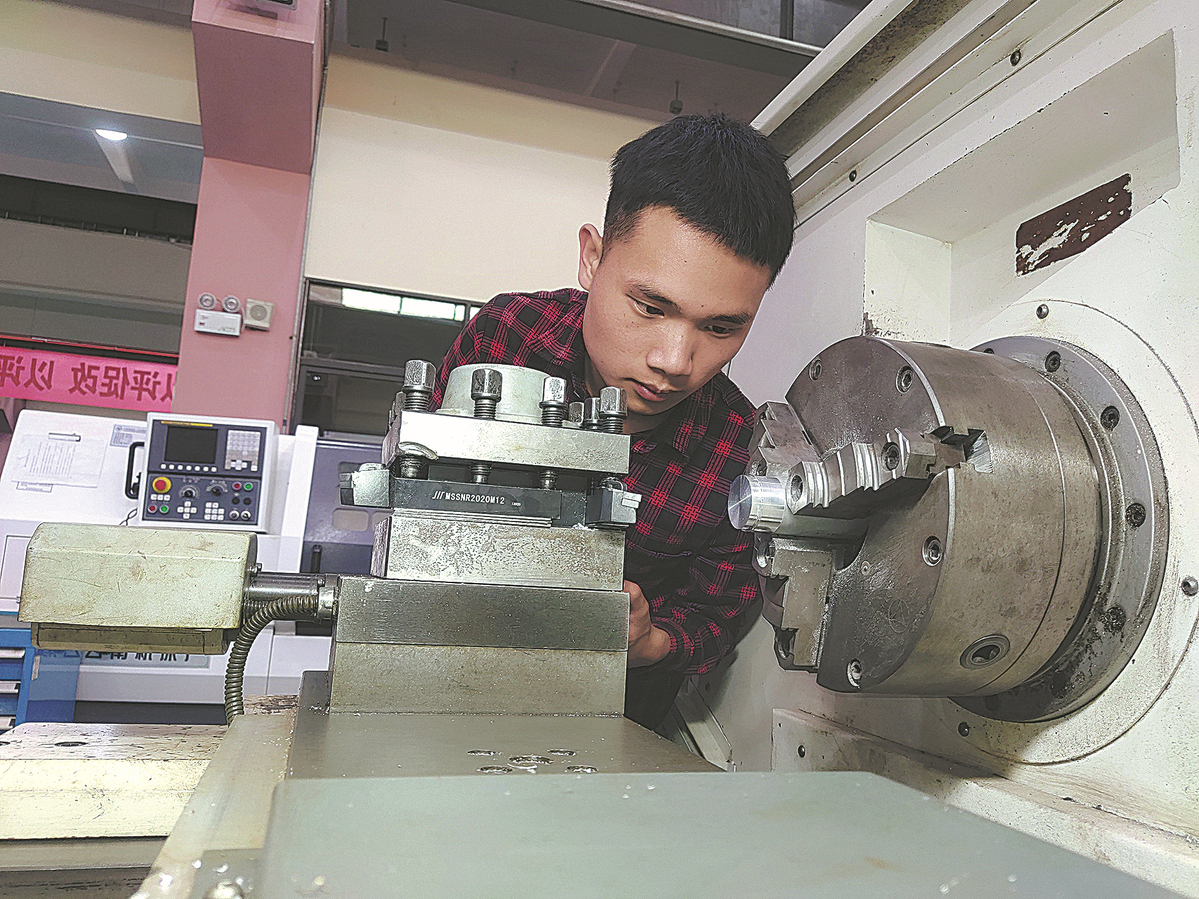
Policies in the past 10 years to develop vocational education and improve skilled workers' incomes and status have resulted in more young people entering China's talent pool for manufacturing and innovation.
Ye Junfeng, dean of Guangdong Machinery Technician College, said: "There is great demand in China for skilled workers as the nation's manufacturing industry advances. Traditionally, people may think the job market demands a large number of scientists, but it is also thirsty for skilled workers."
He said the public has shown a more friendly and inclusive attitude toward vocational education and skilled workers in recent years thanks to government efforts to improve such workers' social status and pay, and also through the introduction of world-class skills competitions.
"China joined the WorldSkills Competition for the first time in 2011 (entering the 41st such event in London) and won its first gold medal in Brazil in 2015. This year, the Chinese team has won 15 golds so far," Ye said.
"The skills competition brings confidence to Chinese people and showcases the impressive skills of the nation's workers on the world stage. We've changed the stereotypical view that China only produces low-quality products due to a lack of skilled workers.
"Receiving vocational education is not a bad plan for students with poor academic performances, but a personal choice by these young people who have skills and enjoy technical research."
China has made continuous efforts to improve the public recognition and social status of vocational education, and also the promotion prospects and payment of skilled workers, with the aims of enhancing innovation capability and relieving a structural employment imbalance.
A recent guideline released by the State Council, China's Cabinet, said the nation aims to build a more sound and reasonable mechanism to cultivate skilled workers by the end of 2025, with a more scientific evaluation system, attractive incentives, stable payments, and a friendly social environment.
According to the guideline, skilled workers are projected to make up 30 percent or more of the nation's total working population by 2025, and the highly skilled will comprise roughly one-third of all skilled workers.
The numbers, quality and structure of skilled workers will be adapted to meet the nation's modernization requirements by 2035, the guideline states.
In July last year, the Ministry of Human Resources and Social Security released an action plan, clarifying that the nation will produce more than 40 million new skilled workers from last year to 2025.Skilled workers are projected to comprise 30 percent of the total labor force.
According to the plan, highly skilled workers in eastern provinces such as Zhejiang and Jiangsu will make up 35 percent of the provinces' total skilled population. The population of highly skilled workers in central and western areas — for example, Shaanxi province — should rise by two or three percentage points from last year to 2025.
Chen Lixiang, vice-chairman of the Chinese Society for Technical and Vocational Education, said raising the incomes and social status of skilled workers is a progressive step in accordance with China's economic development.
Ye, the dean, said the nation can better connect the vocational education systems now managed by the Ministry of Education and the Ministry of Human Resources and Social Security, in order for vocational students to take a uniform degree that can help them better advance their careers after graduation.






- Chinese sailor forced to halt Antarctic expedition after robbery
- French, Chinese artists revive industrial heritage in Hunan
- New engineering academicians vow to advance scientific innovation
- Former top railway official expelled from CPC
- Mainland says Taiwan's Lai a 'peace breaker' and 'troublemaker'
- New materials reinforce Nanjing war truth